Navigating Global Uncertainty with Science and Serenity
Golden Hook & Introduction
SECTION
Atlas: A staggering amount of your daily energy is being siphoned off by events you have zero power to change. It is the ultimate efficiency leak. You are running a high-performance system, but you are wasting processing power on variables that are completely outside of your control.
Nova: That is the perfect way to frame it, Atlas. Because most of us operate under the delusion that if we just worry hard enough, or analyze the data long enough, we can somehow manipulate the outcome of systemic, global, or even personal disruptions. We treat uncertainty like a bug in the software of our lives that needs to be debugged, when in reality, it is a permanent feature.
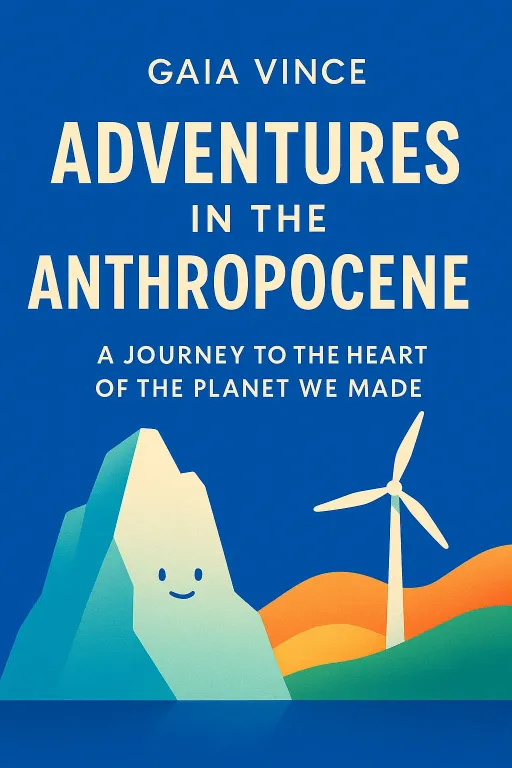
Atlas: Right. And today, we are looking at two very different, yet surprisingly complementary, ways to patch that leak. We are diving into the work of Gaia Vince and her book, Adventures in the Anthropocene, alongside the psychological frameworks found in The Universe Has Your Back by Gabrielle Bernstein. One looks at how the planet is changing, and the other looks at how our minds are breaking under the pressure of trying to stop that change.
Nova: It is a fascinating juxtaposition. Gaia Vince is a science journalist who spent years traveling the globe, documenting how humans are physically and technologically adapting to a rapidly transforming environment. She brings a very grounded, almost evolutionary perspective to the table. Then you have Gabrielle Bernstein, who approaches this from a mental and spiritual architecture, providing tools to release the white-knuckle grip we keep on our lives when things get unpredictable.
Atlas: I am curious to see how these two worlds collide. We have the macro-level environmental reality from Vince, and the micro-level internal reality from Bernstein. Let’s start with the big picture. How do we even begin to categorize the disruption we are facing?
The Reality of Adaptation
SECTION
Nova: To understand our current moment, we have to look at what Gaia Vince uncovered. She traveled through the Anthropocene—this current geological age where human activity is the dominant influence on climate and the environment. Her findings are profound because she avoids the standard doom-and-gloom narrative. Instead, she maps out human ingenuity. She shows that throughout history, when faced with extreme environmental transformations, humans do not just survive; they innovate.
Atlas: I see that. It sounds like she is suggesting that the adaptation is not just reactive, but creative. But for a listener who is sitting in an office or working on a project, how does that translate? It feels like a massive historical scale, whereas most people are dealing with, say, a supply chain breakdown or a career pivot.
Nova: That is the exact bridge we need to build. Think about the specific case studies she documented. She looked at communities dealing with severe water scarcity. Instead of just waiting for rain, they developed localized, highly efficient water harvesting systems that fundamentally changed their relationship with their environment. The lesson is that the environment changed, the rules changed, and the successful groups were the ones who stopped trying to force the old weather patterns to return and started building systems that worked with the new reality.
Atlas: That resonates with anyone who has tried to fight a market shift. You see a competitor disrupt your industry, or a new technology render your skill set obsolete, and your first instinct is to try to force the old model to work. You throw more resources at it, you work longer hours, you try to bend the reality back to what you are comfortable with.
Nova: Exactly. And that is where the efficiency leak happens. In the Anthropocene, the environment is the system. In your career, the market is the system. When you try to fight the system, you lose energy. Vince’s work shows us that the most resilient humans are the ones who assess the new, harsh reality and immediately start building the infrastructure—whether that is physical infrastructure like vertical farms or digital infrastructure like new workflows—to thrive within it.
Atlas: Okay, but let’s be honest. That sounds exhausting. It implies that every time the world shifts, we have to become master engineers of our own lives. That is a heavy burden. Is there a point where that constant adaptation just leads to burnout?
Nova: That is where the tension lies. Adaptation requires energy. If you are constantly scanning the horizon for the next shift, you are never fully present. You are always living in the future, trying to preempt the next disaster. And that is precisely why we need the second piece of the puzzle—the psychological framework for letting go.
The Psychology of Control
SECTION
Atlas: That brings us perfectly to Gabrielle Bernstein. If Vince is telling us how to build the raft for the storm, Bernstein is telling us how to handle the anxiety of being on the open water. I have always been skeptical of the idea of just letting go. It sounds passive. It sounds like giving up.
Nova: It is a common misconception. Letting go is not about apathy. It is about a strategic reallocation of focus. Bernstein’s framework in The Universe Has Your Back is about identifying the difference between force and flow. When you try to force a result, you are usually operating from a place of fear—fear that if you do not micromanage every detail, the system will collapse.
Atlas: That feels very familiar. I think about the listeners who are managing high-pressure teams or complex projects. If they stop micromanaging, they feel like the whole house of cards will come down. How do you reconcile that with the need to be an effective leader?
Nova: The key is to realize that your control is limited. You can control your input, but you cannot control the outcome. Bernstein argues that when you release the need to dictate the outcome, you actually increase your efficiency because you are no longer wasting mental bandwidth on variables that are outside your influence. You are essentially clearing the cache of your brain.
Atlas: That is a great analogy. It is like clearing the RAM on a computer so it can run the active tasks faster. But how do you practically distinguish between what you can control and what you cannot? We are back to the idea of a blueprint. Is there a way to audit this?
Nova: There is. This is where we synthesize the two perspectives. When you are facing a systemic disruption—whether it is a climate shift or a project failure—you have to perform a rapid audit. You list three external factors that are currently causing you stress, and you explicitly label them as things you must accept. You have to acknowledge them, map them, and then—this is the crucial part—you redirect one hundred percent of your current focus to your immediate, actionable response.
Atlas: I like that. It creates a hard boundary. You are not ignoring the external factors; you are just categorizing them as the environment, not the task. It is like a pilot. The pilot cannot control the wind shear, but they can control the angle of the flaps and the thrust.
Nova: Precisely. You accept the wind shear. You do not spend your energy wishing the wind would stop blowing. You focus entirely on the flight path you can adjust.
Atlas: But what about the anxiety? Even if I accept the wind shear, I am still worried about the plane crashing. How does Bernstein’s approach handle the emotional weight of that uncertainty?
Nova: She suggests that the anxiety often comes from the illusion that we are the ones keeping the plane in the air entirely by our own willpower. When you realize that you are part of a larger system—that there are other resources, other people, other data points you can lean on—you can cultivate a sense of trust. It is not blind faith; it is a pragmatic trust in your own ability to adapt.
Atlas: That shifts the perspective from "I have to save this" to "I have to navigate this." It is a subtle but massive pivot. If I am the navigator, I am looking for the next waypoint. If I am the savior, I am looking for a miracle.
Nova: That is beautifully put. The navigator is always looking for the next actionable step. The savior is looking for a specific outcome. When the environment changes, the navigator recalibrates. The savior just gets frustrated that the destination is now harder to reach.
Synthesis & Takeaways
SECTION
Atlas: So, if we pull this all together for someone who wants to apply this today, the blueprint looks like this: We acknowledge the Anthropocene—the fact that our environment is always shifting and that stability is a myth. We then use the Bernstein framework to categorize our stressors. We pick the three things we are obsessing over that we cannot control, we accept them, and then we pivot all our cognitive energy into the immediate, actionable response.
Nova: Exactly. It is about moving from a state of reactive anxiety to a state of proactive adaptation. Think about the last time you felt overwhelmed. You were likely trying to solve the external variables—the "what ifs"—instead of solving for the "what now."
Atlas: I do that all the time. I start gaming out five different scenarios of how a project could fail. I am burning hours on mental simulations that might never happen.
Nova: And in doing that, you are missing the signal in the noise. Gaia Vince’s work shows us that the survivors are the ones who observe the environment as it is, not as they want it to be. If the water is rising, you build a boat. You do not sit there and argue with the water.
Atlas: It is about radical acceptance of the reality followed by radical focus on the solution. And I think that is the missing link for a lot of high-performers. They are so good at solving problems that they forget to distinguish between a problem that can be solved and a reality that must be navigated.
Nova: That is the ultimate test of a strategic mind. Can you look at a chaotic system, identify the immutable laws of that system, and then build a strategy that works within those laws?
Atlas: I am definitely going to try this. The next time I feel that surge of anxiety about a deadline or a market shift, I am going to stop and ask: "What are the three external factors I am trying to control?" and "What is the single, immediate action I can take right now to move forward?"
Nova: And you will likely find that as soon as you focus on that one action, the anxiety begins to dissolve. Because action is the antidote to the paralysis of uncertainty.
Atlas: It is a powerful cycle. Accept, focus, act. It is simple, yet it feels like it could handle almost any level of disruption.
Nova: It is the only way to scale your impact, too. You cannot scale if you are constantly bogged down by the friction of trying to control the uncontrollable. When you let go of that friction, you move faster.
Atlas: I love that. It is not just about survival; it is about velocity. It is about how fast you can turn an obstacle into an operational reality.
Nova: And that is how you thrive, regardless of the era you find yourself in. Whether you are navigating the literal Anthropocene or the metaphorical chaos of a modern career, the principles remain the same.
Atlas: This has been a masterclass in shifting from a mindset of panic to a mindset of architecture. We have the environmental reality from Vince, the psychological tools from Bernstein, and now, a clear path forward.
Nova: We do. And for anyone listening, try this today. Identify those three external stressors. Write them down. Then, cross them out, not because they are gone, but because you are done fighting them. Then, write down the one thing you can do before noon that moves the needle.
Atlas: That is the blueprint. Accept the reality, reclaim your focus, and get to work.
Nova: This is Aibrary. Congratulations on your growth!