

Lawn Signs & Logjams
Golden Hook & Introduction
SECTION
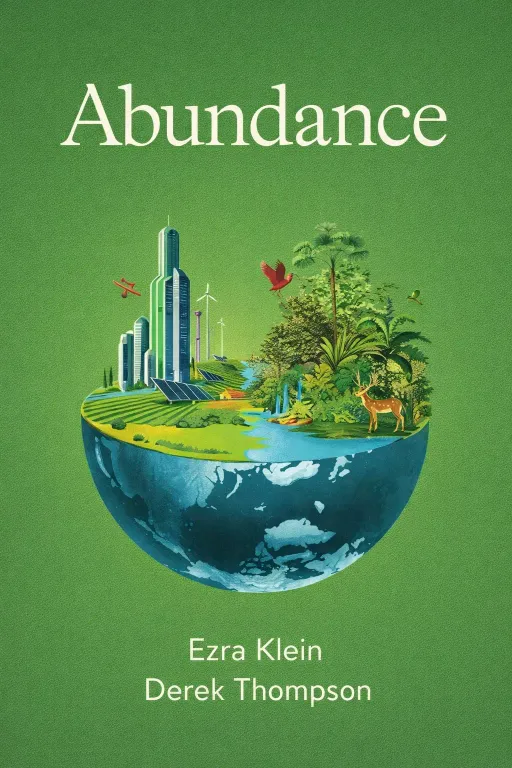
Joe: Here's a wild thought for you, Lewis. A construction worker in America today is less productive than a construction worker in 1970. Lewis: Wait, what? With all our new tools, laser levels, advanced software, and giant cranes? That makes zero sense. Are you sure that's right? Joe: It's not only right, it's one of the central mysteries that gets to the heart of why progress in the physical world feels so stuck. And it's a key piece of the puzzle in the book we're talking about today. Lewis: Okay, you have my full attention. That is one of the most counter-intuitive facts I've ever heard. Joe: It’s a perfect entry point. We're diving into Abundance: The Future Is Better Than You Think, by Ezra Klein and Derek Thompson. Lewis: Right, two really sharp journalists. Klein from the New York Times, Thompson from The Atlantic. And this book feels like the culmination of years of them both wrestling with this single, frustrating question: we have all this technology and wealth, so why does it feel like we’ve forgotten how to do big things? Joe: Exactly. They argue that our biggest problems aren't caused by a lack of resources, but by a lack of will and a surplus of self-imposed rules. And they start with the most personal, infuriating example of this for so many people: housing.
The Paradox of 'Lawn-Sign Liberalism'
SECTION
Lewis: Ah, the great American housing crisis. The one thing that unites everyone in frustration. Where do they even begin? Joe: They begin with a really provocative image. Picture a beautiful, tree-lined street in a city like San Francisco. In the front yard of a million-dollar single-family home, you see a sign. It says, "In This House, We Believe: Black Lives Matter, Science is Real, Kindness is Everything." Lewis: I can picture it perfectly. I’ve seen that exact sign a thousand times. Joe: Well, the book points out the brutal irony. That very house is likely in a neighborhood zoned exclusively for single-family homes, a policy that historically locked out, and continues to lock out, lower-income families, disproportionately people of color. The city's Black population has been in decline for 50 years. This is the paradox they call "lawn-sign liberalism." Lewis: Hold on. So the 'In This House, We Believe...' crowd is also the 'Not In My Backyard' crowd? That feels... deeply hypocritical. Joe: It's the central paradox! The book argues that many of our most progressive places are "symbolically liberal but operationally conservative." They vote for politicians who promise to tackle inequality, but they show up to city council meetings to kill any proposal for a new apartment building in their neighborhood. Lewis: So they want to solve the problem, as long as the solution is somewhere else. Joe: Precisely. The authors trace this back to the 1970s, with a case study on Petaluma, California. It was one of the first towns to enact a growth cap, limiting new housing permits to just 500 a year. It was framed as environmentalism, a way to stop sprawl. But the effect was to pull up the drawbridge. It became a model for cities across the country. Lewis: And when you pull up the drawbridge, the people already inside the castle get richer because their property becomes more valuable, and everyone else is stuck outside. Joe: You've got it. And that’s how our most dynamic cities, which used to be the great engines of opportunity, transformed. The book has this killer line: "Cities are meant to be escalators into the middle class, not penthouses for the upper class." But by choosing scarcity, we've turned them into penthouses. Lewis: This connects directly to the homelessness crisis, doesn't it? The common narrative is that it's about addiction or mental health, but the book seems to be making a different argument. Joe: A radically different one. They cite this stunning research from Gregg Colburn and Clayton Page Aldern. The researchers looked at cities across the country and found no strong correlation between rates of poverty, drug use, or mental illness and rates of mass homelessness. Lewis: Really? That's what everyone says causes it. Joe: Right, but think about it. West Virginia has high rates of poverty and drug abuse, but its per capita homelessness rate is one-sixth of California's. The variable that predicted mass homelessness with terrifying accuracy was housing costs and vacancy rates. As rents go up and the number of available apartments plummets, homelessness skyrockets. Individual problems might explain who becomes homeless, but housing scarcity explains why so many people do. It's a policy choice. Lewis: Wow. So when a city makes it impossible to build, it is, in effect, choosing to have a homelessness crisis. That's a heavy thought.
The Paralysis of 'Everything-Bagel Liberalism'
SECTION
Lewis: Okay, so that's housing. It’s a mess of good intentions and bad outcomes. But this problem of not being able to build feels bigger. It's not just homes. It's trains, it's clean energy projects, it's everything. Joe: And that brings us to their next brilliant concept, which might be my favorite phrase in the whole book: "everything-bagel liberalism." Lewis: Everything-bagel liberalism. I love that. It's like you go to order a simple, plain bagel, but it comes with sesame seeds, poppy seeds, garlic, onion, salt, and also a plan for workforce equity, three environmental impact reviews, and a commitment to use only locally-sourced artisanal cream cheese. Joe: That is the perfect analogy. It’s the tendency, especially in modern progressive governance, to try and load every single project with dozens of other worthy goals. Each goal is good on its own—we want environmental justice, and local business participation, and strong labor standards. But when you pile them all onto one project, it becomes so complex, so expensive, and has so many veto points that it collapses under its own weight. Lewis: It's paralyzed by its own virtue. Joe: Exactly. And the book's poster child for this is the California High-Speed Rail project. This was the moonshot of our time. In 2008, voters approved a plan to connect Los Angeles and San Francisco. The trip would take two and a half hours. It was supposed to cost $33 billion and be finished by 2020. Lewis: A classic optimistic California dream. How's that going? Joe: It's a tragicomedy. The current estimate is over $100 billion, and the new, scaled-back goal is to maybe connect the cities of Merced and Bakersfield sometime after 2030. Lewis: That's a spectacular failure. They're spending triple the money to connect two places that nobody was clamoring to get between. What on earth went wrong? Was the engineering too hard? Joe: That's the craziest part. The engineering was the easy part. The book quotes one of the former CEOs of the project saying the real work wasn't building, it was negotiating. To get federal funding, they had to prioritize a route through the Central Valley to meet an air quality goal, which meant they started building in the least-populated, least-useful section first. Every single county, city, and interest group had a say. Environmental lawsuits held things up for years. It's what the authors call a "procedure fetish," where following the process becomes more important than achieving the outcome. Lewis: So the train wasn't defeated by mountains or earthquakes. It was defeated by paperwork. Joe: By paperwork and by trying to be an everything-bagel. It had to be a jobs program, an environmental justice program, a climate program, and a transit program all at once. In trying to be everything to everyone, it ended up being a very expensive nothing for a very long time.
The 'Karikó Problem' & The Bottleneck Detective
SECTION
Joe: So if we're paralyzed by our own rules, how do we break free? The book argues we need to not just build better, but we have to invent better. We need new technologies and new solutions. But here’s the rub: our system for invention is broken, too. They call it the "Karikó Problem." Lewis: Katalin Karikó... that name sounds familiar. Isn't she the scientist behind the mRNA vaccines? What's her problem? She won a Nobel Prize! Joe: She did! And she's a hero. But the "problem" is what she went through to get there. For decades, she was a brilliant but obscure scientist obsessed with mRNA. She applied for grant after grant from the National Institutes of Health, and they rejected her. Again and again. Her ideas were seen as too weird, too risky. She was demoted at her university. They basically pushed her out because she couldn't bring in the funding. Lewis: That's insane. The woman who developed the core technology that saved millions of lives from COVID was seen as a failure by the system designed to fund science? How does a system get that broken? Joe: That's the Karikó Problem. The book argues that our scientific funding system, especially the NIH, has become incredibly risk-averse. It's designed to fund "safe" science—incremental improvements on what we already know. It's not designed to fund the wild, high-risk, high-reward bets that lead to true breakthroughs. It filters for "grantsmanship"—the ability to write a good proposal—not necessarily for genius. Lewis: That's terrifying. It means we almost missed out on the mRNA vaccines entirely because of bureaucracy. Who knows what other breakthroughs are currently being rejected in some NIH slush pile? Joe: It's a chilling thought. So the book proposes a new model for government, a new role for it to play. It needs to become a "bottleneck detective." Lewis: A bottleneck detective. I like the sound of that. What does it do? Joe: Instead of just throwing money at problems or getting tangled in its own rules, a bottleneck detective government actively seeks out the specific, crucial obstacles that are holding back progress and then systematically removes them. The prime example they use is Operation Warp Speed. Lewis: Right, the COVID vaccine program. It wasn't just about funding the research, was it? Joe: Not at all. It was a masterclass in bottleneck detection. The government didn't just give Moderna and Pfizer money for research. It gave them huge pre-purchase orders, which removed the financial risk of scaling up manufacturing before the vaccines were even approved. That was bottleneck number one: market uncertainty. Then, they found out there weren't enough of the special glass vials needed for ultra-cold storage. So they worked with the manufacturer, Corning, to ramp up production. That was bottleneck number two: a supply chain issue. They solved problem after problem, all the way to the finish line. Lewis: So they weren't just a funder. They were an active partner, clearing the path. That’s a completely different way of thinking about government's role.
Synthesis & Takeaways
SECTION
Joe: And that's the thread that ties the whole book together. Whether it's the housing crisis, our crumbling infrastructure, or the pace of scientific discovery, we have the capacity for abundance. The scarcity we feel is a choice, baked into the sedimentary layers of our rules, our laws, and our institutions. Lewis: It's a surprisingly hopeful message, then. It's not saying we're doomed because we've run out of ideas or resources. It's saying we're choosing to be stuck in a low-gear, and we can choose to shift up. It’s a call to move away from a politics of scarcity—which is all about fighting over a shrinking pie—and embrace a politics of abundance, which is about figuring out how to bake a much, much bigger pie for everyone. Joe: Precisely. The book is a diagnosis, but it's also a prescription. And the authors end by giving us a powerful new lens to apply to any problem. They say we should stop arguing in circles and instead ask three simple questions. Lewis: What are they? Joe: First: What is scarce that should be abundant? Second: What is difficult to build that should be easy? And third: What inventions do we need that we do not yet have? Lewis: I love that. It’s so direct. It’s not about left versus right; it's about stuck versus unstuck. It's a practical framework for making things better. It makes you want to go out and find a bottleneck to smash. Joe: It really does. And on that note, we'd love to hear from our listeners. What's a bottleneck you see in your own life, your community, or your industry? What's something that is way harder to do than it should be? Let us know on our social channels. We'd love to hear your thoughts. Lewis: A fantastic and thought-provoking read. Joe: This is Aibrary, signing off.