

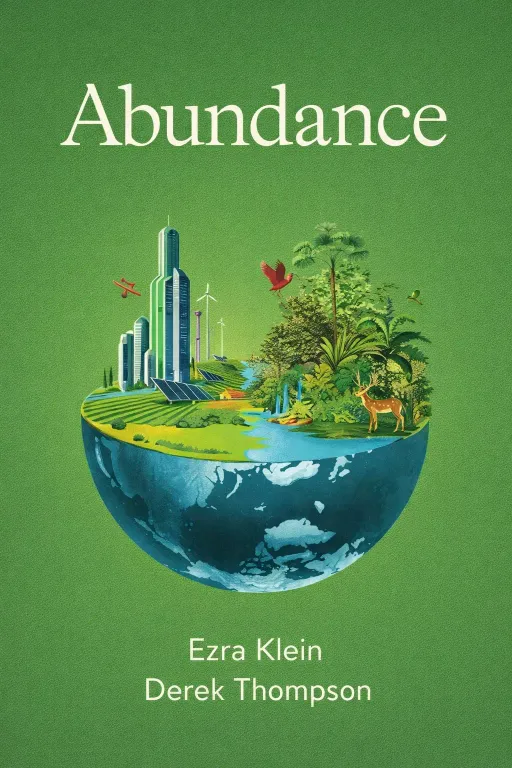
Aligning Abundance: From Tech Utopia to Human-Centered Systems
Golden Hook & Introduction
SECTION
Dr. Roland Steele: Imagine a box, about the size of a dorm-room refrigerator. You can pour any water into it—seawater, polluted river water, even raw sewage—and out the other side comes perfectly pure, distilled drinking water. This isn't science fiction; it's a real invention detailed in Peter Diamandis's book, "Abundance." It promises to solve one of humanity's oldest problems. But it also raises a crucial question: once you have the box, what happens next?
Freddie Williams: Exactly, Roland. That's the question that keeps me up at night. Who owns the box? Who maintains it? And who ensures the water gets to the people who need it most? The magic box is just the first step. The real, complex, and fascinating challenge is building the system around it.
Dr. Roland Steele: And that is the heart of our conversation today, because your work is all about building those systems. We're talking with Freddie Williams, a writer and systems designer who works at the intersection of governance, infrastructure, and human-centered solutions. And we're diving into "Abundance: The Future Is Better Than You Think."
Freddie Williams: It's a pleasure to be here. It's a book that sparks exactly the right kind of debate.
Dr. Roland Steele: It really does. So today we'll dive deep into this from two perspectives. First, we'll explore the book's incredible techno-optimist vision of a future of abundance. Then, with Freddie's expertise, we'll stress-test that vision by asking what it takes to build the human-centered systems and governance needed to actually deliver that future for everyone.
Deep Dive into Core Topic 1: The Exponential Promise
SECTION
Dr. Roland Steele: So let's start with that promise, Freddie. Diamandis's core argument is built on something he calls the 'Abundance Pyramid.' It's essentially Maslow's hierarchy of needs, but for the whole planet. At the base, you have the absolute essentials for survival: clean water, nutritious food, and energy.
Freddie Williams: The foundation of everything. Without that, no society can flourish.
Dr. Roland Steele: Precisely. And for all of human history, we've lived in a world where those resources were scarce, and economics was the study of how we manage that scarcity. Diamandis’s explosive idea is that this is no longer true. He argues that a handful of technologies are progressing exponentially, not linearly, and they are on the verge of making those foundational resources abundant for everyone.
Freddie Williams: And it’s that word, ‘exponential,’ that’s so hard for our brains to grasp, right? We think in straight lines.
Dr. Roland Steele: We really do! And the best example he gives is solar power. It’s a fantastic story. If you go back to 1977, solar energy cost about seventy-seven dollars per watt. It was an expensive novelty, something you’d see on a satellite or a calculator, but not on a house. It was completely impractical for mass energy production.
Freddie Williams: A niche technology for specialized uses.
Dr. Roland Steele: Exactly. But then, something incredible started happening, quietly in the background. Driven by innovations in materials science and manufacturing, the price didn't just go down—it started falling exponentially. It was halving, and then halving again, on a regular basis. Today, the cost for large-scale solar projects can be less than twenty cents a watt. From seventy-seven dollars to under twenty cents. That's not a simple improvement; it's a complete paradigm shift.
Freddie Williams: It fundamentally changes the equation of what's possible.
Dr. Roland Steele: It changes everything! From an economist's perspective, it's mind-bending. Energy is no longer just a commodity to be extracted from the ground and fought over. It's becoming a technology that can be manufactured and deployed anywhere the sun shines. Diamandis argues this pattern—this exponential curve of increasing performance and plummeting cost—is happening with computing power, with AI, with biotech, with network bandwidth. And when you combine these trends, you get the tools to tackle the base of that pyramid.
Freddie Williams: And that potential for decentralization is what I find most compelling. It shifts power, literally, away from massive, centralized grids and into the hands of communities. The potential for local resilience and self-sufficiency is enormous. You're no longer dependent on a fragile, thousand-mile-long supply chain for your power.
Dr. Roland Steele: That's the dream, isn't it? The democratization of energy.
Freddie Williams: It is. But it also creates a completely new set of challenges that have to be designed for. If a community is now self-sufficient in its energy, it also becomes responsible for the entire lifecycle of that system—the installation, the maintenance, the eventual disposal or recycling of the panels. That's a huge shift in governance, in local skills, in long-term planning. That capability doesn't just appear automatically when the solar panels arrive.
Dr. Roland Steele: Ah, and you've just built the perfect bridge to our next topic. It’s not automatic. That's the critical insight.
Deep Dive into Core Topic 2: The Alignment Gap
SECTION
Dr. Roland Steele: You've put your finger on the exact issue I want to explore next, Freddie. You talk about 'alignment' in your work. So let's go back to that magic water box, the Slingshot purifier we started with. From your perspective as a systems designer, what does Diamandis's vision of just inventing the box miss? What is the gap between that brilliant invention and a truly human-centered solution?
Freddie Williams: The gap is everything that isn't the physical technology itself. It's the human system. Diamandis's book is brilliant at celebrating what I would call 'extractive' solutions. The technology is designed to a resource—clean water from dirty water, energy from the sun. And that's a vital first step.
Dr. Roland Steele: But it's not the whole story.
Freddie Williams: Not even close. An 'aligned' solution is about the system that embeds that technology into a society in a way that is lawful, scalable, and genuinely empowering. It’s about designing the social and legal operating system with as much care as we design the technological hardware.
Dr. Roland Steele: So what would that look like in practice? For the Slingshot, what does an 'aligned' system look like?
Freddie Williams: Okay, so let's build it out. The first, and most important, principle is co-design. Did the inventors go to a community and work with them from day one to understand their specific water needs, their daily routines, their existing social structures around water collection? Or did they just show up with a box and a manual? True human-centered design starts with the humans, not the tech.
Dr. Roland Steele: Right, so you avoid the classic 'solutionism' trap of just dropping a gadget in and expecting it to work.
Freddie Williams: Precisely. The second piece is education and capacity building. Who is trained in the community to maintain and repair that machine? What happens when a filter clogs or a valve breaks? If the solution always relies on an expert flying in from another country, you haven't created abundance; you've created a new, more sophisticated form of dependency. An aligned system builds local expertise. It means training programs, accessible spare parts, and a sustainable maintenance model.
Dr. Roland Steele: So the knowledge has to be as distributed as the technology itself.
Freddie Williams: Exactly. And the third, and perhaps most complex, piece is governance and law. This is critical. In the community where you place this machine, what are the existing water rights? Is water viewed as a free, communal resource or something that can be owned? Many Indigenous frameworks, for example, view water as a living entity, a relative, not a commodity to be bought and sold.
Dr. Roland Steele: That’s a profoundly different starting point.
Freddie Williams: It is. And an aligned system has to respect and integrate with that legal and cultural context. Does this new machine accidentally privatize a communal well? Does it create a new social hierarchy where the 'owner' of the machine now holds power over everyone else? These are governance questions, not engineering questions. And if you don't answer them, even the most brilliant technology can inadvertently cause social harm.
Dr. Roland Steele: So what you're saying is, the physical hardware—the box—is maybe 10% of the real solution. And the 'human-ware,' as you put it—the governance, the legal frameworks, the education, the co-design process—is the other 90%.
Freddie Williams: That's the core of it. That's the work of alignment. It's slower, it's more complex, it's less glamorous than inventing a magic box, but it's the only thing that creates lasting, scalable, and just solutions. Abundance without alignment is just a temporary surplus. It's not a sustainable future.
Synthesis & Takeaways
SECTION
Dr. Roland Steele: That is such a powerful framework, Freddie. Listening to you, it's clear that the abundant future Diamandis describes is absolutely possible, but it's not inevitable. It's not a passive process where technology just automatically saves us.
Freddie Williams: Not at all. It requires active, intentional design of our social systems. A breakthrough in technology should be an immediate trigger for a conversation about the breakthrough in governance needed to manage it. The two have to evolve together, in lockstep.
Dr. Roland Steele: So, the path to abundance isn't just paved with silicon and circuits; it's built on a foundation of thoughtful governance and human alignment. You can't have one without the other.
Freddie Williams: You can't. And that's where I find the most hope, actually. Because these are things we can design. We can build better institutions, better laws, better educational frameworks. We have agency over that 90%.
Dr. Roland Steele: A perfect summary. Freddie, as we close, what's the one thing you want our listeners to take away from this conversation? The one question they should carry with them?
Freddie Williams: It's a simple question to ask. The next time you read a headline about a world-changing technology—whether it's AI or fusion energy or a new vaccine—just take a moment and ask yourself: Who is building the system around it? Is that system designed for short-term extraction, or is it designed for long-term alignment and stewardship? The answer to that question tells you everything you need to know about whether it will create true abundance for all.
Dr. Roland Steele: A powerful and essential question. Freddie Williams, thank you so much for bringing your expertise and helping us see not just the promise of abundance, but the path to achieving it.
Freddie Williams: It was my pleasure, Roland. Thank you.