Stop Guessing, Start Designing: The Blueprint for Intentional Learning Architectures
Golden Hook & Introduction
SECTION
Nova: What if I told you that your most brilliant idea, your most profound insight, your most advanced cognitive architecture... could be utterly useless? Not because it's flawed, but because of something far more insidious.
Atlas: Whoa, useless? That’s a bold claim, Nova. I imagine many of our listeners, especially the visionary architects out there, pour their heart and soul into groundbreaking concepts. How could something so brilliant just... fall flat?
Nova: It's the cold, hard truth, Atlas. Even with the most revolutionary ideas, a poorly designed interface or learning flow can completely derail adoption. People struggle when systems don't match their mental models. It creates this invisible friction that limits impact, despite the profound insights embedded within. It's the silent saboteur of brilliance.
Atlas: That makes sense. I can picture it – trying to use a cutting-edge tool, but the buttons are in the wrong place, the instructions are confusing, and you just give up, even if you know the potential is there. It’s frustrating.
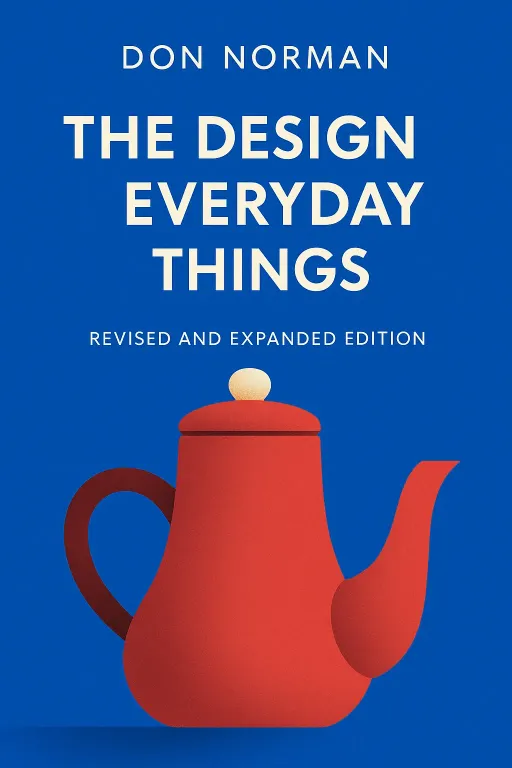
Nova: Exactly. And that's precisely why we're talking about a blueprint for intentional learning architectures today. We’re diving into the wisdom of two titans in the field: Don Norman’s seminal work, "The Design of Everyday Things," and Alan Cooper’s pioneering "About Face."
Atlas: Norman and Cooper. Icons in design. I know Norman, with his cognitive science background, really brought a scientific rigor to understanding how people interact with everyday objects. And Cooper, he was really a trailblazer in interaction design, pushing for user-centric approaches when the industry was often focused on just what was technically feasible.
Nova: Precisely. Their insights are absolutely crucial for anyone, like our visionary architects, who are building advanced cognitive architectures and striving for profound impact in AI-native learning. It's about ensuring that power is profoundly human-centered and easy to use.
The Silent Saboteur: How Bad Design Undermines Brilliance
SECTION
Atlas: So, let's start with that friction you mentioned. What does that actually look like in a learning environment? Can you give me an example of how a brilliant learning concept gets sabotaged by design?
Nova: Absolutely. Imagine this: a team of brilliant cognitive alchemists develops an AI-powered learning platform. It uses cutting-edge neural networks to adapt content in real-time, personalizing every module to the learner's unique cognitive style and knowledge gaps. The algorithms are revolutionary, the content is curated by Nobel laureates, truly profound insights are being delivered.
Atlas: Sounds incredible! The future of learning, right there.
Nova: On paper, yes. But the interface... it's a labyrinth. The navigation menu has twenty sub-menus, each with cryptic icons. The progress bar is hidden. When you try to save your work, the button is labeled "Archive Session," and it's tiny, tucked away in the corner. There's no clear feedback if your answer was right or wrong, just a generic "Processing..." message.
Atlas: Oh man, I’ve been there. You just want to learn, but you're spending all your mental energy trying to figure out how the system works, not on the actual learning material.
Nova: Exactly! That’s the friction. That’s where good design makes complex systems feel intuitive, as Norman explains. He talks about "affordances" – how an object's design should suggest its function. A door handle affords pulling. A flat plate affords pushing. In our hypothetical platform, a save button should saving, not archiving. And "signifiers" – visual cues that indicate an action. A clear arrow pointing to the next lesson is a signifier. A hidden, unlabeled icon is not.
Atlas: So, for our visionary architects who are building these complex cognitive architectures, they might be so focused on the brilliance of the AI itself, the underlying logic, that they overlook these very human, almost primitive, needs for clear affordances and signifiers. It's like building a supercar with a steering wheel that's hidden under the seat.
Nova: That’s a perfect analogy, Atlas. The brilliance of the engine doesn't matter if the driver can't intuitively control it. Norman's work reveals how critical it is to match the system to the user's mental model – their internal representation of how things work. If the system demands you learn arbitrary rules, rather than adapting to natural expectations, it creates frustration and limits impact. It's not about making users adapt to the system; it's about the system adapting to the users.
Designing for Intuition: Building Human-Centered AI Learning Architectures
SECTION
Atlas: So, how do we flip that script? How do we take that brilliant AI concept and make it not just powerful, but profoundly human-centered and truly easy to use? What's the blueprint for designing that intuitive experience?
Nova: That's where Alan Cooper's "About Face" becomes our guiding star, especially with his advocacy for goal-directed design. Cooper challenges us to focus on user behaviors and needs technical capabilities. It’s not about what the AI do, but what the learner to achieve.
Atlas: So, instead of starting with "We have this incredible AI that can personalize content," we start with "What does a learner want to achieve when they sit down at this platform?"
Nova: Precisely. Let's revisit our AI-powered learning platform. With a goal-directed approach, we wouldn't start by showcasing the AI's capabilities. Instead, we'd define the learner's goals: "master a new coding language," "understand quantum physics fundamentals," or "prepare for a certification exam." Every design decision, from the layout to the feedback mechanisms, would then be evaluated against how well it helps the learner achieve.
Atlas: That makes so much sense. It feels like it shifts the entire perspective from "tech-centric" to "human-centric." So, what would that look like in practice for our AI learning platform?
Nova: Imagine the redesigned platform. Upon login, it asks, "What do you want to learn today?" or "What's your biggest challenge right now?" The interface then dynamically reconfigures. If your goal is "master a concept," the platform highlights interactive explanations, practice problems, and clear progress indicators. If it's "review for an exam," it prioritizes spaced repetition, flashcards, and simulated tests. Every action the learner takes, every piece of feedback they receive, directly correlates to their stated goal.
Atlas: That sounds incredibly empowering. And I can see how that ties into the "Philosophical AI Ethics" that our visionary architects are so passionate about. It’s not just efficient; it’s respectful of the learner’s autonomy and purpose. It avoids that feeling of being a passive recipient of an algorithm.
Nova: Absolutely. By designing for intuition and focusing on the learner's goals, we build trust. We ensure the AI is serving the human, not the other way around. It becomes a powerful tool that amplifies human potential, rather than a complex system that frustrates or alienates. This approach ensures your advanced cognitive architectures are not just powerful, but also profoundly human-centered and easy to use. It’s about engineering empathy into every interaction.
Synthesis & Takeaways
SECTION
Nova: So, what we've really been discussing today is this profound truth: brilliance alone isn't enough. The bridge between a groundbreaking idea and its real-world impact is intentional, human-centered design.
Atlas: And for those of us building the future of learning, particularly in AI-native settings, this isn't just a nice-to-have; it's a fundamental requirement for success and for truly empowering others to transform insight into sustained growth.
Nova: Exactly. And the great thing is, you don't need to be a design guru to start. Our tactical insights point to a tiny, yet powerful, step.
Atlas: What's that? Something tangible our listeners can do right now?
Nova: Observe a user interacting with one of your learning designs. Just one. Identify a single point of confusion they encounter, something that makes them pause, hesitate, or ask for help. Then, brainstorm a simple design fix for that one point.
Atlas: That’s brilliant in its simplicity. It cultivates both analytical prowess and intuitive wisdom, exactly what our visionary architects excel at. That direct observation, that empathy for a single point of friction, can spark a cascade of improvements, leading to more profound clarity and meaning in their designs. It’s about making the complex feel effortless.
Nova: It is. Intentional design is the blueprint for impact. It transforms friction into flow, and potential into profound, sustained growth.
Atlas: What a powerful thought to end on. It really underscores that human experience must always be at the center of innovation.
Nova: Absolutely. This is Aibrary. Congratulations on your growth!