

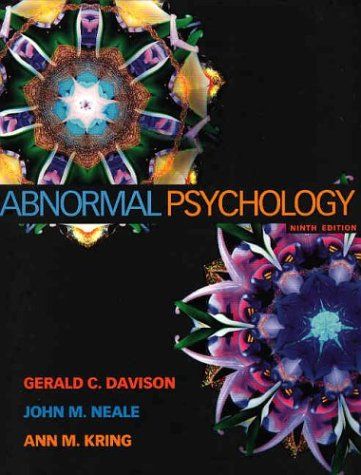
Abnormal Psychology
Introduction: Drawing the Line Between Normal and Not
Introduction: Drawing the Line Between Normal and Not
Nova: Welcome to Mind Over Matter, the podcast where we dissect the foundational texts that shape how we understand the human mind. Today, we are diving deep into a book that has been a cornerstone of clinical psychology education for decades: Abnormal Psychology by Gerald C. Davison, often co-authored with giants like John Neale and Ann Kring.
Nova: : That's a heavy hitter, Nova. When you pick up a textbook titled 'Abnormal Psychology,' the first question that hits me is, who gets to decide what's abnormal? Is it just what’s rare? Is it what makes you sad? It feels like a philosophical minefield before you even get to Chapter One.
Nova: Precisely! And that is where Davison’s approach immediately sets itself apart. It’s not just a catalog of disorders; it’s an argument for we should think about them. Davison and his collaborators don't shy away from that philosophical challenge. They tackle it head-on by proposing a framework that moves beyond simple deviation.
Nova: : So, this isn't just a DSM summary wrapped in a textbook cover? What's the hook? What makes this particular text, which has seen over a dozen editions, the one that keeps showing up on syllabi?
Nova: The hook is its commitment to an and its insistence on integration. They don't just present the 'what'—the symptoms—they relentlessly pursue the 'why' and the 'how to fix it,' grounding everything in empirical evidence. We’re talking about a text that has evolved alongside the science itself, from behavior therapy breakthroughs to modern neuroscience.
Nova: : I’m intrigued. It sounds like it aims to be both authoritative and practical. For our listeners who might be students or just curious about the field, why should they care about a textbook from a clinical psychologist like Davison?
Nova: Because understanding abnormal psychology isn't just about diagnosing others; it’s about understanding the spectrum of human experience, resilience, and suffering. Davison's work provides the clearest map we have for navigating that spectrum, emphasizing that mental illness is complex, multi-faceted, and, crucially, treatable. Let's start with the very definition that underpins the entire book.
Nova: : Lead the way, Nova. I’m ready to see how they draw that crucial line in the sand.
Key Insight 1: Defining the Disorder
The Davison Definition: Harm and Dysfunction as Cornerstones
Nova: Let's talk about the bedrock of the text: how Davison defines a psychological disorder. He argues compellingly that for a pattern of thought, emotion, or behavior to qualify as a disorder, it generally needs two key components working in tandem: harm and dysfunction.
Nova: : Harm and dysfunction. That sounds deceptively simple. Can you unpack that for us? Because I can think of plenty of behaviors that cause harm but might be culturally accepted, or dysfunction that isn't necessarily harmful to anyone but the individual.
Nova: That’s the brilliance of the framework. The 'harm' component isn't just physical; it’s about significant distress or impairment in functioning. Think about severe social anxiety. The distress is internal, and the impairment is external—you can't take that promotion, you avoid relationships. It clearly meets the harm criterion.
Nova: : Okay, that makes sense for distress. But what about the 'dysfunction' part? The research suggests this relates to an internal mechanism not working as it should, often judged against societal norms. That 'societal norm' part still feels a bit slippery.
Nova: It is, and Davison acknowledges that subjectivity. The dysfunction component is where the science steps in to try and objectify it. It suggests that something internal—a cognitive process, a neurotransmitter system, a learned response pattern—is malfunctioning. For example, in severe depression, the dysfunction might be a biological inability to regulate mood chemicals, or a cognitive pattern of catastrophic thinking that is objectively maladaptive to survival and well-being.
Nova: : So, if someone is a world-class, obsessive-compulsive cleaner who never gets distressed and whose cleaning habits actually help their career—say they run a high-end cleaning consultancy—do they meet the criteria? No harm, no dysfunction in the context of their success?
Nova: Exactly. They might exhibit that look like OCD, but without the subjective distress or the objective impairment—the inability to function elsewhere—it doesn't cross the clinical threshold according to this model. It’s a crucial distinction that separates eccentricity or intense dedication from pathology.
Nova: : I see. It forces the clinician to look beyond the surface behavior and ask, 'Is this pattern of internal operation genuinely breaking down, and is that breakdown causing measurable negative consequences?' It’s a very scientific, almost engineering-like approach to the human condition.
Nova: Precisely. And this scientific grounding is what leads us into the next major theme of the book: the move away from singular explanations. For a long time, abnormal psychology was dominated by one school of thought. Davison’s text champions the idea that disorders are rarely caused by just one thing.
Nova: : It’s like saying a car breakdown isn't just a flat tire; it could be the tire, the engine management system, or the driver’s poor maintenance schedule. All three contribute to the overall failure.
Nova: A perfect analogy. And the book dedicates significant space to exploring those three major contributing areas—the biological, the psychological, and the sociocultural—showing how they weave together to create the final clinical picture. It’s this commitment to a multi-causal view that has kept the text relevant even as new discoveries emerge.
Nova: : It sounds like the book is essentially teaching students to think like a modern clinical scientist, rather than just to memorize for an exam. That emphasis on the 'how' must be tied to Davison's own background in behavior therapy, which I know is a huge part of his legacy.
Nova: It absolutely is. We’ll explore that experimental edge next, but first, let’s solidify this idea: Davison’s framework demands evidence of both internal failure and external consequence before labeling something a disorder. It’s a high bar, and it’s a necessary one for responsible clinical practice.
Key Insight 2: Multi-Causal Models
The Integrative Approach: Weaving Biological, Psychological, and Sociocultural Threads
Nova: Moving into the core structure of the book, one of its defining features is its commitment to an integrative approach. Davison doesn't let any single paradigm—be it psychoanalytic, purely biological, or purely behavioral—claim sole ownership of explaining psychopathology.
Nova: : That’s a big shift from older texts, right? I imagine earlier books might have leaned heavily on Freud or perhaps just the medical model. What does this integrative approach look like in practice when discussing, say, schizophrenia or major depression?
Nova: In practice, it means dedicating serious, non-dismissive chapters to each major model. You get the biological explanations—genetics, neurotransmitter imbalances, structural brain differences. Then, you pivot to the psychological models, which the research shows often include learning theories and cognitive paradigms. The book excels at showing the limitations of any one model in isolation.
Nova: : For instance, if we look at anxiety disorders, the biological model might point to an overactive amygdala, the 'fight or flight' center. But that doesn't explain why one person develops a specific phobia of spiders while another develops generalized anxiety about finances. Where does the psychological piece fit in?
Nova: That’s where the learning and cognitive models shine. The learning perspective, heavily influenced by behaviorism, explains phobias through classical conditioning—a bad experience paired with a neutral stimulus. The cognitive model then steps in to explain: the person avoids the spider, which temporarily reduces anxiety, thus negatively reinforcing the avoidance behavior. The cognitive distortion is, 'I must never encounter a spider, or I will die.'
Nova: : So, the biological vulnerability might load the gun, but the learning and cognitive experiences pull the trigger and then keep the weapon loaded. It’s a dynamic interplay.
Nova: Precisely. And the sociocultural model adds the final layer of complexity. It asks: What about the environment? What about cultural expectations regarding emotional expression? A culture that stigmatizes mental health issues will likely see those 'harm' and 'dysfunction' criteria met much faster because the individual lacks social support to cope.
Nova: : I remember reading about how the expression of depression can look vastly different across cultures. In some places, it manifests as somatic complaints—stomach aches, fatigue—rather than the classic sadness we might expect in a Western context. Does Davison’s text cover these cross-cultural variations well?
Nova: It does, and this is where the book’s authority shines. It doesn't just present the DSM criteria; it contextualizes them. They often include primary source readings—actual articles or first-person accounts—that illustrate these nuances. This moves the student from abstract knowledge to empathetic understanding. It forces you to confront the fact that 'abnormal' is often a negotiation between internal states and external cultural demands.
Nova: : It sounds like the book is constantly pushing the reader to synthesize. It’s not enough to know the serotonin hypothesis for depression; you have to know how that hypothesis interacts with early childhood attachment styles and current economic stress.
Nova: That’s the goal. And this commitment to empirical synthesis is directly linked to Davison’s own clinical roots. He wasn't just a theorist; he was a practitioner deeply involved in developing and testing therapeutic interventions. That leads us perfectly into discussing the 'experimental' side of his approach.
Nova: : I’m ready for that. If the book is so good at explaining the causes, I want to know how well it explains the cures, especially given Davison’s reputation in behavior therapy.
Key Insight 3: Science in the Clinic
The Experimental Clinical Edge: Behavior Therapy and Empirical Rigor
Nova: This is where we see the influence of Gerald Davison’s personal research agenda most clearly. The book is often subtitled 'An Experimental Clinical Approach.' This means the text prioritizes treatments and etiological theories that have been rigorously tested in controlled studies.
Nova: : That’s a huge differentiator. It suggests a skepticism toward purely speculative or untestable theories. I recall from my own studies that Davison was instrumental in advancing behavior therapy. Does the book heavily feature techniques like systematic desensitization?
Nova: Absolutely. Systematic desensitization, a cornerstone of behavior therapy developed by Joseph Wolpe, is often highlighted because it’s a perfect example of applying learning principles—specifically counterconditioning—to clinical problems like phobias. Davison's own research has focused on the mechanisms behind these effective, evidence-based treatments.
Nova: : So, when the book discusses anxiety, it doesn't just stop at the cognitive model; it immediately pivots to, 'Here is how we systematically dismantle that learned fear response in a measurable way.' It’s very action-oriented.
Nova: It is. And this focus on empirical rigor means the book is constantly updated to reflect the latest findings on efficacy. For example, when discussing depression, it won't just cover psychodynamic therapy; it will give significant weight to Cognitive Behavioral Therapy and its measurable outcomes, comparing it against pharmacological interventions.
Nova: : But doesn't that emphasis on 'experimental' sometimes risk oversimplifying complex human suffering? Can you really reduce the experience of trauma or psychosis down to a set of measurable variables and interventions?
Nova: That’s the perennial tension in abnormal psychology, and Davison navigates it by including the 'clinical emphasis' alongside the 'experimental.' They use case studies extensively—real-world narratives—to humanize the data. They show the messy reality of clinical work where perfect experimental controls are impossible, but they insist that even in those messy situations, we must strive for the most evidence-supported path.
Nova: : It’s the difference between knowing the ingredients for a cake and actually baking it successfully under imperfect kitchen conditions. The textbook provides the perfect recipe but also acknowledges the reality of a slightly too-hot oven.
Nova: Exactly. And this scientific foundation also informed Davison’s broader contributions to the field, which extend beyond the textbook’s pages. His dedication to empirical validation meant he was often at the forefront of challenging outdated or unsupported practices.
Nova: : I've seen mentions of his work advocating for sexual minorities and challenging societal attitudes. How does that connect to his role as a clinical scientist?
Nova: It connects through the core concept of 'harm' and 'dysfunction.' Davison used his scientific standing to argue that societal prejudice, not inherent pathology, was often the source of harm for sexual minorities. By applying rigorous psychological science to challenge prevailing social norms, he helped shift the entire field's perspective on what constitutes 'abnormal' behavior related to sexuality. It’s a powerful example of science serving humanitarian goals.
Nova: : That’s incredible. It shows that the textbook isn't just a static document; it’s a product of a career dedicated to improving clinical practice and social attitudes through evidence. It makes the text feel much more vital than just a collection of facts.
Key Insight 4: Textbook Longevity
The Enduring Legacy: Clarity, Authority, and Evolution
Nova: We’ve talked about the core definition, the integrative approach, and the experimental rigor. Now, let’s zoom out and look at the sheer longevity of this work. With editions spanning decades, how has the book managed to stay current, especially in a field that changes as rapidly as psychopathology?
Nova: : Well, the search results mentioned the 13th edition in 2015, and the fact that it’s still being updated suggests constant revision. What kind of updates would be most crucial to keep a text like this relevant?
Nova: The biggest shifts are always in the diagnostic manuals, primarily the DSM. As the DSM moves from DSM-IV to DSM-5 and now incorporates updates like the DSM-5-TR, the textbook must meticulously integrate those changes. For instance, how the criteria for Autism Spectrum Disorder or PTSD have evolved directly impacts how students learn to conceptualize these conditions.
Nova: : Right. If the book is still teaching the old criteria, it’s instantly outdated. But beyond the diagnostic codes, what about the science? Are we talking about new genetic markers or entirely new therapeutic modalities?
Nova: Both. The later editions have to incorporate advances in neuroscience—things like the role of the default mode network in self-referential thought in depression, or the latest findings on the HPA axis and stress response. They also have to integrate newer therapies that have gained empirical support since the first edition, perhaps newer forms of mindfulness-based therapies or advancements in psychopharmacology.
Nova: : It sounds like the co-authors—Kring, Johnson—are essential here, bringing in fresh perspectives to keep Davison’s original framework robust. It’s a living document, not a historical artifact.
Nova: Precisely. And the book’s reputation for clarity and authority is what makes students willing to invest in the latest edition. It’s often praised for presenting complex, sometimes contradictory research in a way that is exceptionally clear and accessible, without sacrificing scientific depth. That balance is incredibly hard to strike.
Nova: : I think that clarity is what makes it such a good teaching tool. It provides a solid scaffolding. If you understand the Davison framework—harm, dysfunction, multi-causal models—you have the tools to evaluate new research paper you encounter later in your career.
Nova: That’s the ultimate goal of any great textbook: to teach you how to think, not just what to know. Davison’s work, especially through its inclusion of primary source readings, encourages that critical engagement. It invites the reader to be a participant in the scientific process, not just a passive recipient of established facts.
Nova: : It’s fascinating how much weight a single textbook can carry in shaping the next generation of clinicians. It’s not just information transfer; it’s culture transfer for the field of clinical psychology.
Nova: It truly is. And as we wrap up, let’s synthesize what this book offers that makes it so enduring.
Conclusion: The Value of a Scientific Compass
Conclusion: The Value of a Scientific Compass
Nova: We’ve covered a lot of ground today, exploring the impact of Gerald C. Davison’s Abnormal Psychology. The key takeaway, I think, is that this book provides a robust scientific compass for navigating the inherently complex and often subjective world of mental health.
Nova: : Absolutely. If I had to boil it down, the three pillars I’m taking away are: First, the insistence on the dual criteria of to define pathology responsibly. Second, the commitment to the —no single explanation suffices. And third, the grounding in, which champions effective, tested treatments like behavior therapy.
Nova: And let’s not forget Davison’s broader legacy—using that scientific authority to advocate for social change, particularly in challenging stigma and promoting acceptance for marginalized groups. That humanitarian streak, rooted in empirical understanding, is what elevates it beyond a mere academic survey.
Nova: : So, for any listener interested in psychology, whether they are studying for an exam or just trying to understand a loved one’s struggle, this text represents a commitment to clarity, evidence, and comprehensive understanding.
Nova: It forces us to ask hard questions: What is normal? What constitutes suffering? And most importantly, what is the most ethical, evidence-based path forward? It’s a challenging read, but one that rewards the effort tenfold by equipping you with the tools to approach psychopathology with both scientific rigor and deep compassion.
Nova: : It sounds like the perfect foundation for anyone wanting to move beyond simple labels and truly understand the science and treatment of psychological disorders.
Nova: Indeed. The journey through Davison’s work is a journey toward becoming a more critical, informed, and ultimately, more effective thinker about the human mind in distress. This is Aibrary. Congratulations on your growth!