Stop Chasing Short-Term Gains, Start Building Lasting Wealth: The Guide to Financial Freedom.
Golden Hook & Introduction
SECTION
Nova: What if the biggest obstacle to your financial freedom isn't the market, or the economy, or even your income, but something far more intimate: you?
Atlas: Whoa, Nova, are you saying the enemy is... us? That's a bold claim right out of the gate! I imagine a lot of our listeners are thinking, "Wait, I thought it was rising interest rates and inflation."
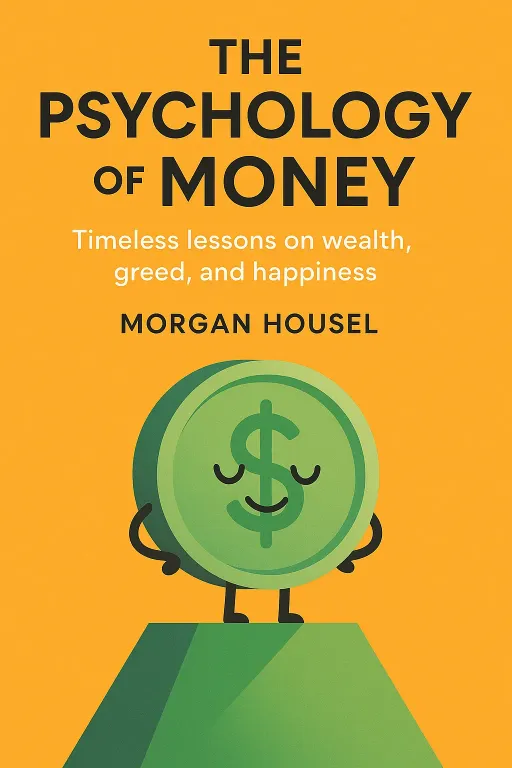
Nova: Well, it turns out our own brains play a far more significant role than we often give them credit for. Today, we're diving into this profound truth by exploring two absolutely essential books. First, "The Psychology of Money" by Morgan Housel, a brilliant financial columnist who masterfully blends historical anecdotes with psychological insights to reveal how our behavior truly dictates our financial destiny. And then, we'll look at "A Random Walk Down Wall Street" by Burton G. Malkiel, an influential economist from Princeton whose academic rigor fundamentally shifted how many view market efficiency.
Atlas: Okay, so two titans of financial thought, both pointing us inward. I'm curious, what makes Housel's approach so compelling, beyond just his background? It sounds like he's almost a financial therapist.
Nova: He really is, in a way. His insights have garnered widespread acclaim because he taps into something universal. He argues that financial success isn't about what you know, it's about how you behave. Think about it: we're constantly bombarded with complex financial jargon and sophisticated models, but Housel cuts through all of that to say, "Look, your temperament matters more than your IQ when it comes to money."
Atlas: That makes me wonder, what's a classic example of this behavioral trap that even smart people fall into? Something that highlights how our emotions can sabotage our best intentions?
The Psychology of Money: Beyond the Numbers
SECTION
Nova: Absolutely. Consider the story of Isaac Newton, one of history's greatest minds. He was a brilliant scientist, a literal genius who defined the laws of gravity. But when it came to investing in the South Sea Company in the early 18th century, he made some truly spectacular blunders.
Atlas: Isaac Newton? The guy who invented calculus? He lost money in the stock market? That's incredible!
Nova: He did. He initially made a tidy profit, then pulled out, only to watch the stock continue to skyrocket. Overcome by the collective euphoria—the cause—he jumped back in at a much higher price, pouring his life savings into it. The stock then crashed, and Newton lost a fortune, famously declaring he "could calculate the motions of heavenly bodies but not the madness of people."
Atlas: Wow, that's kind of heartbreaking. So even a mind that could unravel the universe couldn't resist the pull of herd mentality and greed. It's like he saw everyone else getting rich and thought, "I should be part of that."
Nova: Exactly. His process was driven by emotion, not by his usual scientific rigor. The outcome was a significant financial loss and a powerful lesson in humility. Housel uses stories like Newton's to illustrate that financial decisions are often made in the messy, irrational realm of human emotion, not in a perfectly logical spreadsheet.
Atlas: So you're saying that the biggest variable in our personal finance equation isn't the market's volatility, but our own emotional volatility? It's almost like our brain is wired to work against our long-term financial interests.
Nova: Precisely. And Housel goes deeper. He talks about the "man in the car paradox." You see someone driving a fancy sports car, and you think, "Wow, that person must be rich and successful." But what you're actually doing is imagining in that car, enjoying the admiration. You're not thinking about the person driving it; you're thinking about how feel.
Atlas: Oh, I love that. It's a subtle distinction, but it's everywhere! We project our desires onto others' perceived success. So, we chase these external symbols of wealth, but what we're actually craving is the feeling we they represent.
Nova: Right. And that chase often leads to impulsive decisions, trying to keep up, taking on too much debt, or risking too much for quick gains. It's a continuous cycle fueled by our own psychological biases and the social comparisons we make, often subconsciously.
Atlas: That makes sense. So basically, we're better at predicting the past than the future, and our emotions make us terrible long-term planners. But how do we even begin to fight that innate human tendency? What's the antidote to our own financial follies?
The Power of Simplicity: Long-Term Investing Strategies
SECTION
Nova: Well, Atlas, that leads us perfectly to the antidote to that emotional roller coaster: the power of simplicity, championed by Burton Malkiel in "A Random Walk Down Wall Street." He essentially argues that trying to "beat the market" is a fool's errand.
Atlas: Index funds? That sounds... almost too easy. Isn't everyone trying to find the next big stock, the hot tip that will make them rich overnight? What's the "random walk" part mean?
Nova: It refers to the idea that stock price movements are essentially unpredictable, like a random walk. Malkiel, from his long tenure as a professor at Princeton, meticulously lays out the case that financial markets are incredibly efficient. All available public information is almost instantly priced into a stock. So, by the time you hear about a "hot stock" from a friend or on the news, that information is already reflected in its price.
Atlas: Okay, but how does that translate into a practical strategy? If everything is random, how do you even invest?
Nova: He advocates for low-cost, diversified index funds. These funds simply track a broad market index, like the S&P 500, rather than trying to pick individual winners. Think of it like this: instead of trying to pick the fastest horse in a race, you just bet on the entire racetrack to perform well over time.
Atlas: That's a great analogy! So the strategy is essentially: don't gamble, just ride the market's long-term upward trend. But for someone who enjoys deep thinking, doesn't that feel a bit... passive? Where's the intellectual challenge?
Nova: That's the beauty and the paradox of it! The intellectual challenge lies not in outsmarting the market, but in outsmarting. It's about having the discipline and the patience to stick with the simple strategy, especially during market downturns, when every emotional fiber in your being is screaming at you to sell everything. It links directly back to Housel's psychology.
Atlas: I see. So the real work isn't in picking stocks, it's in managing your own fear and greed. It's about consistent compounding, not heroic market timing. Can you give an example of how this simple approach actually outperforms all that complex analysis?
Nova: Consider a hypothetical scenario: two investors, both starting with the same amount of money. One tries to actively trade, constantly buying and selling based on "expert" advice or market trends, incurring fees and taxes with each transaction. The other simply invests in a broad market index fund, adds to it regularly, and leaves it alone for decades.
Atlas: I can already guess where this is going. The active trader probably gets eaten alive by fees and makes emotional decisions.
Nova: Exactly. Over the long term, say 30 or 40 years, the index fund investor, despite doing nothing "clever," almost consistently outperforms the active trader, often by a significant margin. The power of compounding, combined with minimal fees and avoiding emotional pitfalls, creates astonishing wealth. It's a testament to the idea that simplicity, consistency, and patience truly win the race.
Atlas: That's a powerful contrast. So it's not about being smarter than everyone else; it's about being more disciplined and emotionally stable. It's like financial zen.
Synthesis & Takeaways
SECTION
Nova: It absolutely is, Atlas. When you combine Housel's deep dive into our financial psychology with Malkiel's rational, long-term approach, a clear path to financial freedom emerges. It's a path built not on chasing quick wins or trying to predict the unpredictable, but on understanding ourselves, managing our emotions, and consistently applying simple, proven strategies. True wealth, it turns out, is a marathon, not a sprint, fueled by consistent habits and emotional management.
Atlas: It's interesting how both books, from different angles, arrive at this central truth: financial security is less about what you with your money in terms of complex maneuvers, and more about who you when it comes to managing your reactions to money. It's about self-awareness and self-control.
Nova: Precisely. And that self-awareness is the first step. For our listeners who are passionate about deep thinking and learning, this isn't just about financial numbers; it's about profound self-discovery.
Atlas: So, what's one tiny step listeners can take right now to start building that lasting wealth, grounded in this understanding? Something that cuts through the noise and gets to the core of it?
Nova: For one week, try this: track every emotional reaction you have to your personal finances, without judgment. Just observe. Notice when you feel anxious checking your balance, excited after a market upswing, or frustrated by a bill. No need to change anything, just observe.
Atlas: That's a brilliant, actionable step. It's like building a financial mindfulness muscle. It makes me wonder, how many of our listeners have never truly paused to observe their financial emotions? We'd love to hear from you: what emotional reactions do you notice when you look at your finances? Share your insights with us and let's continue this conversation. This is Aibrary. Congratulations on your growth!