The Art of Asking: How Better Questions Unlock Deeper Understanding
Golden Hook & Introduction
SECTION
Nova: We're always told to find the answers, right? From school to job interviews, it’s about having the right response, the perfect solution. But what if the real secret to unlocking breakthroughs, in your career and your life, isn't about knowing, but about asking?
Atlas: Oh, I like that! It's almost counterintuitive. We're conditioned to be answer-driven, to have the data, the facts, the definitive statement. But you’re suggesting that the itself might be the ultimate superpower.
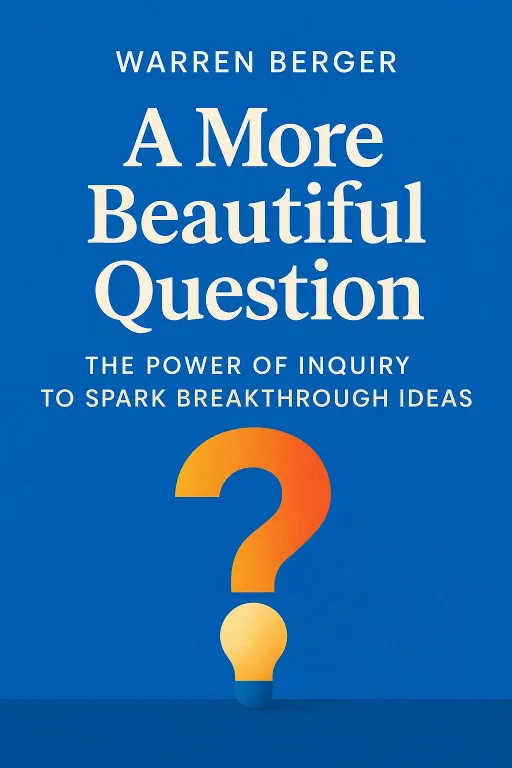
Nova: Exactly! And today, we’re diving into two phenomenal books that champion this very idea. First up, we have "A More Beautiful Question" by Warren Berger, an innovation expert and journalist whose work really zeroes in on how profound questions spark revolutionary ideas. He argues that the world's greatest innovations didn't start with an answer, but with a powerful "Why?" or "What if?"
Atlas: That makes me wonder, how does that fit into our everyday lives, beyond the big innovators? Because then we also have "Crucial Conversations" by Kerry Patterson, Joseph Grenny, Ron McMillan, and Al Switzler. Those authors are the team behind VitalSmarts, a leadership development company, and their book is practically a bible for navigating those high-stakes, emotionally charged discussions.
Nova: Precisely. Whether you're trying to invent the next big thing or just trying to have a productive discussion with your boss or your partner, the quality of our answers is directly proportional to the quality of our questions. Inquiry, it turns out, is the fundamental skill for growth.
The Transformative Power of "Beautiful Questions"
SECTION
Atlas: So you're saying it's not just question, but a specific of question that unlocks this growth? Because I ask questions all the time, like "What's for dinner?" or "Where are my keys?" And while those are important, they're not exactly sparking innovation.
Nova: That's a perfect point! Berger differentiates between ordinary questions and what he calls "beautiful questions." These aren't just curious inquiries; they're ambitious yet actionable questions that challenge assumptions, push boundaries, and fundamentally reframe problems. They often start with "Why," "What if," or "How."
Atlas: What’s the difference between a "beautiful question" and just… a really good, well-thought-out question? Can you give an example of how a "beautiful question" actually sparked something completely new, something that changed the game?
Nova: Absolutely. Think about Edwin Land, the founder of Polaroid. Before him, taking a picture involved film, development, waiting. It was a process. But one day, his young daughter asked, "Daddy, why can't I see the picture?" That simple, almost childlike "why" question wasn't just about convenience; it challenged the fundamental assumption of photography. Land didn't dismiss it. He took that "beautiful question" and it led to the invention of instant photography, a multi-billion dollar industry.
Atlas: Wow. That's incredible. So it's about seeing the obvious, but then digging deeper into it's the way it is, or it could be different? It sounds like it requires a certain mindset, almost a beginner's mind.
Nova: It absolutely does. Berger, coming from his background as an innovation expert, observed that many successful innovators weren't necessarily the smartest people, but the ones who remained perpetually curious, who weren't afraid to ask "Why is this done this way?" or "What if we tried something completely different?" Another famous example is the origin of Airbnb. The founders were struggling to pay their rent in San Francisco, and they noticed a design conference was coming to town, making hotel rooms scarce. Their "beautiful question" wasn't "How do we make more money?" or "How do we find a better job?" It was "What if people could rent out airbeds in their living rooms to strangers?"
Atlas: That's fascinating. It really reframes a problem from a constraint to an opportunity. It sounds like a 'beautiful question' forces you to look at a situation not just as it is, but as it. But how do you even asking a beautiful question when you're stuck in the weeds of a problem, feeling overwhelmed?
Nova: That's where Berger's framework becomes so powerful. He suggests starting with "Why" to understand the problem, then moving to "What if" for ideation, and finally "How" for implementation. For someone facing a persistent challenge, it’s about pausing the immediate search for answers and instead asking: "Why is this challenge truly a challenge for me right now?" or "What if I approached this from a completely different angle, one I haven't even considered?" It’s a deliberate shift from reaction to inquiry.
Strategic Questioning in High-Stakes Conversations
SECTION
Atlas: That makes sense. It’s about creating space for new possibilities. And while beautiful questions unlock innovation, sometimes the questions we need to ask are far more immediate, far more… crucial.
Nova: Exactly. Because it's one thing to ask a "beautiful question" about a product or a strategy, but what about when the stakes are personal? When emotions are running high, and you need to navigate a difficult conversation with a colleague, a family member, or a friend? That's where "Crucial Conversations" steps in.
Atlas: Okay, but in the heat of the moment, when emotions are running high, how do you even to ask these strategic questions? My instinct is usually to either shut down or just react.
Nova: That's a common struggle, and it's precisely what the VitalSmarts team addresses. They found that in crucial moments, people often revert to silence or violence – either withdrawing or lashing out. Their research-backed approach is about creating a "Pool of Shared Meaning," where everyone feels safe enough to contribute their ideas, feelings, and motives. And the key to building that pool? Asking strategic questions.
Atlas: Are we talking about interrogation here, or something more nuanced? Because I can see how asking too many questions in a tense situation could feel confrontational.
Nova: Absolutely not interrogation. It’s about genuine curiosity, not accusation. One of their core techniques is "making it safe." When you sense the other person is clamming up or getting defensive, you ask questions that demonstrate your positive intent, or you clarify what you intend. For example, instead of saying, "Why are you always missing deadlines?" which is accusatory, a strategic question might be, "My goal here is to ensure we hit our project milestones, and I’m concerned about the recent delays. Can you help me understand what's been happening from your perspective?" You’re inviting dialogue, not laying blame.
Atlas: That’s a great way to put it. It’s about inviting dialogue. So, what if the other person to engage in this kind of dialogue? What if they just shut down, or worse, get aggressive?
Nova: That's a crucial point. The authors emphasize that you can only control your half of the conversation. But by mastering techniques like "Contrasting," you can often de-escalate. Contrasting is clarifying what you intend and what you intend. For instance, "I don't want to imply that I think you're lazy, because I know you work incredibly hard. What I want is to find a way for us to both meet our commitments." That kind of question, framed with care, can truly open up a conversation. It's about asking questions that explore their path, not just pushing your own.
Atlas: That sounds a bit like therapy, but for everyday life. Is that fair to say? Because it's about understanding underlying motives and creating a space where people feel heard.
Nova: It has therapeutic elements in that it prioritizes psychological safety and mutual understanding, yes. But it's rigorously practical. The VitalSmarts team studied thousands of real-world interactions to distill these methods. It’s about equipping yourself with concrete tools to navigate those inevitable moments when what you say, and how you say it, can profoundly impact relationships and outcomes. It’s about turning potential breakdowns into breakthroughs, all through the power of thoughtful inquiry.
Synthesis & Takeaways
SECTION
Nova: So, whether we're talking about Warren Berger's "beautiful questions" sparking innovation or the "Crucial Conversations" team's strategic questions for high-stakes dialogue, the message is clear: the most powerful tool in our arsenal isn't knowledge itself, but the humble, yet profound, act of asking.
Atlas: It's truly amazing how something as seemingly simple as a question can be such a fundamental lever for growth and understanding. It shifts us from passive recipients of information to active architects of our reality. It's about empowering ourselves, not just to find answers, but to shape the very questions that define our path forward.
Nova: Exactly. It's about recognizing that the quality of our answers, our innovations, and our relationships is directly proportional to the quality of our questions. It's a skill that can be cultivated, practiced, and refined, leading to an entirely new level of insight and connection. It really is inquiry as a fundamental skill for growth.
Atlas: So, as you go about your week, what's one persistent challenge you're facing that could be reframed, not by seeking an immediate answer, but by asking a more beautiful, more insightful question? Think about it, truly sit with that challenge and ask yourself: What am I questioning here?
Nova: We'd love to hear what "beautiful questions" you're asking, or what crucial conversations you're navigating using these techniques. Share your insights with us!
Atlas: Thanks for joining us on this journey into the art of asking.
Nova: This is Aibrary. Congratulations on your growth!