The Art of Asking Better Questions: Unlocking Deeper Insights
Golden Hook & Introduction
SECTION
Nova: Oh, I love that game! Okay, Atlas, rapid-fire word association for 'questions.' Ready?
Atlas: Ready as I’ll ever be. Hit me!
Nova: 'Curiosity.'
Atlas: Exploration!
Nova: 'Problem.'
Atlas: Opportunity.
Nova: 'Answer.'
Atlas: Trap!
Nova: Whoa, 'trap'? That’s... intriguing. Care to elaborate, or should we save that for our deep dive today?
Atlas: I mean, we're talking about questions, right? And sometimes, the answer you get is a trap because you asked the wrong question to begin with. It locks you into a path you didn't even intend.
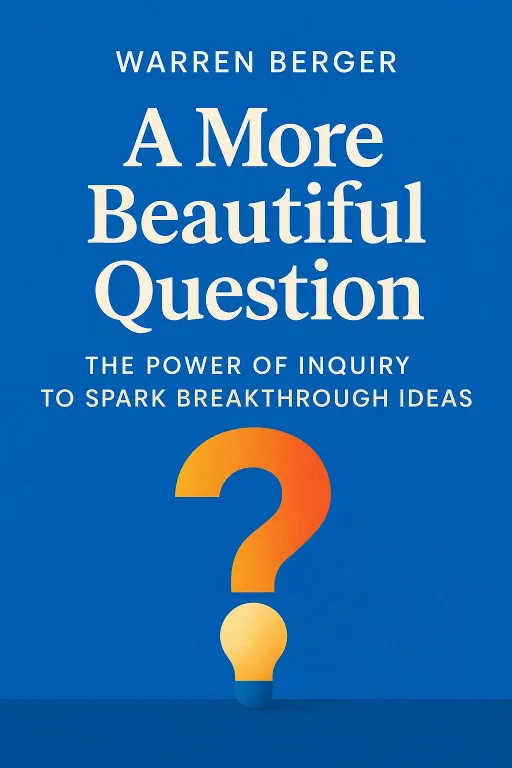
Nova: That's a perfect segue, because today we’re diving into 'The Art of Asking Better Questions: Unlocking Deeper Insights.' It’s a topic that draws heavily from the wisdom of thinkers like Warren Berger, author of 'A More Beautiful Question,' and H. James Brown, who wrote 'Asking Better Questions.'
Atlas: And what’s fascinating about this approach, especially with Berger, is that he didn't just stumble upon this. He spent years as a journalist, constantly refining his craft of inquiry, and then turned that lens onto innovation itself, showing how the greatest breakthroughs often start not with an answer, but with a truly profound question. It’s not just theory for him; it’s lived experience from the trenches of investigation.
Nova: Exactly! It’s about shifting our entire paradigm. And that's where we start today, with what we’re calling 'The Blind Spot.'
The Blind Spot: The Peril of Unexamined Questions
SECTION
Atlas: The Blind Spot. I can see that. I imagine a lot of our listeners, myself included, often jump straight to solving something. We don't even pause to ask if we’re tackling the right 'something.'
Nova: Precisely. Think about it: our culture is so answer-driven. From school tests to corporate meetings, the premium is always on having the 'right' answer. But this hyper-focus often blinds us to the quality, or lack thereof, of the question itself. We're so busy digging for gold that we don't realize we're in the wrong mine.
Atlas: Right, like, you’re asked, 'How can we increase sales by 20%?' And immediately, the team brainstorms marketing campaigns, discounts, new features. But what if the real question should have been, 'Why are our current sales declining?' or even 'Are we selling the right product to the right people?'
Nova: That's a perfect example. H. James Brown, in his work, really emphasizes this: that without a practical framework for formulating powerful questions, we operate on hidden assumptions. We assume the initial question is the correct one, and that assumption becomes our blind spot. It's like trying to navigate a dense fog with a map that's based on a false starting point. You'll just get more lost, faster.
Atlas: So, basically you’re saying that the very act of questioning the question is what leads to superficial solutions? That’s kind of profound because it implies a systemic flaw in how we approach problem-solving.
Nova: It absolutely is. And it's insidious because it feels productive. We're busy, we're active, we're 'finding answers.' But if those answers are to the wrong questions, we're just creating more work, more frustration, and ultimately, missing opportunities for genuine innovation. Warren Berger illustrates this beautifully with countless examples of companies that were on the brink of collapse, only to be saved when someone dared to ask a radically different question about their product or their customer.
Atlas: Can you give an example? Like how does that play out in real life?
Nova: Think about Polaroid. For years, their question was, 'How do we make instant photography better?' They poured resources into faster developing film, sharper images, smaller cameras. But then digital photography emerged, and the real question became, 'What is the of instant gratification photography in a digital world?' They were still asking about the 'better instant camera' when the world was moving beyond physical prints.
Atlas: That’s a bit like Blockbuster, right? Their question was, 'How do we get more people into our stores?' while Netflix was asking, 'How do we get movies to people wherever they are, whenever they want?' Two entirely different questions, leading to two entirely different outcomes.
Nova: Exactly! And that’s the power of moving beyond the blind spot. It’s about recognizing that the first question that pops into your head, or the one handed to you, might just be a symptom, not the root cause. It’s about digging deeper, challenging the premise.
Atlas: And I imagine a lot of our listeners who are navigating complex challenges, whether it's in technology, health, or even entrepreneurship, can relate. You're trying to build, to innovate, to maintain vitality, but if you're asking the wrong foundational questions, you're building on shaky ground.
Nova: Which leads us perfectly into 'The Shift.' How do we move from this reactive, answer-driven mindset to one of proactive, strategic inquiry?
The Shift: Proactive Inquiry as a Catalyst for Growth
SECTION
Nova: So, 'The Shift' is all about transforming from passively receiving information to actively shaping your understanding and progress through strategic questioning. It’s about becoming an 'inquirer' rather than just a 'responder.'
Atlas: So you’re saying it’s not just about asking question, but asking questions? What does 'better' even mean in this context?
Nova: That’s a great question, Atlas! And it’s exactly what Berger and Brown explore. 'Better' questions are often those that: one, challenge assumptions; two, explore possibilities rather than just known solutions; and three, get to the root cause of a problem, not just its symptoms. They’re expansive, not restrictive.
Atlas: Like how you said 'opportunity' was the association for 'problem.' It’s a reframing.
Nova: Absolutely. Warren Berger refers to this as 'Beautiful Questions' – questions that are ambitious yet actionable, that can shift a paradigm. He recounts the story of Edwin Land, the founder of Polaroid, who was inspired to invent instant photography when his three-year-old daughter asked, 'Why do we have to wait for the picture?' That wasn't a question about making existing cameras better; it was a question that challenged the fundamental assumption of photography at the time.
Atlas: Wow, that’s actually really inspiring. A three-year-old’s innocent query sparking a multi-billion dollar industry. It makes you wonder, how many 'beautiful questions' are we missing because we’re too busy giving pre-programmed answers?
Nova: Precisely. And Brown’s work complements this by providing practical frameworks. He talks about techniques like the '5 Whys' – repeatedly asking 'why?' to get to the core issue. Or using 'What if?' questions to explore entirely new scenarios. It’s not about being clever for cleverness' sake; it’s about a systematic approach to inquiry that uncovers hidden assumptions and leads to more effective strategies.
Atlas: So, it's not just about a mindset shift, but also having a toolkit, a methodology, for actually doing it. That makes sense, because just telling someone to 'ask better questions' without explaining to do it can feel a bit abstract.
Nova: Exactly. Nova’s take on this is that these insights fundamentally shift your approach. It’s the difference between being a passenger on the journey of knowledge, simply observing the scenery, and being the driver, actively choosing the route and exploring new territories. It’s about personal growth, innovation, and mastery. It’s about taking control of your cognitive process.
Atlas: That gives me chills. So, for someone who is driven by personal accomplishment, who seeks mastery, and wants lifelong adaptability, this isn’t just a nice-to-have skill. It’s foundational. It's about being able to pivot, to innovate, to sustain energy, because you’re constantly re-evaluating the map, not just trying to drive faster down the wrong road.
Nova: And it’s especially vital in today’s rapidly changing world. With new technologies constantly emerging, with the need for sustained health and wellness, and the drive for entrepreneurship, the ability to ask powerful, probing questions is what separates those who adapt and thrive from those who get left behind. It’s about building momentum through clarity, not just brute force.
Synthesis & Takeaways
SECTION
Nova: So, Atlas, as we wrap up, what’s one assumption you hold about a current challenge that you could turn into a powerful question to explore new possibilities?
Atlas: Oh, that’s a direct hit, Nova! I’ve been assuming that for a current project, the challenge is purely about 'scaling efficiency.' But what if the real question is, 'How can we redefine value for our users in a way that makes efficiency a secondary concern?' It completely changes the lens. It's not about making the current thing faster; it's about asking if the current thing is even the right thing.
Nova: That's a fantastic example of 'The Shift' in action. It's about pulling back, challenging that initial premise, and opening up a whole new realm of possibilities. The power of asking better questions isn't just about finding better answers; it’s about unlocking deeper insights, fostering genuine innovation, and ultimately, shaping a more meaningful path forward. It’s about trusting your inherent wisdom to see beyond the obvious.
Atlas: And that’s such a hopeful way to look at it. It empowers you to not just accept the problems as presented, but to actively participate in defining them, and thus, defining your own solutions. It’s about building momentum, one well-crafted question at a time.
Nova: Exactly. It’s the ultimate tool for the curious explorer, the practical innovator, and the purposeful achiever. It’s how you build mastery and maintain vitality in every aspect of your life.
Atlas: This is Aibrary. Congratulations on your growth!