

The Human Story: Discovering Yourself in the Echoes of the Past
Golden Hook & Introduction
SECTION
Nova: For centuries, we’ve been told a simple story about human history: from primitive hunter-gatherers, we inevitably evolved into complex, hierarchical societies. But what if that story is profoundly, fundamentally wrong?
Atlas: Whoa, that’s a bold claim right out of the gate, Nova. Are you saying everything I learned in school about the march of progress was just… a story?
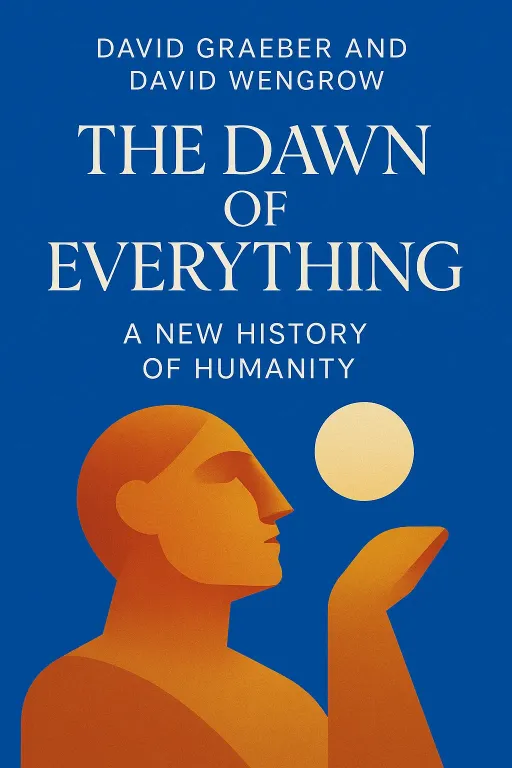
Nova: Precisely, Atlas! Today, we’re unraveling that very question, drawing insights from two extraordinary books that, in their own ways, challenge our ingrained perceptions of the past. We're talking about David Graeber and David Wengrow’s monumental work, "The Dawn of Everything: A New History of Humanity," and E. H. Gombrich’s beloved classic, "A Little History of the World."
Atlas: That first one, "The Dawn of Everything," is particularly fascinating because Graeber, a renowned anthropologist and anarchist thinker, sadly passed away before its publication, leaving Wengrow to complete this ambitious project. It’s a book that’s not just rewriting history; it's practically detonating our understanding of early civilizations, causing quite a stir among historians and archaeologists.
Nova: Absolutely. It’s a book that doesn't just revise; it reimagines. And it pushes us to consider that human history isn't a linear march, but a vast, experimental laboratory of social possibilities.
Atlas: Okay, so if it's not a linear march, then what is it? I'm curious how this new perspective on our origins actually reshapes our understanding of human potential.
Rewriting Humanity's Origin Story: Challenging Conventional Narratives
SECTION
Nova: Well, that naturally leads us right into the heart of "The Dawn of Everything." For so long, the prevailing narrative has been that early human societies were either small, egalitarian hunter-gatherer bands, or large, hierarchical agricultural states. And we were told that once agriculture came along, hierarchy was inevitable. Humanity was trapped in this progression.
Atlas: Right, like we were destined for kings and taxes and social stratification the moment we planted a seed. That sounds a bit out there.
Nova: Exactly! Graeber and Wengrow meticulously dismantle this idea. They argue that early human societies were far more diverse, complex, and experimental than we've ever given them credit for. They weren't just passively evolving; they were actively how to organize themselves.
Atlas: So you’re saying ancient people were consciously designing their societies? Like, they had town hall meetings to decide whether to have a chief or not? That feels incredibly modern for, say, 10,000 years ago.
Nova: In many cases, yes, that’s precisely what they suggest. Consider the Wendat people of North America, for instance. They were a sophisticated confederacy. During the summer, when they gathered for war and trade, they often adopted more centralized, hierarchical structures. But come winter, when they dispersed into smaller hunting groups, those hierarchies would dissolve, and they’d revert to more egalitarian forms. They weren't stuck in one mode; they had seasonal shifts in their social organization.
Atlas: Hold on, so they could just… switch? Like changing clothes? That completely contradicts the idea of an inevitable march towards hierarchy. I mean, for a curious learner like me, it almost sounds too good to be true, like romanticizing the past. Were these societies truly "free" in a way we understand it?
Nova: That’s a great question, and it's a crucial distinction. Graeber and Wengrow aren't romanticizing a lost Eden. They're highlighting the. These societies weren't always idyllic, but they demonstrated a remarkable capacity for political self-determination and experimentation. They consciously chose different forms of organization, sometimes rejecting what they saw as oppressive, and often experimenting with different forms of freedom – the freedom to move, the freedom to disobey, the freedom to reshape their world.
Atlas: That makes me wonder, what does this mean for us today? If our ancestors weren't just passively evolving into our current systems, but actively choosing and experimenting, does that mean we also have more agency than we realize in shaping our own societies and even our own lives?
Nova: Absolutely. The profound insight here is that if early humans were capable of such sophisticated social experimentation, then the rigid structures we often perceive as inevitable in our modern world might actually be choices we've made, or choices we've forgotten we can unmake. It suggests that human potential for diverse social arrangements is far greater than conventional history allows. It’s a powerful message of hope and possibility, particularly for those who feel constrained by current systems.
The Intimate Thread: Finding Yourself in the Universal Human Experience
SECTION
Nova: And that naturally leads us to the second key idea we need to talk about, which often acts as a beautiful counterpoint to what we just discussed: the deeply personal connection we can find in this grand, evolving human story. If history is this dynamic, experimental thing, how do we find ourselves in it?
Atlas: I guess that makes sense. It’s one thing to learn about ancient Wendat social structures, but how does that connect to the feeling of looking at an old artifact and feeling that deep, almost nostalgic resonance you mentioned earlier?
Nova: That’s where E. H. Gombrich’s "A Little History of the World" comes in. This book, originally written for younger readers, has captivated generations precisely because Gombrich makes the vast sweep of human history feel incredibly intimate and personal. He doesn't just list dates and kings; he tells the story of humanity as a continuous thread, linking us to those who came before.
Atlas: I still struggle with history sometimes, just seeing it as a collection of facts. So how does Gombrich make it feel personal?
Nova: He does it by focusing on the universal human experiences that transcend time. He’ll introduce a Roman emperor grappling with betrayal, a medieval craftsman finding joy in his work, or a Renaissance artist striving for beauty. He describes their hopes, their fears, their struggles, their moments of discovery—things we all feel, regardless of the century. He makes them feel like characters in a story you're personally invested in.
Atlas: That’s actually really inspiring. So it’s not just about learning happened, but feeling it happened, and recognizing a bit of ourselves in those echoes. It almost sounds like a healing moment, to realize that our own joys and struggles aren't unique, but part of a much larger, ongoing human narrative.
Nova: Exactly! It’s the feeling that the human experience, with all its complexities and contradictions, is a continuous thread. When you read Gombrich, you realize that the fundamental emotions—love, loss, ambition, fear, the desire for connection, the search for meaning—are constant. A curious learner, someone who enjoys deep thinking, can find immense comfort and perspective in this. It helps you see your own life not as an isolated incident, but as a chapter in this incredible, evolving story.
Atlas: It’s kind of like looking at an ancient tool and realizing someone, just like you, fashioned it with their hands, trying to solve a problem, or create something beautiful. That gives me chills. It makes history less about memorizing and more about empathizing.
Nova: Precisely. It’s about discovering yourself in the echoes of the past. It’s realizing that the challenges we face today, the questions we ask, the feelings we experience—they’ve all been part of the human journey for millennia. And in that recognition, there's a profound sense of shared humanity and continuity.
Synthesis & Takeaways
SECTION
Nova: So, bringing these two powerful ideas together, we see that history is far more than a fixed, linear progression. "The Dawn of Everything" reveals it as a vibrant, experimental canvas of human agency and diverse social choices, shattering our assumptions about inevitability. And "A Little History of the World" reminds us that within this grand, dynamic story, there's an intimate thread connecting us all.
Atlas: In other words, humanity isn't just marching towards some predetermined fate; we've always been experimenting, adapting, and choosing. And those choices, those universal human experiences, are deeply personal and resonate with us today, offering both lessons and a sense of belonging.
Nova: What emerges is that understanding this dynamic, personal history empowers us. It shows us that human societies are not static, and our own lives are part of an unfolding, meaningful narrative. It’s the ultimate antidote to feeling isolated or powerless in the face of change.
Atlas: So, for all our curious learners out there, take a moment to reflect. What historical period or culture truly resonates with you? What lesson or feeling does it offer you today, right now, in your own unfolding story?
Nova: Let that thought guide you. This is Aibrary. Congratulations on your growth!