

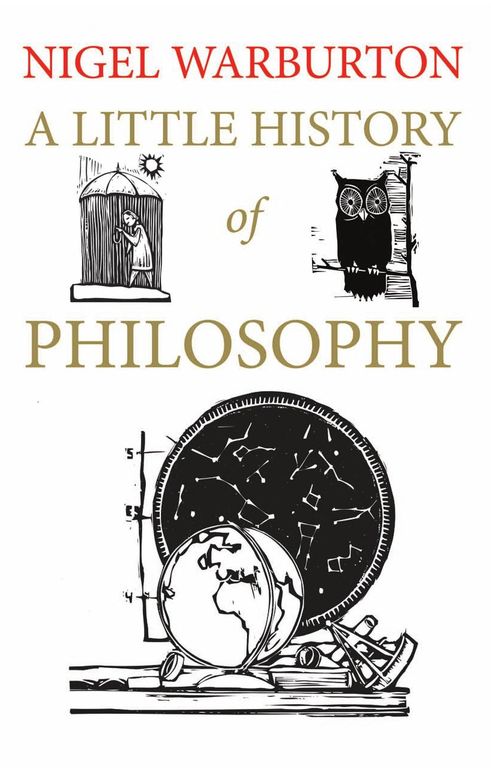
A little history of philosophy
Introduction
Nova: Imagine you are standing in a library, staring at a shelf of philosophy books. The spines read Aristotle, Kant, Nietzsche, Sartre. You pull one down, flip it open, and within three sentences you are completely lost. Most people walk away right there. But what if someone handed you a book that made every single one of those thinkers not just understandable, but genuinely fascinating? That is exactly what Nigel Warburton pulled off with A Little History of Philosophy.
Nova: : And I have to confess, Nova, I was one of those people who walked away. I tried reading philosophy in college and felt like I needed a translator just to get through a paragraph. So when you told me about this book, I was skeptical. A little history that covers two and a half thousand years of philosophy in under three hundred pages? That sounds like a magic trick.
Nova: It kind of is a magic trick. Warburton wrote forty short chapters, each one focused on a single philosopher or a small cluster of thinkers, moving chronologically from Socrates in ancient Athens all the way to Peter Singer in the present day. The book has been translated into more than twenty languages and has become a genuine bestseller, which is almost unheard of for a philosophy book.
Nova: : Forty chapters covering the entire sweep of Western philosophy. That is ambitious. What makes it work?
Nova: That is exactly what we are going to unpack today. Warburton himself is a fascinating figure. He is a British philosopher who spent years teaching at the Open University, and he also co-hosts the Philosophy Bites podcast with David Edmonds, which has racked up over fifty million downloads. So he has spent decades figuring out how to make complex ideas accessible without dumbing them down. This book is the culmination of that skill.
Nova: : Fifty million downloads? Okay, that is a serious track record. I am ready to hear how he does it. Let us dive in.
From Ancient Athens to Modern Ethics
The Socratic Bookends
Nova: One of the most elegant structural choices Warburton makes is how he bookends the entire book. He starts with Socrates and ends with Peter Singer, the contemporary Australian moral philosopher. And this is not just alphabetical convenience, both names start with S. Warburton deliberately chose these two because he sees them as doing the exact same thing, separated by twenty-five centuries.
Nova: : What do you mean, the same thing? Socrates was wandering around ancient Athens in a toga, asking people annoying questions until they got so fed up they executed him. Peter Singer is a professor at Princeton writing about animal rights and global poverty. Those feel like very different worlds.
Nova: They are different worlds, but the method is identical. Socrates never wrote anything down. Everything we know about him comes through his student Plato. Socrates would stop people in the marketplace and ask them seemingly simple questions like, what is justice, or what is courage. And through relentless follow-up questions, he would expose that they did not actually know what they were talking about. He called himself a gadfly, biting the lazy horse of Athens to wake it up.
Nova: : And Peter Singer is the modern gadfly?
Nova: Exactly. Warburton presents Singer as someone who asks deeply uncomfortable questions that most people would rather avoid. For instance, Singer argues that if you would jump into a shallow pond to save a drowning child, ruining your expensive shoes in the process, then you have the same moral obligation to save a child dying from preventable disease on the other side of the world, even if it means donating a significant portion of your income. The distance does not change the moral calculus.
Nova: : That is genuinely uncomfortable. I feel called out right now.
Nova: That is the point. Warburton says in his Philosophy Bites interview that the essence of philosophy is not passively absorbing facts about what dead thinkers said. It is thinking for yourself in response to challenging ideas. You do not have to agree with Singer, or with Socrates, or with anyone in the book. In fact, Warburton says it is better if you disagree, because then you are actually doing philosophy rather than just memorizing it.
Nova: : So the book is not a museum tour of dusty ideas. It is more like an invitation to join an ongoing argument that has been running for millennia.
Nova: That is beautifully put. And Warburton reinforces this by showing how each philosopher was responding to the thinkers who came before. Plato was reacting to Socrates. Aristotle was reacting to Plato. The Stoics were reacting to the Epicureans. It is a chain of conversation, and Warburton invites the reader to become the next link.
How to Explain Kant in Ten Minutes
The Art of the Short Chapter
Nova: Let us talk about the craft of the book itself, because the format is deceptively simple. Every chapter follows a very specific formula. Warburton opens by posing the key philosophical question that the thinker was grappling with. Then he gives a little biographical or historical context, usually in the second or third paragraph. Then he explains one or two core ideas in clear, short sentences. And finally, he creates a bridge to the next chapter.
Nova: : So it is almost like a recipe. Question, context, explanation, transition. Repeat forty times.
Nova: Exactly. And the Guardian review by Julian Baggini described it as a kind of philosophical Jackanory, which is a reference to a beloved BBC children's storytelling program. The comparison is apt because Warburton writes with an avuncular, conversational tone. He never condescends, but he also never assumes you already know the jargon.
Nova: : I am curious about one thing. You mentioned Kant gets special treatment. What is the story there?
Nova: Immanuel Kant is the only philosopher in the entire book who gets two chapters. Warburton said he simply could not do justice to both Kant's metaphysics and his ethics in a single short chapter. Kant argued that the human mind is not a passive receiver of information. Instead, it actively structures our experience through built-in categories like time, space, and causality. Warburton compares this to wearing rose-tinted spectacles that you can never take off. You see everything through them, but you can never know what the world looks like without them.
Nova: : And then the second chapter covers his moral philosophy?
Nova: Right. Kant's ethics are built on the idea of the categorical imperative. Basically, before you act, ask yourself whether the principle behind your action could be turned into a universal law that everyone should follow. If you are about to tell a lie, ask yourself, what if everyone lied whenever it was convenient? The whole practice of truth-telling would collapse. So lying is wrong, period. Not because of the consequences, but because it fails the test of universalizability.
Nova: : That is intense. And Warburton manages to explain all of that in a few pages?
Nova: He does. And here is the thing that the Christian Century review pointed out. Warburton writes in short, clear sentences where the subject and predicate are in tolerable proximity. That sounds like faint praise, but anyone who has tried to read actual philosophy knows how rare that is. The review also noted a limitation though. By boiling philosophy down to conclusions, you sometimes lose the method. Philosophy is as much about how a thinker arrives at an idea as the idea itself. Kierkegaard wrote under pseudonyms. Nietzsche used aphorisms and myth. Wittgenstein agonized in person with select students. The form matters.
Nova: : So there is a trade-off. Clarity versus depth.
Nova: Yes, and Warburton is upfront about this. He is not trying to replace reading the original texts. He is trying to give people a map so they know which territory they might want to explore further. Think of it as a tasting menu, not a full meal.
The Agonizing Choices Behind the Table of Contents
Who Made the Cut
Nova: Any history of philosophy has to make choices about who to include and who to leave out, and Warburton's choices have sparked some fascinating debates. The book covers roughly forty thinkers across forty chapters, but the distribution is heavily weighted toward the modern period. More than half the book is devoted to Kant and everyone who came after him.
Nova: : That makes sense though, right? More recent philosophy is more relevant to our lives today.
Nova: That is exactly Warburton's argument. He says he is light on medieval philosophers because so many of them were entangled in religious metaphysics that feel remote to modern readers. But some critics have pushed back. The Christian Century review noted that Warburton's selection shows a clear allegiance to English-language analytic philosophy. In the entire twentieth century, the only non-English philosophers who get a chapter are Sartre, de Beauvoir, and Camus, the French existentialists.
Nova: : What about Heidegger? He is one of the most influential philosophers of the twentieth century.
Nova: Warburton was asked about this directly in his Philosophy Bites interview, and he did not agonize about leaving Heidegger out at all. He gave two reasons. First, Heidegger is almost unintelligible to most intelligent people, and Warburton did not want to send readers to Being and Time only to waste hours of their lives. Second, he referenced the philosopher Jonathan Glover's critique that Heidegger's obscurity sometimes functioned as a veil hiding something less impressive underneath.
Nova: : That is a pretty bold stance. Did he regret leaving anyone out?
Nova: Yes, and this is a delightful detail. Warburton said he later realized he absolutely should have included Diogenes the Cynic. Diogenes was a performative philosopher who lived in a barrel outside Athens. When Alexander the Great, the most powerful person in the world, visited him and offered to grant any wish, Diogenes simply said, move your shadow, you are blocking the sun. He also wandered around Athens in broad daylight carrying a lit lantern, and when people asked why, he said he was looking for an honest man.
Nova: : That is incredible. Why did he want Diogenes in the book?
Nova: Two reasons. First, Diogenes was one of the earliest explicitly cosmopolitan thinkers. When asked where he was from, he said he was a citizen of the world, not of any particular place. That would have tied beautifully into the book's ending with Peter Singer, who also argues for cosmopolitan ethics. Second, Diogenes showed his philosophy through action rather than just words, which makes for great storytelling.
Nova: : What about the inclusions that raised eyebrows? I noticed Darwin and Freud are in the book, and they are not typically classified as philosophers.
Nova: Warburton defends both choices. He argues that you cannot understand the major shift toward atheism in twentieth-century philosophy without appreciating Darwin's theory of natural selection. Before Darwin, the apparent design in nature seemed to demand a designer. After Darwin, there was a plausible causal story for how complex organisms arise without divine intervention. As for Freud, Warburton says the idea of the unconscious, that much of what we do is driven by hidden desires we are not aware of, has fundamentally shaped how modern people understand what it means to be human.
Nova: : And what about women philosophers? The book covers three, all from the twentieth century.
Nova: Yes, Hannah Arendt, Simone de Beauvoir, and Philippa Foot. The pre-1900 history is, as one reviewer put it, unrelievedly male. Warburton acknowledges this is a limitation of the Western philosophical canon itself, but some critics argue he could have done more to recover overlooked voices. It is a fair critique, and one that reflects broader conversations happening in philosophy today about whose ideas get preserved and whose get forgotten.
Why These Ancient Questions Still Matter
Philosophy as a Living Conversation
Nova: Let me share one of my favorite through-lines in the book, because it illustrates why Warburton's approach is so effective. Early on, we meet Epicurus, the ancient Greek philosopher who argued that death is nothing to fear because when death is here, you are not, and when you are here, death is not. It is a logical argument that tries to cure fear through reason.
Nova: : That is oddly comforting, in a cerebral sort of way.
Nova: Then, centuries later, we encounter Boethius, a Roman statesman writing The Consolation of Philosophy while literally awaiting execution. He is in prison, facing death, and he turns to philosophy for comfort. He argues that true happiness comes from within, not from external circumstances. Happiness is a state of mind, not of the world.
Nova: : So the same question, how to face death, keeps resurfacing across completely different eras.
Nova: Exactly. And then we jump to the twentieth century and meet Albert Camus, who opens The Myth of Sisyphus with the arresting line that the only serious philosophical question is whether to commit suicide. He is asking, in a world without God or inherent meaning, is life worth living? His answer is yes, but you have to embrace the absurdity. Sisyphus, condemned to roll a boulder up a hill forever, is happy because he finds meaning in the struggle itself.
Nova: : That is a powerful arc. From Epicurus saying do not fear death because you will not experience it, to Boethius saying happiness is internal, to Camus saying meaning is something you create in the face of absurdity. Same fundamental question, evolving answers.
Nova: And Warburton traces another fascinating thread around the problem of evil. Augustine in the fourth century wrestled with why a good and all-powerful God allows suffering. His answer was the Free Will Defense. God gave humans the capacity to choose, which makes moral goodness possible, but also opens the door to evil. Then in the eighteenth century, Voltaire satirized the idea that this is the best of all possible worlds in his novel Candide, after witnessing the horrors of the Lisbon earthquake. The conversation never ends. It just gets more nuanced.
Nova: : What about the more practical side? Does the book show how philosophy changes how people actually live?
Nova: There is a remarkable example Warburton includes. He tells the story of James Stockdale, a US fighter pilot who was shot down during the Vietnam War and spent seven years as a prisoner of war, much of it in solitary confinement and under torture. Stockdale credited his survival to the Stoic philosophy of Epictetus, a formerly enslaved philosopher from the first century who taught that you should focus only on what you can control and accept everything else with equanimity.
Nova: : So a Roman slave's philosophy helped an American pilot survive a Vietnamese prison camp two thousand years later. That is not abstract. That is life and death.
Nova: That is the point Warburton wants readers to grasp. Philosophy is not a luxury for people with too much time on their hands. It is a toolkit for living. When Socrates said the unexamined life is not worth living, he was not being dramatic. He was stating what he believed to be a fundamental truth about what it means to be human.
Conclusion
Nova: So here is what we have learned about Nigel Warburton's A Little History of Philosophy. It is forty short chapters spanning two and a half millennia, from Socrates asking uncomfortable questions in the Athenian marketplace to Peter Singer asking uncomfortable questions about how we spend our money and what we eat. It is written in clear, jargon-free prose that never talks down to the reader. It makes deliberate choices about who to include and who to leave out, choices that have sparked productive debates. And most importantly, it treats philosophy not as a collection of dead ideas but as a living conversation that you, the reader, are invited to join.
Nova: : What strikes me most, Nova, is how Warburton manages to make philosophy feel urgent. These are not abstract puzzles. The Stoics helped a prisoner of war survive torture. Boethius wrote about happiness while waiting to be executed. Camus asked whether life is worth living in the aftermath of world wars. These questions matter.
Nova: They do. And Warburton's book has found an enormous audience precisely because people sense that philosophy matters, even if they have been intimidated by it in the past. The book has been translated into more than twenty languages. His Philosophy Bites podcast has over fifty million downloads. His earlier book Philosophy: The Basics sold over a hundred thousand copies. There is clearly a hunger for accessible philosophy.
Nova: : If someone listens to this episode and wants to pick up the book, what should they expect? Is it a cover-to-cover read or something you dip into?
Nova: Both, honestly. You can read it straight through and watch the conversation unfold across centuries. Or you can jump to whichever philosopher intrigues you. Each chapter stands alone. Warburton himself said he designed it so that a reader could open to any page and find something interesting. But I think the cumulative effect of reading it in order is powerful. You start to see the patterns, the recurring questions, the way each generation builds on and rebels against the last.
Nova: : And if someone finishes this book and wants to go deeper?
Nova: That is the best possible outcome, and Warburton would be thrilled. The book is a gateway, not a destination. After reading his chapter on Descartes, maybe you pick up the Meditations. After his chapter on Mill, maybe you read On Liberty. The whole point is to give you enough of a taste that you want to explore the full meal.
Nova: : I love that. It is like a philosophical tapas bar. Sample everything, then order more of what you like.
Nova: Exactly. And I will leave our listeners with one final thought from Warburton himself. He said that the essence of philosophy is thinking for yourself in relation to thousands of years of discussion. You do not have to agree with any of these thinkers. In fact, it is better if you disagree, because then you are actually doing philosophy. The book is not a set of answers. It is an invitation to join the conversation.
Nova: : That is a beautiful place to land. Thank you, Nova, for walking us through this remarkable little book.
Nova: Thank you for the great questions. And to our listeners, if you have ever been curious about philosophy but did not know where to start, A Little History of Philosophy by Nigel Warburton might just be your perfect entry point.
Nova: : This is Aibrary. Congratulations on your growth!