

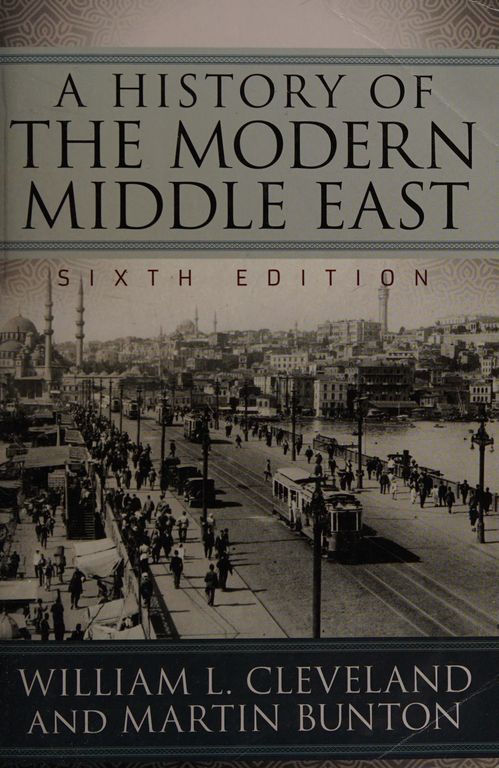
A history of the modern Middle East
Introduction
Nova: If you look at a map of the Middle East today, you see a collection of nation-states with fixed borders, national anthems, and complex bureaucracies. But just two hundred years ago, that world didn't exist. The transformation from a region of vast empires to the modern landscape we see on the news is one of the most dramatic stories in human history. And today, we are diving into the book that many consider the definitive guide to that journey: A History of the Modern Middle East by William L. Cleveland.
Atlas: It is a massive undertaking. I mean, how do you even begin to summarize a region that is so diverse, so ancient, and frankly, so misunderstood in the West? Cleveland has this way of cutting through the headlines and the stereotypes to show us the actual mechanics of how these societies changed. It is not just a list of wars and kings; it is about the fundamental shift in how people lived and identified themselves.
Nova: Exactly. Cleveland starts the clock in 1798, with Napoleon Bonaparte landing in Egypt. It is a choice that some historians debate, but for Cleveland, it represents the first major shock of Western modernity hitting the heart of the Islamic world. From that moment on, the region was in a race to adapt, to resist, and to redefine itself. Today, we are going to walk through the key milestones Cleveland identifies, from the last gasps of the Ottoman Empire to the rise of political Islam.
Atlas: I am ready. I have always wondered why the borders look the way they do and why certain ideologies took such a strong hold. If Cleveland is the guide, let's see where he takes us.
Key Insight 1
The Race to Modernize
Nova: One of the most important concepts Cleveland introduces early on is something he calls defensive developmentalism. It sounds like a mouthful, but it is actually a very intuitive idea. Imagine you are the leader of the Ottoman Empire in the 1800s. You see Europe industrializing, building massive navies, and expanding their reach. You realize that if you don't modernize your military and your tax system immediately, you are going to be swallowed whole.
Atlas: So it is modernization as a survival tactic. It is not necessarily because they wanted to be like the West, but because they had to be to keep the West out.
Nova: Precisely. Cleveland focuses heavily on the Tanzimat reforms in the Ottoman Empire and the reign of Muhammad Ali in Egypt. These leaders were trying to centralize power. They created modern schools to train officers, they built factories to make uniforms and weapons, and they tried to count every person and every acre of land for taxing. It was a total overhaul of the traditional social contract.
Atlas: But that kind of top-down change usually comes with a price, right? You can't just flip a switch and turn a traditional empire into a modern state without breaking a few things.
Nova: And that is exactly what happened. Cleveland points out that while these reforms created a new class of educated elites, they also put an enormous burden on the peasantry. To pay for the new armies and the new technology, the states had to squeeze the people harder. This led to massive debt, which ironically gave European powers the very opening they needed to step in and take control of the finances.
Atlas: So the attempt to stay independent actually made them more vulnerable to foreign influence? That is a tragic irony.
Nova: It really is. By the late 1800s, Egypt was essentially under British occupation because it couldn't pay its debts. The Ottoman Empire was being called the sick man of Europe. Cleveland shows that this era wasn't just about progress; it was about the birth of a dependency on Western capital and expertise that would haunt the region for a century.
Atlas: It makes you realize that the modern Middle East wasn't just born out of thin air. It was forged in this high-stakes pressure cooker of trying to catch up while being pushed down.
Key Insight 2
The Colonial Scalpel
Nova: If the 19th century was about internal reform, the early 20th century was about external surgery. Cleveland spends a lot of time on World War I, which he describes as the ultimate turning point. When the Ottoman Empire collapsed, the victors—mainly Britain and France—didn't just walk away. They sat down with maps and rulers and created the Mandate system.
Atlas: This is the part everyone talks about, right? The Sykes-Picot Agreement. The idea that a couple of guys in a room in London and Paris drew lines in the sand that ignored the people actually living there.
Nova: Cleveland is very careful here. He acknowledges that Sykes-Picot is a symbol of colonial arrogance, but he also shows that the process was more complex. The British and French weren't just drawing lines; they were creating entirely new political entities like Iraq, Syria, and Lebanon. These weren't nations with long histories of unified statehood; they were administrative zones designed to serve colonial interests.
Atlas: And that creates a massive identity crisis. If I am a person living in Baghdad, suddenly I am told I am an Iraqi, but my primary loyalty might be to my tribe, my religion, or the broader Arab world. How does Cleveland explain how people handled that?
Nova: He explains it through the rise of nationalism. In the interwar period, you see these different movements competing. Some people wanted a Great Syria. Others wanted a single, unified Arab state from the Atlantic to the Persian Gulf. And then you had the specific local nationalisms—Egyptianism, for example, which focused on the unique history of the Nile valley.
Atlas: It sounds like a recipe for constant friction. You have these artificial borders, and then you have these massive, sweeping ideologies trying to transcend them.
Nova: And don't forget the Balfour Declaration. Cleveland highlights this as a pivotal moment where the British promised support for a Jewish national home in Palestine, while also making vague promises of independence to the Arabs. He shows how this set the stage for a conflict that would become a central pillar of Middle Eastern politics for the next hundred years. The Mandate era wasn't just a temporary occupation; it was the period where the modern grievances and the modern borders were baked into the system.
Key Insight 3
The Age of the Strongmen
Nova: After World War II, the colonial powers were exhausted, and a new era began: the age of the independent nation-state. This is where Cleveland introduces us to the giants of the mid-20th century, most notably Gamal Abdel Nasser of Egypt. Nasser is a central figure in the book because he embodied the hope of an entire generation.
Atlas: He was the face of Pan-Arabism, right? The idea that the Arab world could unite and become a global power, independent of both the West and the Soviet Union.
Nova: Exactly. When Nasser nationalized the Suez Canal in 1956 and stood up to Britain, France, and Israel, he became a hero. Cleveland describes this as a moment of pure electricity. For the first time in centuries, an Arab leader had successfully defied the old colonial masters. It felt like the Middle East was finally taking its destiny into its own hands.
Atlas: But that hope didn't last forever. What went wrong?
Nova: Cleveland points to 1967—the Six-Day War. He calls it a watershed moment, and it is hard to overstate how devastating it was. In just six days, Israel defeated the combined armies of Egypt, Syria, and Jordan, and occupied the Sinai, the West Bank, and the Golan Heights. For the Arab world, it wasn't just a military defeat; it was a psychological collapse.
Atlas: It proved that the secular, nationalist rhetoric of leaders like Nasser couldn't actually deliver on its promises. If you can't protect your land, what good is your ideology?
Nova: That is the exact question people started asking. Cleveland shows that after 1967, the energy shifted. The dream of Pan-Arab unity began to fade, and leaders became more focused on just staying in power. This led to the rise of what Cleveland calls the mukhabarat states—regimes built on massive security apparatuses and secret police. Think of Assad in Syria or Saddam Hussein in Iraq. The state became a fortress, protecting the leader from his own people.
Atlas: So we go from the high-flying idealism of the 1950s to the grim, authoritarian stability of the 70s and 80s. It is a sobering transition.
Key Insight 4
The Islamic Resurgence
Nova: As the secular nationalist dream faltered, a new force began to fill the vacuum. Cleveland devotes a significant portion of the later chapters to the rise of political Islam. And the turning point here is 1979.
Atlas: The Iranian Revolution. That is the big one.
Nova: It changed everything. Before 1979, the dominant view in the West—and among many Middle Eastern elites—was that religion was a fading force, something that would eventually disappear as societies modernized. The Iranian Revolution proved that was completely wrong. It showed that Islam could be a revolutionary, modern political ideology that could topple a powerful, Western-backed monarch like the Shah.
Atlas: And it wasn't just Iran, right? Cleveland looks at how this trend manifested in other places too.
Nova: Right. He looks at the Muslim Brotherhood in Egypt, the rise of Hamas in Palestine, and the general shift toward religious identity across the region. He argues that this wasn't just a return to the past; it was a response to the failures of the present. People felt that Western-style capitalism and Soviet-style socialism had both failed them. The slogan of the time was Islam is the solution.
Atlas: It is interesting because Cleveland doesn't treat this as some inexplicable outburst of fanaticism. He frames it as a logical reaction to the corruption and the lack of dignity people felt under those authoritarian secular regimes.
Nova: That is one of the book's greatest strengths. He contextualizes everything. He also ties this to the oil boom of the 1970s. Suddenly, countries like Saudi Arabia had unimaginable wealth, which they used to spread their specific, conservative interpretation of Islam. So you have this combination of political frustration and massive financial resources, which fundamentally reshaped the social fabric of the region.
Atlas: It makes you realize that the religious movements we see today aren't just about theology. They are about power, social services, and a search for an authentic identity in a world that felt like it was being dictated by outsiders.
Conclusion
Nova: As we wrap up our look at William L. Cleveland's A History of the Modern Middle East, we have to look at where he leaves us. The later editions, updated with Martin Bunton, cover the Arab Uprisings of 2011—what many called the Arab Spring. Cleveland is cautious about that term, preferring to see them as part of a long, ongoing struggle for dignity and representation.
Atlas: It feels like the book comes full circle. We started with leaders trying to modernize from the top down to save their empires, and we end with the people trying to reclaim their states from the bottom up. The struggle for what it means to be a modern Middle Eastern society is still very much alive.
Nova: Cleveland's work reminds us that the Middle East is not a static place defined by ancient hatreds. It is a region of dynamic, resilient people who have navigated some of the most intense political and social transformations in history. If you want to understand why the region looks the way it does today, you have to understand the layers of history that Cleveland so masterfully peels back.
Atlas: It is a lot to take in, but it is essential. You can't look at a headline about the Middle East today without seeing the echoes of the Tanzimat, the Mandates, or the 1967 war. This book gives you the tools to see those connections.
Nova: Thank you for joining us on this journey through one of the most important historical texts of our time. This is Aibrary. Congratulations on your growth!