

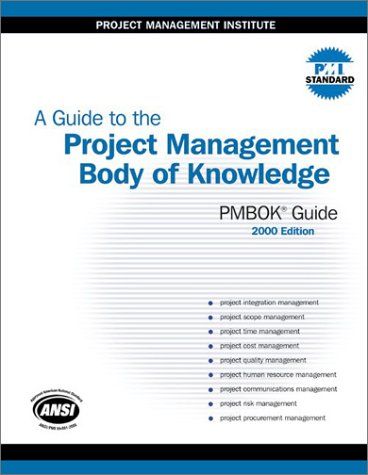
A Guide to the Project Management Body of Knowledge (PMBOK® Guide)
The Unofficial Bible of Project Management
The Unofficial Bible of Project Management
Nova: Welcome to The Blueprint, the podcast where we dissect the frameworks that build our modern world. Today, we are diving deep into a document so foundational, so comprehensive, that many in the industry call it the 'Bible' of project execution: A Guide to the Project Management Body of Knowledge, or the PMBOK Guide, from the Project Management Institute.
Nova: : That's a heavy title, Nova. The 'Bible' implies dogma, but project management, especially today, feels anything but rigid. Is this guide still relevant, or is it just a dusty tome required for a certification exam?
Nova: That is precisely the tension we're exploring. The PMBOK Guide has been the bedrock for decades, standardizing language and processes across every sector imaginable—from building skyscrapers to launching satellites. But the world changed. Agile arrived, and suddenly, everyone was asking if the PMBOK could keep up.
Nova: : So, we're not just talking about a book; we're talking about the evolution of an entire profession. What's the core promise of this guide, fundamentally?
Nova: Its core promise is consistency and quality. It distills decades of collective experience into a structured set of processes, terminology, and best practices that are accepted globally. It’s the shared vocabulary that allows a project manager in Tokyo to understand the exact meaning of a 'Work Breakdown Structure' used by a colleague in London. It’s about reducing ambiguity.
Nova: : I like that—a shared language. But if it’s so foundational, we have to start at the beginning. When did this whole concept of a 'Body of Knowledge' even start taking shape?
Nova: Let's roll back the tape. We'll trace its history and see how it’s managed to survive—and radically transform—to stay relevant in our fast-paced digital era. Get ready, because the latest edition is a complete departure from what many veterans remember.
Key Insight 1: The Genesis and Early Structure
From 1996 to Now: The Evolution of Standardization
Nova: The first edition of the PMBOK Guide landed in 1996. Think about that timeframe. The internet was just starting to become mainstream. Project management was heavily rooted in large-scale, predictive, waterfall-style engineering and construction projects.
Nova: : Right. So the initial focus was likely on control, documentation, and sequential phases. What did that first version look like structurally?
Nova: It was the blueprint for structure. The early editions solidified the famous framework: the five Process Groups—Initiating, Planning, Executing, Monitoring & Controlling, and Closing—and the ten Knowledge Areas, like Scope, Time, Cost, and Quality. These became the pillars of PMP certification for years.
Nova: : Those ten Knowledge Areas are what most people picture when they hear PMBOK. I remember studying them for my own certification prep years ago. It felt like a massive checklist of things you manage.
Nova: Exactly. And that rigidity is both its strength and its weakness. Its strength is that it forces thoroughness. For a multi-billion dollar infrastructure project, you absolutely need rigorous change control and detailed scope baselines. The guide provided the definitive 'how-to' for those activities.
Nova: : But what about the evolution? I hear the latest version, the 8th Edition, barely resembles the 6th Edition, which was the last one to heavily feature those 10 areas and 49 processes. What drove that massive change?
Nova: The driving force was the market itself. By the time we hit the 6th Edition, the rise of software development, digital transformation, and the explosion of Agile methodologies exposed the PMBOK’s limitations. It was seen as too prescriptive, too focused on the 'what' and 'how' of documentation, rather than the 'why' of delivering actual business value.
Nova: : So, the market was screaming for flexibility, and PMI listened, albeit slowly. I recall the 7th Edition being the first major pivot away from the process-heavy approach. What was the key takeaway from that transition?
Nova: The key takeaway was the shift from to. The 7th Edition introduced 12 Principles, and the recently released 8th Edition refined this further into 6 core Principles. It’s a philosophical upgrade. Instead of saying, 'You must perform the Perform Integrated Change Control process,' the guide now says, 'Be an Accountable Leader' and 'Focus on Value.'
Nova: : That sounds much more like leadership coaching than a technical manual. It’s moving from a prescriptive manual to a set of guiding philosophies. That’s a huge leap for an organization built on standardization.
Nova: It is. And this leads us perfectly into the heart of the modern PMBOK: the focus on outcomes. Let's look at what that new value-centric model actually entails.
Key Insight 2: From Outputs to Outcomes
The Principle-Based Paradigm Shift: Focusing on Value
Nova: The latest editions, particularly the 8th, are built around a concept called the Value Delivery System. This is where the rubber meets the road for modern project managers. It’s a fundamental reorientation.
Nova: : Help me visualize this. In the old 6th Edition world, success was often defined by meeting the triple constraint: on time, on budget, within scope. Is that definition officially dead?
Nova: Not dead, but certainly demoted. The new focus is on and. An on-time, on-budget project that delivers a product nobody uses is now considered a failure, even if it technically met its schedule baseline. The PMBOK 8 emphasizes that the project is just the vehicle; the destination is the realized business benefit.
Nova: : That makes perfect sense in the context of digital products. If you release an app feature quickly but it doesn't improve user engagement by 15%, you missed the point. What are the specific principles guiding this new value focus?
Nova: The research highlights six core principles in the 8th Edition. The most critical, arguably, are 'Focus on Value' and 'Adopt a Holistic View.' 'Focus on Value' mandates that every decision must trace back to delivering intended outcomes. 'Holistic View' forces the PM to look beyond the project boundaries—considering the organization, the environment, and sustainability.
Nova: : Sustainability is interesting. Is that a nod to ESG concerns creeping into project management standards?
Nova: Absolutely. The guide now explicitly integrates sustainability within all project areas. It’s recognizing that a successful project cannot create value today at the expense of creating massive problems tomorrow. It’s about long-term viability.
Nova: : And what about the structure that supports these principles? If we don't have the 10 Knowledge Areas in the same way, what replaces that organizational structure?
Nova: The 8th Edition introduces 'Performance Domains.' There are eight of these domains, which are essentially groupings of related activities and knowledge needed to perform project work effectively. They cover areas like Delivery, Planning, Uncertainty, and Stakeholders. They are designed to be adaptable, not a rigid checklist.
Nova: : So, instead of having a dedicated 'Cost Management' chapter you must follow, you now have a 'Planning Performance Domain' where you apply cost management techniques based on the project's context?
Nova: Precisely. The guide stresses tailoring. It says, and I’m paraphrasing here, 'Select the right processes, artifacts, and methods—be they predictive, agile, or hybrid—that fit the specific context of your project.' It’s empowering the PM to be a strategic decision-maker, not just a process administrator.
Nova: : That sounds like a massive relief for project managers stuck in environments that demand Agile speed but mandate Waterfall documentation. It gives them permission to adapt the framework.
Key Insight 3: Application and Certification
The PMBOK as a Toolbox: Real-World Application
Nova: Let's ground this in reality. Despite the philosophical shifts, the PMBOK Guide remains the foundation for the Project Management Professional, or PMP, certification. How does this theoretical framework translate into the day-to-day grind of managing a real project?
Nova: : I’ve heard it described as a carpenter’s toolbox. You don't use every tool on every job. You wouldn't use a sledgehammer to hang a picture frame. The PMBOK provides the sledgehammer, the precision screwdriver, and the level.
Nova: That analogy is spot on. Research suggests that practitioners use it as a reference library. When a specific problem arises—say, stakeholder engagement is failing, or scope creep is rampant—the PM goes to the relevant section, finds the recommended inputs, tools, techniques, and outputs, and adapts them.
Nova: : Can you give us a concrete example of how a specific PMBOK concept is used practically, even in a modern setting?
Nova: Take the concept of the Stakeholder Register, which is a classic artifact. In the old model, you filled it out once during initiation and filed it away. Now, under the principle of 'Engage Stakeholders Effectively,' the register is a living document. You use it to analyze power/interest grids, determine communication frequency, and actively manage expectations throughout the project lifecycle, not just at the start.
Nova: : So, the artifact remains, but the around it becomes continuous and adaptive, driven by the principle.
Nova: Exactly. Furthermore, the guide provides the common language needed for governance. When a PM needs to present a formal Change Request to an executive steering committee, using PMBOK terminology ensures everyone understands the impact analysis, the required approvals, and the documentation trail. It’s the universal translator for governance.
Nova: : That governance aspect is crucial, especially in large organizations where compliance matters. But this brings up the historical criticism: many people felt the PMBOK Guide was too focused on the 'predictive' or 'waterfall' style, making it feel disconnected from the rapid iteration needed in software or product development.
Nova: That friction was intense for years. The 6th Edition was often criticized for being a 500-page instruction manual for a world that was already moving at warp speed. It felt like you had to spend more time documenting compliance with the guide than actually managing the project.
Nova: : So, if the 8th Edition is principle-based, how does it address that historical criticism head-on? Does it finally embrace the spirit of Agile fully?
Key Insight 4: Integrating Hybrid and Agile Mindsets
Bridging the Divide: PMBOK and the Agile Reality
Nova: This is the make-or-break chapter for the PMBOK’s future relevance. The Project Management Institute recognized that they couldn't ignore the dominance of iterative and incremental delivery methods. The 7th and 8th Editions are PMI's massive effort to bridge the gap between traditional governance and Agile flexibility.
Nova: : How do they reconcile the need for structure with the need for speed? Agile is about embracing change; traditional PMBOK was about controlling change.
Nova: They did it by explicitly endorsing hybrid approaches. The guide now clearly states that project managers should tailor their approach, selecting predictive, agile, or hybrid methods based on the project's complexity and uncertainty. It’s no longer an either/or proposition.
Nova: : I saw a snippet suggesting that the new guide is trying to show that Agile projects follow the project lifecycle, just executed differently. Is that the argument?
Nova: That’s the core argument. The idea is that even in a purely Scrum environment, you still have to initiate the work, you still have to plan the next sprint, you still have to monitor progress, and you certainly have to close out the product increment. The PMBOK 8 frames these as necessary activities within the Performance Domains, regardless of the specific methodology used to execute them.
Nova: : So, instead of prescribing a 'Change Request Form' for every scope change, an Agile team might use a 'Product Backlog Refinement Session' as their mechanism for managing that change, and the PMBOK 8 says, 'Yes, that's valid tailoring.'
Nova: Precisely. It shifts the focus from the to the. Another interesting point from the research is the move toward recognizing complexity. The 8th Edition seems to incorporate more systems thinking, which is vital for understanding how a project interacts with its larger organizational ecosystem—something traditional, siloed process models often missed.
Nova: : That holistic view must be essential when integrating AI tools, which are becoming more common in project management. Are there hints about future technologies in the guide?
Nova: There are definitely hints about the future. While the core document focuses on principles, the supporting materials and PMI’s broader direction point toward integrating data analytics and AI for better forecasting and risk management. The principle 'Embed Quality Into Processes and Deliverables' strongly implies leveraging technology to automate quality checks, moving beyond manual sign-offs.
Nova: : It sounds like the PMBOK Guide is finally shedding its reputation as a rigid rulebook and positioning itself as a dynamic framework for strategic delivery in any environment. It’s less about being a certified process follower and more about being a certified value driver.
Synthesis and The Way Forward
Synthesis and The Way Forward
Nova: We’ve covered a lot of ground today, moving from the 1996 origins to the principle-driven, value-centric focus of the latest PMBOK 8th Edition. Let’s synthesize our key takeaways.
Nova: : My biggest takeaway is the philosophical divorce from pure process adherence. The guide is now firmly stating: context matters most. If you are managing a project, you must tailor the approach, whether you lean predictive or agile.
Nova: Absolutely. Takeaway number one: The PMBOK Guide is no longer a prescriptive manual; it is a. The six principles—especially 'Focus on Value'—are the lens through which all project decisions should now be viewed.
Nova: : Takeaway two: The structure has changed dramatically. We’ve moved from the rigid 5 Process Groups and 10 Knowledge Areas to the more flexible 8 Performance Domains. This allows for better integration of modern concepts like sustainability and systems thinking.
Nova: And takeaway three, which is crucial for anyone studying for the PMP: The exam reflects this shift. It tests your ability to apply these principles in complex, hybrid scenarios, not just your ability to recall the inputs and outputs of a specific process from the 6th Edition.
Nova: : So, what is the actionable advice for a listener who has an old copy of the PMBOK 6th Edition on their shelf?
Nova: Don't throw it out, but don't treat it as gospel. Use the old structure—the process groups and knowledge areas—as a checklist for needs to be managed. Then, use the new principles from the 8th Edition as the —the mindset you apply to manage those elements effectively and deliver true value.
Nova: : It’s about marrying the proven structure of the past with the adaptive mindset required for the future. The PMBOK Guide, in its current form, is less about standardization and more about providing a robust, adaptable foundation for strategic leadership.
Nova: Exactly. It proves that even the most established standards can evolve when the world demands it. It’s a guide, after all, not a straitjacket.
Nova: : A powerful distinction. Thank you for guiding us through this essential framework, Nova.
Nova: My pleasure. This has been The Blueprint. This is Aibrary. Congratulations on your growth!