Living Deliberately: Stoicism Meets Essentialism
Golden Hook & Introduction
SECTION
Nova: We're all chasing something, aren't we? More success, more time, more peace. But what if the secret to getting everything you truly desire isn't about adding more to your plate, but meticulously taking things off?
Atlas: Huh. That sounds like a radical idea in a world that constantly tells us to hustle harder, optimize every second, and expand our influence. My gut reaction is, "Really? Less is more? How?"
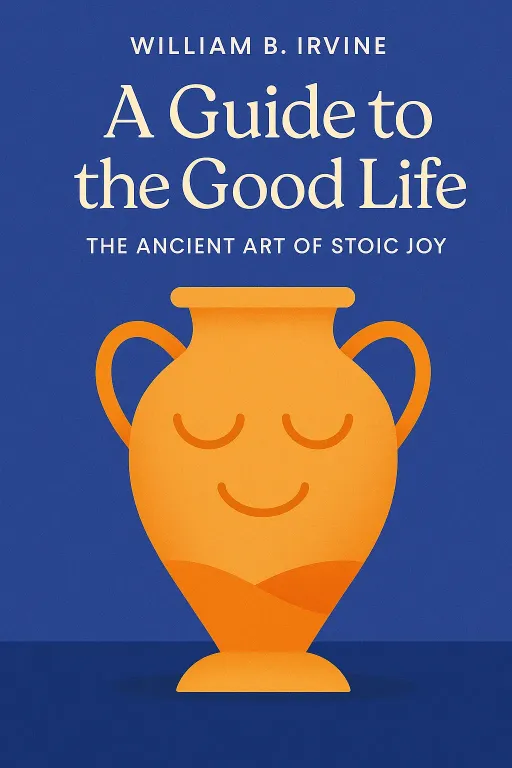
Nova: Exactly! And that's the beautiful paradox we're diving into today. Our focus is on "Living Deliberately," and it's a conversation inspired by two incredibly powerful books. First, we have William B. Irvine's "A Guide to the Good Life," which meticulously unpacks the practical application of Stoic philosophy for contemporary living.
Atlas: Right, Stoicism, that ancient philosophy that often gets misunderstood as just being emotionless. But I gather Irvine makes it incredibly relevant.
Nova: He absolutely does. Irvine, a philosophy professor, has this incredible knack for translating complex ancient wisdom into actionable blueprints for modern challenges. He doesn't just explain Stoicism; he shows you to live it. And then, we'll connect that with Greg McKeown's "Essentialism," which champions the disciplined pursuit of less. McKeown, a leadership consultant who has advised some of the world's leading companies, isn't just about theory; he provides actionable methods for discerning what's truly important and then building a life around it.
Atlas: I can see that connection. Because for anyone feeling stretched thin, constantly battling burnout, or just feeling like they're busy but not impactful, these ideas hit home. It’s like we’re all trying to be everything to everyone, and in the process, we become nothing to ourselves.
Nova: Precisely. And that feeling of being perpetually overwhelmed, yet strangely unfulfilled, is exactly where these two philosophies offer profound healing. They provide a framework to reclaim not just our time, but our inner peace and true purpose.
The Stoic Art of Control: Finding Peace in What You Can Influence
SECTION
Nova: So, let's start with Irvine and the Stoics. The core of their teaching, which Irvine brings to life so beautifully, is something called the "dichotomy of control." It's incredibly simple, yet profoundly difficult to master.
Atlas: Okay, so you’re saying there are things I can control and things I can't. That feels obvious, but I imagine the Stoic take on it goes deeper than just a simple checklist.
Nova: It goes much deeper. The Stoics argue that our tranquility, our inner peace, is directly proportional to how well we distinguish between what is our control and what is of it. And then, crucially, how much we focus our energy on the former. They'd say our opinions, desires, goals, and actions are within our control. Everything else—other people's actions, the weather, the economy, our reputation, even our own bodies to some extent—is external.
Atlas: That makes sense, but how does that help me achieve my goals or mentor others effectively? From a strategist's perspective, my job often feels like it's influencing external factors and people to achieve a desired outcome. Isn't this just giving up?
Nova: That’s a common misconception, and it’s a brilliant question. The Stoics aren't advocating for apathy or inaction. Quite the opposite! They're saying, direct your efforts where they can actually make a difference. For instance, you can control your in mentoring someone, your for a presentation, or your to a market downturn. You cannot control whether the mentee takes your advice, whether the audience likes your presentation, or whether the market recovers next week.
Atlas: Okay, so it’s about shifting the focus of success. Success isn't the, it's the. I can see how that could reduce a lot of anxiety for leaders who often feel responsible for things entirely out of their hands.
Nova: Exactly! And one of Irvine's most powerful techniques for internalizing this is "negative visualization." It's not about being pessimistic; it's about actively contemplating the loss of things you value.
Atlas: Wow, that sounds intense. So it's not about being pessimistic, it's about building mental resilience, almost like a pre-mortem for your peace of mind?
Nova: Precisely. Imagine your favorite coffee mug. You love it, it’s perfect. Negative visualization means spending a few moments imagining that mug broken, shattered on the floor. Or imagine a loved one not being in your life tomorrow. The point isn't to dwell in sadness, but to realize how precious these things are. When you then look at your mug, or spend time with that loved one, you experience a profound sense of gratitude and appreciation.
Atlas: That’s actually really powerful. I imagine a lot of our listeners, especially those leading teams or building businesses, are constantly looking forward, planning for growth, for the next big thing. This technique seems to force a pause, to anchor you in the present and appreciate what you have, rather than constantly striving for what you.
Nova: It fundamentally shifts your perspective. Instead of taking things for granted, you appreciate them more deeply. And when, inevitably, something go wrong, or you lose something, you've mentally rehearsed it. You've built a kind of emotional armor, allowing for a more tranquil and rational response, rather than being completely blindsided by despair. It frees up an enormous amount of mental and emotional energy that would otherwise be spent worrying about uncontrollable futures or lamenting losses.
The Essentialist Path: Designing Your Life for Maximum Impact and Minimal Distraction
SECTION
Nova: And speaking of freeing up energy, that naturally leads us to Greg McKeown's "Essentialism," which takes a very different, but equally powerful, approach to living deliberately. While Stoicism helps us manage our inner world in response to external realities, Essentialism is about meticulously shaping our external world to align with our deepest values.
Atlas: So, it's not just about what you, but what you. I’m curious, how does McKeown actually define "essential"? Because it feels like everything is important when you're trying to build something significant, nurture relationships, or mentor others effectively.
Nova: That’s the crux of it, and it's where McKeown offers a clear framework. He argues that an Essentialist doesn't ask, "How can I fit more in?" but rather, "What is the I can do that, by doing it, will make everything else easier or unnecessary?" It’s a disciplined pursuit of less, but better. He breaks it down into three core practices: Explore, Eliminate, Execute.
Atlas: Explore, Eliminate, Execute. I like that. It sounds like a strategic roadmap. But let's dig into "Eliminate." That's often the hardest part. How do you actually say "no" to things gracefully, especially when those things might be requests from colleagues, clients, or even family, all of whom you want to support or nurture?
Nova: McKeown provides brilliant strategies for this. It's not about being rude or unhelpful; it's about understanding your highest contribution. He suggests saying "no" with a purpose, often by clarifying your priorities. For example, instead of a blunt "no," you might say, "I'd love to help with that, but I'm currently fully committed to Project X, which is crucial for. How can I best support you within those boundaries?" Or, "That sounds interesting, but I'm focusing all my energy on right now. I'll have to pass."
Atlas: So it's about protecting your focus for what truly builds legacy and impact, rather than just being busy for the sake of it. That’s actually really inspiring, especially for those driven by a desire to make a lasting difference. It redefines "busy" as a choice, not a default.
Nova: Exactly. And it also involves designing systems to protect your "vital few" activities. It could be setting boundaries around your work hours, creating specific "deep work" blocks, or even delegating tasks that don't align with your highest contribution. It's about making the essential path the easiest path.
Atlas: That makes me wonder, could this actually backfire? What if saying no too much limits opportunities, especially for someone trying to grow their network or explore new ventures? There's a balance, right?
Nova: Absolutely, it’s not a rigid dogma, but a guiding principle. McKeown acknowledges that there are times to explore and experiment. The key is. An Essentialist explores, then ruthlessly, and with precision. It’s not about never trying new things, but about making conscious choices about what to invest your finite time and energy in, rather than passively letting demands dictate your life. It’s about being the editor of your own life story, not just a character in someone else’s.
Synthesis & Takeaways
SECTION
Nova: When you bring these two ideas together – Irvine’s Stoicism and McKeown’s Essentialism – you get a powerful synergy. Stoicism gives you the inner resilience and peace to navigate the uncontrollable chaos of life, while Essentialism gives you the external clarity and discipline to craft a life of profound purpose and impact.
Atlas: I can see how combining these two approaches could be incredibly powerful. It’s like building an inner fortress while also meticulously pruning your external garden. Both are about being profoundly intentional with your most precious resources: your attention and your energy. It’s not just about surviving; it’s about thriving with purpose.
Nova: Exactly. In a world of constant demands and endless distractions, remember the profound peace that comes from distinguishing what you can control from what you cannot, and focusing your energy solely on the former. That's your healing moment.
Atlas: And for a tiny step this week, I'd say identify one non-essential activity or commitment you can eliminate. Just one. It could be a meeting, a subscription, a social obligation. Create more space for what truly matters to your well-being and legacy. It’s not just about doing less; it’s about doing the less.
Nova: It’s about living a life that isn't just full, but truly fulfilling. A life designed by you, for you.
Atlas: That's a great note to end on.
Nova: This is Aibrary. Congratulations on your growth!