Beyond Newtonian Limits: Understanding Gravity's True Nature
Golden Hook & Introduction
SECTION
Nova: What if everything you thought you knew about gravity was... fundamentally wrong? Not just a little off, but a complete conceptual overhaul that reshapes the entire cosmos.
Atlas: Whoa, that's a bold claim, Nova. I mean, gravity is pretty straightforward, right? Apple falls, we stay on the ground. What's the big secret?
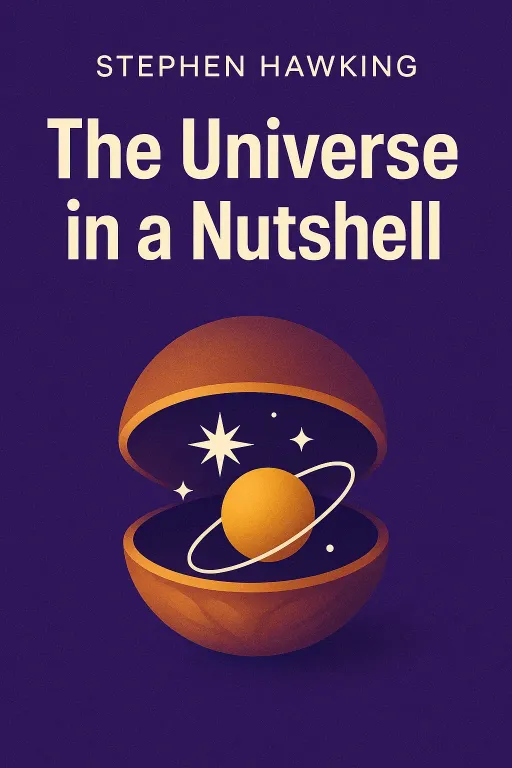
Nova: That's the blind spot, Atlas! We're conditioned to think of gravity as a force, a pull between objects. But today, we're diving into a paradigm shift that redefines it entirely. We're drawing inspiration from a conceptual framework we're calling "Beyond Newtonian Limits: Understanding Gravity's True Nature," and particularly a book that absolutely blew the doors off popular science: Stephen Hawking's "A Brief History of Time."
Atlas: Ah, Hawking! I remember that book being everywhere. It really made cosmology accessible.
Nova: Exactly! It wasn't just a book; it was a cultural phenomenon. It sold millions, translated into countless languages, and introduced the idea of gravity as geometry to a global audience. It was groundbreaking in making these incredibly complex ideas understandable for the everyday curious mind.
Atlas: That's a huge task. So, if gravity isn't a force, what is it? And how does that change everything?
Gravity as Spacetime Geometry: The Paradigm Shift
SECTION
Nova: Well, Atlas, instead of a force, imagine gravity as the curvature of spacetime. Think of spacetime as a giant, flexible trampoline. If you place a bowling ball in the center – that's a massive object like our Sun – it creates a dip, a curve in the trampoline.
Atlas: Okay, I can visualize that. So, the Sun isn't "pulling" the Earth?
Nova: Precisely. The Earth, which is like a marble rolling across this trampoline, isn't being pulled by the bowling ball. It's simply following the shortest, easiest path around the curve created by the Sun. It's following the geometry of spacetime itself.
Atlas: That makes sense, but… spacetime? What exactly are we curving? Is it just empty space?
Nova: Not just empty space! It’s the fabric of reality, where space and time are inextricably linked. Mass and energy don't just sit spacetime; they spacetime, and they actively warp it. So, when we talk about curvature, we're talking about the very structure that dictates how everything moves and interacts. It's not a force acting on objects; it's the stage upon which objects perform, and the stage itself is dynamic.
Atlas: That's a great way to put it. So, our traditional idea of gravity, the apple falling, that's just a local manifestation of this larger cosmic dance?
Nova: Exactly. Newtonian gravity works beautifully for everyday scales, but it breaks down when you get to extreme masses or speeds. Einstein's general relativity, which describes gravity as geometry, gives us a far more complete picture. It's not that Newton was wrong; it's that he only saw part of the story.
Atlas: Wow, that’s kind of mind-bending to think about. It feels so intuitive that it’s a pull, a force. How do you reconcile that feeling with this abstract concept of curved geometry?
Nova: It's all about perspective. On our scale, the curvature is so subtle that it feels like a downward pull. But from a cosmic perspective, it’s all about following geodesics, the straightest possible lines in a curved space. It's like walking on the Earth – you think you're walking in a straight line, but you're actually following the curve of the planet.
Consequences of Curvature: Black Holes and Cosmic Expansion
SECTION
Nova: Once you accept gravity as geometry, some of the universe's most mind-bending phenomena suddenly make perfect sense. Let's talk about black holes.
Atlas: Okay, I have to ask the deep question from our reading: If gravity is the curvature of spacetime, how does this change your mental image of a black hole? Because my mental image is still a giant cosmic vacuum cleaner, sucking everything in.
Nova: That's a common image, but it's not quite right when you think about spacetime geometry. A black hole isn't just a super-dense object with an insane gravitational pull. It's a region where spacetime itself is so incredibly warped, so intensely curved, that all paths within a certain boundary lead inward. It's like being on a river where the current gets faster and faster until, at a certain point—the event horizon—the current is moving faster than you can swim. No matter how hard you try, you're going over the waterfall.
Atlas: Oh, I like that waterfall analogy. So it's not a "suck," it's more like the fabric of reality itself collapsing in on itself, and you're just caught in the flow.
Nova: Exactly! The event horizon isn't a physical surface; it's a boundary in spacetime. Once you cross it, all future paths lie within the black hole. It’s an extreme consequence of mass and energy curving spacetime to its ultimate limit.
Atlas: That’s fascinating. Sean Carroll, in "Spacetime and Geometry," really goes deep into how general relativity unifies these concepts. Does this geometric view also help us understand something as massive as the expansion of the universe?
Nova: Absolutely! The geometric view is crucial for understanding cosmology on the grandest scale. The overall geometry of the universe—whether it's flat, positively curved like a sphere, or negatively curved like a saddle—determines its ultimate fate. This geometry is influenced by the total mass and energy density within the universe.
Atlas: So, the expansion we observe isn't just things flying apart, but the fabric of spacetime itself stretching?
Nova: That’s it! The distances between galaxies are increasing not because they're moving space, but because space itself is expanding. And this expansion is a direct consequence of the large-scale geometry of the universe, which general relativity describes. It shows how black holes and cosmic expansion are not isolated phenomena, but direct consequences of this fundamental curvature. It's all connected.
Synthesis & Takeaways
SECTION
Nova: So, what we've really explored today is this profound shift: moving from thinking of gravity as a simple attractive force to understanding it as the deep, elegant geometry of spacetime. This isn't just a theoretical nicety; it's the fundamental truth that allows us to understand everything from how planets orbit to the very expansion of the universe.
Atlas: Honestly, that gives me chills. It challenges everything I thought I knew, but in a way that just makes the universe feel so much more elegant and interconnected. It really pushes you to trust your ability to navigate these abstract concepts, just like our aspiring cosmologist listeners.
Nova: It’s true. It's a testament to the power of observation and abstract thought. When you grasp gravity as geometry, the cosmos stops being a collection of objects pulling on each other and becomes this dynamic, constantly shifting tapestry. It’s a beautiful, unified picture.
Atlas: It really does make you want to grab a dedicated notebook and start sketching out some diagrams! For anyone who's been drawn to unraveling complex theoretical frameworks, this geometric view of gravity is a perfect jumping-off point for understanding the grand tapestry of existence.
Nova: And it’s just the beginning. The journey into cosmology, quantum mechanics, and the fundamental laws of the universe is an endless source of wonder. Keep questioning, keep exploring, and embrace the journey of discovery.
Atlas: Thank you for taking us on this incredible journey, Nova. This is Aibrary. Congratulations on your growth!