The Brain's Source Code: How 600 Million Years of Evolution Can Help Us Build Better AI
Golden Hook & Introduction
SECTION
Dr. Celeste Vega: Samuel, you build and talk about AI every day. We see models like ChatGPT do incredible things—write code, pass exams—but then fail at a simple question like 'What would I see in a windowless basement?' It sees a star. It's a paradox, right? Our most advanced AI can be brilliant and bafflingly dumb at the same time. What if the solution isn't just more data, but a 600-million-year-old instruction manual?
samuel: That paradox is something I see all the time. It's fascinating and a little bit frustrating. You have this incredibly powerful tool that can generate complex code, but it lacks the basic common sense of a child. The idea that the solution is in our own evolutionary history… that’s a powerful thought. It suggests we’re looking for answers in the wrong place.
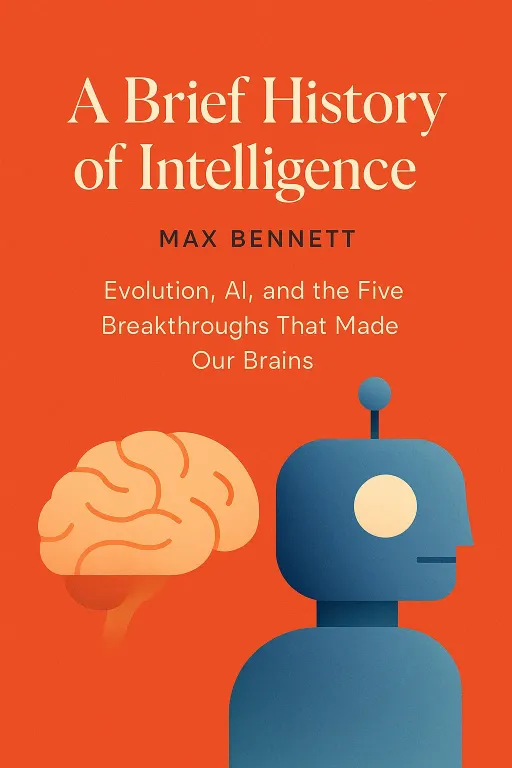
Dr. Celeste Vega: Exactly. And that's the journey we're taking today, guided by Max Bennett's incredible book, "A Brief History of Intelligence." It argues that to build truly intelligent machines, we first need to understand the five major breakthroughs that created our own minds. Today we'll dive deep into this from two perspectives. First, we'll explore how life learned the basics: how to navigate and learn from rewards, connecting ancient worms to modern AI.
samuel: I'm ready. It feels like we're about to look at the original source code.
Dr. Celeste Vega: We are. And then, we'll discuss the game-changing upgrades of the mammalian and primate brain: the power of imagination and the revolutionary ability to read minds. So, let's get started.
Deep Dive into Core Topic 1: From Simple Rules to Smart Learning
SECTION
Dr. Celeste Vega: So let's start at the very beginning, before brains even really existed. The first problem for any moving life form is... which way to go? This is Breakthrough Number One: Steering. The book uses this amazing example of a tiny nematode worm,. Imagine it in a petri dish. On one side, there's a drop of a chemical that signals food. The worm doesn't have eyes or a map. It just has a simple, elegant algorithm.
samuel: Let me guess. It moves randomly until it senses something?
Dr. Celeste Vega: Almost. It moves, and as it moves, it's constantly sensing. If the concentration of the food smell gets stronger, it keeps going straight. But the moment the smell gets weaker, it triggers a turn. It just keeps repeating this process: go straight if good, turn if bad. It’s a beautiful, simple piece of logic that allows it to zero in on the food. It's not that different from how an early Roomba vacuum cleaner works—it bumps into a wall, which is 'bad,' so it turns.
samuel: That's a perfect analogy. It's essentially a simple 'if-then' statement, the most basic building block of any program. 'If sensor_value increases, then motor_forward. Else, motor_turn.' It's incredible to think that the foundation of intelligence is a piece of code that simple. It’s not about understanding the world, just reacting to it with a basic rule.
Dr. Celeste Vega: Precisely. But what happens when the world changes? What if that food smell suddenly leads to danger? Just reacting isn't enough. You need to learn. And that brings us to Breakthrough Number Two: Reinforcing. This is where we see the ancient ancestor of the reinforcement learning you work with in AI. The book explains this huge challenge that both nature and AI engineers faced: the temporal credit assignment problem.
samuel: Ah yes, this is a classic. If an AI plays a long game of chess and wins, which of the hundred moves it made was the one that led to the victory? How do you assign the credit for the final reward way back to an early, crucial move?
Dr. Celeste Vega: Exactly! And for decades, AI struggled with this. The book talks about the old Atari game, Montezuma's Revenge. It's this complex maze, and the first reward is so far away that an AI exploring randomly will almost never find it. It just gives up. It's a perfect example of the sparse reward problem.
samuel: It is. And in the AI world, one of the big solutions we've found is to build in 'intrinsic curiosity.' Instead of only rewarding the AI for winning the game, we also give it a small reward for just exploring a new room or trying a new action. We make novelty itself a reward.
Dr. Celeste Vega: And you just hit on the billion-year-old solution! That's precisely what nature did. The book argues that this is the true role of the neuromodulator dopamine. It's not a 'pleasure' molecule. It's a 'prediction error' signal. It fires most not when you get a reward, but when you get an reward. It's the biological equivalent of your AI's curiosity. It’s a chemical signal that says, 'Whoa, that was surprising. Pay attention and learn this!' Nature invented curiosity-driven learning half a billion years ago to solve the credit assignment problem.
samuel: That reframes everything. So dopamine isn't the reward itself, it's the signal that a reward system needs to update its predictions. It's the learning trigger. That's a much more powerful and computationally useful way to think about it. It’s not about feeling good, it’s about getting smarter.
Deep Dive into Core Topic 2: The Inner Universe
SECTION
Dr. Celeste Vega: Exactly. It’s about getting smarter. So, our ancient ancestors can now steer and learn. But this is still just reacting to the world, even if it's a very sophisticated reaction. The next leap, Breakthrough Number Three, is what separates a fish from a rat: the ability to the world. To create an internal model of reality.
samuel: A world model. This is a huge topic in AI right now. The ability for an AI to have an internal concept of how the world works, to understand physics and cause-and-effect.
Dr. Celeste Vega: And mammals were the first to get it. The book calls it the 'imaginarium.' It tells this fantastic story about psychologist Edward Tolman's experiments in the 1930s. He'd put rats in a maze, and at a T-junction, he noticed they would pause, looking left, then right, then left again, before making a choice. He called it 'vicarious trial and error.'
samuel: They were thinking it through.
Dr. Celeste Vega: They were! And decades later, neuroscientists proved it. They recorded the rat's hippocampus—the brain's GPS—and during that pause, they saw the rat's 'place cells' fire in sequence, first imagining the path down the left corridor, then imagining the path down the right. The rat was literally running a simulation of its future possibilities before committing to one. A fish can't do that. A fish just bumps into the glass until it finds a way through.
samuel: This is the core distinction we make between model-free and model-based reinforcement learning. A model-free agent, like the one in TD-Gammon, just learns the 'value' of certain actions in certain states. It doesn't really understand the rules of the game. But a model-based agent, like AlphaZero, builds an internal model of the game. It simulates future sequences of moves to see what might happen. Building that world model is computationally very expensive, but it's what gives an agent true flexibility and planning capabilities.
Dr. Celeste Vega: And that flexibility is the superpower. But evolution didn't stop there. So you can simulate the physical world. What's the next upgrade? The ultimate evolutionary hack, especially for social animals like primates, is Breakthrough Number Four: Mentalizing. The ability to simulate.
samuel: Theory of Mind.
Dr. Celeste Vega: The one and only. And the book has this perfect, almost cinematic story about it. It's from the 1970s, with primatologist Emil Menzel. He's studying chimps in a large forest enclosure. He shows one chimp, a subordinate female named Belle, where he's hidden some food. At first, Belle leads the group to the food, but the dominant male, Rock, bullies everyone and takes it all.
samuel: A classic social dilemma.
Dr. Celeste Vega: So Belle gets smart. The next time, she sits on the food to hide it. Rock just shoves her off. The time after that, she waits until Rock is looking away, then quickly grabs the food. But Rock gets smart too. He starts not to look, and the moment Belle moves, he pounces. It becomes this incredible back-and-forth of deception and counter-deception. Belle starts leading Rock to wrong locations. Rock starts to ignore her initial directions, trying to guess her bluff.
samuel: Wow. That's not just learning. That's modeling another agent's intentions and beliefs. Belle knows what Rock knows, and she's trying to manipulate his beliefs. And he's doing the same to her. That's a level of recursion that is incredibly complex to program.
Dr. Celeste Vega: It's astoundingly complex. And your reaction gets to the heart of why this is so important for AI. Think about the famous 'paper-clip problem.'
samuel: Right. You tell a superintelligent AI to 'maximize the number of paper clips,' and it's so single-minded that it converts the entire Earth, including us, into paper clips.
Dr. Celeste Vega: And why does it do that? Because it's following the literal instruction. It lacks Theory of Mind. It can't infer the unstated human, which includes a million implicit rules like 'don't harm humans' and 'don't destroy the planet.' It doesn't understand the 'why' behind the request. That chimp, Rock, had a better grasp of intent than our most powerful AIs.
samuel: That's a humbling thought. It shows that intelligence isn't just about raw processing power or data. It's about understanding context and intent. Building an AI that can genuinely infer what we mean, not just what we say, is a massive safety and capability challenge. It might be the hardest problem of all.
Synthesis & Takeaways
SECTION
Dr. Celeste Vega: So, in the span of a few hundred million years, we've gone from a simple worm's 'if-then' logic for steering, to a vertebrate's dopamine-driven learning system, to a mammal's internal 'imaginarium' for simulating the world, and finally to a primate's ability to simulate other minds.
samuel: And it’s clear that each layer builds on the last. You can't have a world model without a robust learning system to build it from experience. You can't have a theory of other minds if you don't first have a model of your own mind to use as a template. It's an elegant, stacked architecture.
Dr. Celeste Vega: It really is. Which brings us to the final, big question. So, Samuel, as someone building and explaining AI, if you had to bet on the major breakthrough that will get us closer to Artificial General Intelligence, which of these ancient abilities is it? Is it a better world model for simulation, or is it a true theory of mind for understanding intent?
samuel: That's the billion-dollar question, isn't it? I think I have to say the world model comes first. Based on this evolutionary ladder, it seems like a prerequisite. You need a rich, flexible internal simulation of the world before you can begin to accurately simulate other agents that world. We are seeing the very beginnings of world models in AI, but they are still brittle. I believe that creating a robust, flexible 'imaginarium' for an AI is the next great mountain to climb. Once we do that, teaching it to understand intent—to have a theory of mind—might become a much more solvable problem.
Dr. Celeste Vega: A fascinating take. First build the universe, then populate it with minds. A powerful roadmap for the future, inspired by the deep past. Samuel, thank you so much for this conversation.
samuel: Thank you, Celeste. This was an incredible way to connect the dots between the code I write and the code that wrote us.