

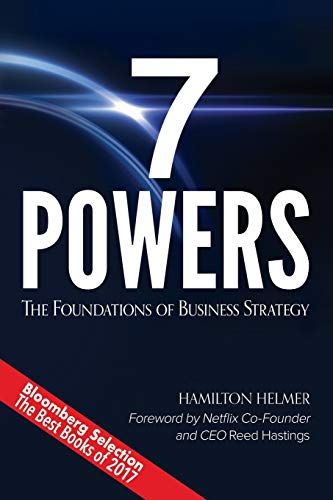
7 Powers
The Foundations of Business Strategy
Introduction
Nova: Welcome back to Aibrary. Today we're cracking open a book that venture capitalists, startup founders, and strategists treat almost like a secret weapon. It's called 7 Powers by Hamilton Helmer, and here's a striking claim from it: Helmer argues that most of what passes for strategy in the business world is actually just planning. And strategy, real strategy, is about one thing and one thing only — achieving power.
Nova: Not quite that dramatic, though the language is deliberately provocative. Helmer defines power as a set of conditions that creates persistent differential returns. In plain English: it's what lets a business earn significantly more money than its competitors, and keep doing so for a long time, without getting copied into oblivion. The book lays out exactly seven distinct types of power — hence the title — and argues that without at least one of them, your business is eventually going to get commoditized.
Nova: That's exactly the right analogy. Helmer was a strategy consultant with a PhD in economics from Yale, and he spent decades advising companies like Netflix and Adobe. The book emerged from his course at Stanford's business school, and it's remarkably rigorous for a business strategy book. He doesn't just name the seven powers — he gives each one a precise mechanism, a clear benefit, and a defined barrier that prevents competitors from eroding it.
Nova: Let's walk through them and explore the companies that exemplify each one — from Netflix to Pixar to Toyota. Some of these stories are going to change how you see familiar brands entirely.
Scale Economies, Network Effects, and Counter-Positioning
The First Three Powers
Nova: Let's start with the power that Helmer describes as perhaps the most durable and enduring of all: scale economies. This one seems obvious on the surface — bigger companies have lower per-unit costs. But Helmer goes much deeper. The key insight is that scale economies only become a true power when the cost structure has a high ratio of fixed costs to variable costs.
Nova: Because if most of your costs are variable — meaning they scale proportionally with every unit you sell — then getting bigger doesn't actually make you more efficient. Think of a hot dog stand. Your buns, sausages, and condiments all cost roughly the same per hot dog regardless of whether you sell 100 or 100,000. But if your costs are mostly fixed — like a semiconductor fabrication plant that costs billions to build but then produces chips for pennies — then every additional unit sold spreads those massive fixed costs thinner and thinner. The leader's cost advantage becomes insurmountable.
Nova: Exactly. The data centers, the algorithm development, the massive infrastructure — those are largely fixed costs. Once Google amortizes them across billions of searches, its per-search cost becomes microscopic. A newcomer would have to spend billions before even approaching Google's unit economics. And Helmer emphasizes that the barrier here is what he calls the competitive game — the big player has a structural cost advantage that can't be overcome, even by an equally capable competitor, as long as the industry economics hold.
Nova: Right, and Helmer treats network effects with unusual rigor. He defines them as occurring when the value of a product to a customer increases as more customers use the same product. But here's the nuance: not all network effects are created equal. He distinguishes between direct network effects — like Facebook, where you literally can't use the platform without other users — and indirect network effects, like the Windows operating system, where more users attract more developers, which attracts more users.
Nova: It is. And the barrier is what makes it a true power: a challenger cannot match the leader's value proposition because they can't replicate the installed base. Even if you built a technically superior social network tomorrow, it wouldn't matter because none of my friends are on it. Interestingly, Helmer notes that network effects can actually be fragile in some cases — if users multi-home, meaning they use multiple platforms simultaneously, the power can weaken. Think of drivers using both Uber and Lyft.
Nova: Counter-positioning is my personal favorite, and it gives us one of the best business stories in the book. It occurs when a newcomer adopts a superior business model that the incumbent does not mimic because it would damage their existing business. The key word is would — not cannot, but would not. The incumbent could copy the new approach, but chooses not to because doing so would cannibalize their profitable existing operations.
Nova: Perfectly put. Helmer's prime case study is Netflix versus Blockbuster. In the early 2000s, Netflix pioneered DVD-by-mail with no late fees and a subscription model. Blockbuster had every resource to copy this — brand, capital, distribution, relationships with studios. And they eventually tried with Blockbuster Total Access. But here's the thing: Blockbuster made hundreds of millions of dollars annually from late fees alone. Every move toward a Netflix-like model would mean torching that revenue stream. The internal resistance was overwhelming, and by the time Blockbuster committed, it was too late.
Nova: They did, and that's an important lesson Helmer emphasizes: powers can transition and compound. But more on that later. The other classic example is how Vanguard counter-positioned against active mutual funds with low-cost index investing. The incumbents couldn't match Vanguard's fees without admitting their own active management was overpriced. It's a brutal strategic trap.
Powers That Lock In Customers and Lock Out Competitors
Switching Costs, Branding, and Cornered Resource
Nova: The fourth power is switching costs. Helmer defines these as the costs — financial, procedural, or relational — that a customer would incur if they switched from your product to a competitor's. When switching costs are high enough, they create what he calls customer captivity.
Nova: Exactly. And Helmer notes something counterintuitive: the benefit of switching costs isn't just customer retention — it's pricing power. When customers are captive, you can raise prices up to the point where the cost of switching becomes lower than the cost of staying. That's the spread you capture. The barrier is that a challenger must offer enough value to overcome the switching cost, which becomes exponentially harder the more embedded the incumbent is.
Nova: Great question. Think about Apple's ecosystem. If you have an iPhone, a MacBook, AirPods, and an Apple Watch, and all your photos are in iCloud and all your messages are in iMessage — moving to Android isn't just buying a new phone. It's disrupting your entire digital life. That data migration, learning a new interface, losing iMessage threads, repurchasing apps — those are all switching costs. Apple has engineered captivity elegantly. Helmer would say Apple wields both switching costs and branding simultaneously, which brings us to power number five.
Nova: Helmer has a very specific, somewhat narrow definition of branding as a power. He says branding only qualifies as a true power when it creates a durable, asymmetric preference based on past experiences with the product that is not easily overcome by a competitor's claims. In other words, a brand isn't a power just because people recognize it. It's a power when that recognition translates into a willingness to pay more — or choose it consistently — based on an information asymmetry.
Nova: Yes. The mechanism is that the customer has gained information over time — through experience or reputation — that a branded product is reliably good, and it's not worth the risk or effort to verify an unknown alternative. The benefit is higher margins or market share. The barrier is that a challenger cannot credibly claim equivalent quality in a short time frame. You can't argue a brand into existence.
Nova: That's precisely it. And Helmer notes that branding as a power has actually declined in many industries because the internet has democratized information. Reviews, comparison sites, social media — they reduce the information asymmetry that branding exploits. That's why branding remains powerful in categories where quality is hard to assess before purchase, like luxury goods, or where the stakes of a bad choice feel high, like medicine or baby products.
Nova: It really is. A cornered resource is preferential access, at favorable terms, to a valuable resource that independently enhances value. The key word is preferential — you have access that your competitors don't. This could be a patent, a mineral deposit, a regulatory license, or even a uniquely talented individual or team.
Nova: Yes, and it's a beautiful case study. Pixar's cornered resource wasn't technology — other animation studios had powerful computers too. Helmer argues it was the creative brain trust: John Lasseter, Ed Catmull, Andrew Stanton, Pete Docter, Brad Bird — a concentration of storytelling genius that produced hit after hit for over 15 years. Toy Story, Finding Nemo, The Incredibles, WALL-E, Up — the track record was absurd. Other studios could not simply hire their way to Pixar's creative output. The benefit was a string of blockbusters that competitors couldn't replicate. The barrier was that talent of that caliber, working together with that chemistry, simply cannot be assembled on demand.
Nova: Absolutely, and Helmer is clear about this. Cornered resources have finite durations, which makes them perhaps the least durable power unless they're continually refreshed. Disney's copyright on Mickey Mouse is a cornered resource that they've famously lobbied to extend. Pharmaceutical patents are cornered resources with explicit expiration dates. The astute strategist using a cornered resource needs to use the window of advantage to build other, more durable powers before the resource runs out.
The Seventh Power and How All Seven Evolve Over Time
Process Power and the Dynamics of Power
Nova: The seventh and final power is process power. Helmer defines this as embedded company organization and activity sets that enable lower costs or a superior product, and which can only be matched by an extended commitment over time.
Nova: That's the spirit of it, but Helmer adds crucial nuance. The barrier is what makes process power a true strategic asset, not just good management. The barrier is opacity and complexity. If a process is transparent and simple, competitors can copy it in months. True process power exists only when the advantage is embedded in so many interdependent routines, cultural norms, and tacit knowledge that even the company itself might not fully understand why it works — and competitors certainly can't reverse-engineer it.
Nova: Toyota and the Toyota Production System, which later became known more broadly as lean manufacturing. For decades, Toyota consistently produced higher-quality cars at lower cost than American and European competitors. Competitors visited Toyota's factories. They read books about the Toyota Production System. They hired Toyota consultants. They implemented their own versions of just-in-time and kaizen. And yet, for decades, they could not match Toyota's quality-cost combination. The process was too deeply woven into Toyota's culture, supplier relationships, employee training, and decades of continuous improvement to be replicated by studying the surface-level practices.
Nova: Exactly. And Helmer draws an important distinction between process power and what he calls best practices. Best practices are widely known and can be adopted by anyone. Process power is proprietary, opaque, and durable. The litmus test is: if a competitor hired away your top operations people and gave them unlimited budget, could they replicate your advantage within a few years? If the answer is yes, you don't have process power.
Nova: This is one of Helmer's most valuable contributions. He introduces the concept of power progression — the idea that different powers dominate at different stages of a company's or industry's development. In the early, origin phase, the most critical powers are typically counter-positioning and cornered resource. These are the powers that let a newcomer get a foothold against entrenched incumbents. Netflix's counter-positioning against Blockbuster. Pixar's cornered resource of creative talent.
Nova: In the takeoff phase, network effects and scale economies become the dominant powers. Once you've counter-positioned your way into the market, you need to build moats that widen with growth. Facebook's network effects kicked in as it expanded from Harvard to other colleges to the world. Amazon's scale economies in fulfillment and cloud infrastructure compounded as it grew. These powers have a beautiful property: they get stronger the bigger you get.
Nova: In the mature or stability phase, switching costs, branding, and process power tend to dominate. The market is no longer growing rapidly, so the game shifts to protecting your position and extracting value. Enterprise software companies lean hard into switching costs. Consumer packaged goods companies rely on branding. Manufacturing and operations-driven companies depend on process power. A mature company might wield multiple powers simultaneously — think of Apple with its switching costs through the ecosystem, its branding power, and its process power in supply chain management.
Nova: They absolutely can, and Helmer is clear-eyed about this. Powers can erode through technological disruption, regulatory change, shifts in customer behavior, or simply the passage of time. A patent expires. A network becomes less valuable because a new platform emerges. Switching costs collapse when a competitor builds an easy migration tool. Counter-positioning loses its force once the incumbent eventually adapts or dies. No power is truly permanent, which is why Helmer emphasizes that strategy is an ongoing activity, not a one-time exercise.
How to Use the 7 Powers Lens in Practice
Applying the Framework
Nova: Let's get practical. One of the most useful aspects of the book is that Helmer gives us a framework for diagnosing whether a business actually has power, and which kind. He introduces two key concepts: the benefit and the barrier.
Nova: Exactly. And Helmer is ruthless about this distinction. He says most business successes get attributed to superior execution, charismatic leadership, or innovation, when in reality, what often matters most is whether the business sits behind one of the seven barriers. A company can be brilliantly run and still get crushed if it lacks power. Conversely, a mediocre operator behind strong power can still generate excellent returns.
Nova: It does, and it aligns with Warren Buffett's famous observation: when a management with a reputation for brilliance tackles a business with a reputation for bad economics, it's the reputation of the business that remains intact. Helmer gives us the vocabulary to understand what good economics actually means — it means possessing one or more of the seven powers.
Nova: That's the fundamental question. And Helmer provides a diagnostic approach. First, identify the potential power. Second, verify the benefit — is there measurable evidence of superior returns, lower costs, or pricing power? Third, verify the barrier — what specifically prevents competitors from closing the gap? If you can't articulate a clear barrier, you probably don't have a power.
Nova: Amazon is a multi-power business, which is part of why it's been so formidable. Its core retail business has massive scale economies in fulfillment and logistics. AWS has both scale economies and switching costs — once a company builds on AWS infrastructure, migrating is expensive and risky. Amazon Prime creates switching costs through the bundled value proposition. And the flywheel between marketplace, Prime, and AWS creates a system where each power reinforces the others.
Nova: Helmer would probably point to businesses in highly competitive, low-differentiation industries. Consider the airline industry — it generates enormous revenue and employs millions, but airlines historically have struggled with persistent profitability. Why? It's hard to point to any of the seven powers. There are limited scale economies beyond a certain point. Minimal switching costs — most travelers book based on price and schedule. No network effects. Branding in airlines is weak — most people will switch for a fifty-dollar difference. Counter-positioning gets matched quickly. The result is a structurally difficult industry where even well-run airlines struggle.
Nova: Beautifully put. And Helmer's framework helps explain why some seemingly unassailable companies eventually fall. Nokia had process power in manufacturing and distribution, and strong branding. But the smartphone revolution, led by Apple's counter-positioning with the iPhone, rendered those powers largely irrelevant because the basis of competition shifted from hardware manufacturing to software ecosystems.
Nova: It's the perfect case study. And it illustrates Helmer's most important strategic insight: strategy isn't about having a five-year plan. It's about continually identifying which powers are available to you, which ones you currently possess, which ones are eroding, and which ones you need to build next. The most valuable businesses in the world — Apple, Google, Amazon, Microsoft, Netflix — each possess multiple reinforcing powers that have evolved over decades. That's not an accident. That's strategy.
Conclusion
Nova: Let's bring it all together. Hamilton Helmer's 7 Powers gives us a rigorous, durable framework for understanding competitive advantage. The seven powers are: scale economies, network effects, counter-positioning, switching costs, branding, cornered resource, and process power. Each has a specific mechanism, a clear benefit, and a defined barrier that prevents competitors from eroding it.
Nova: The book also leaves us with a practical discipline. Whenever you're evaluating a business — whether as an investor, an employee, a founder, or even a curious observer — ask three questions: What power does this business have? What's the specific benefit? And crucially, what's the barrier that protects it? If you can't answer all three clearly, you're probably looking at a business that's riding momentum or luck rather than standing on durable strategic ground.
Nova: Exactly right. The book closes with a call to strategic clarity. In a business world obsessed with growth hacking, agile methodologies, and digital transformation, Helmer argues that none of it matters if you don't understand the fundamental structure of your industry and where durable advantage can be built. All the tactics in the world won't save a business that lacks power.
Nova: That's a perfect note to end on. Hamilton Helmer's 7 Powers is one of those rare business books that gives you not just ideas, but a genuine lens through which to see the world of competition more clearly. Once you learn to spot the seven powers, you'll never look at a business the same way again.
Nova: Congratulations on your growth!