Personalized Podcast
Golden Hook & Introduction
SECTION
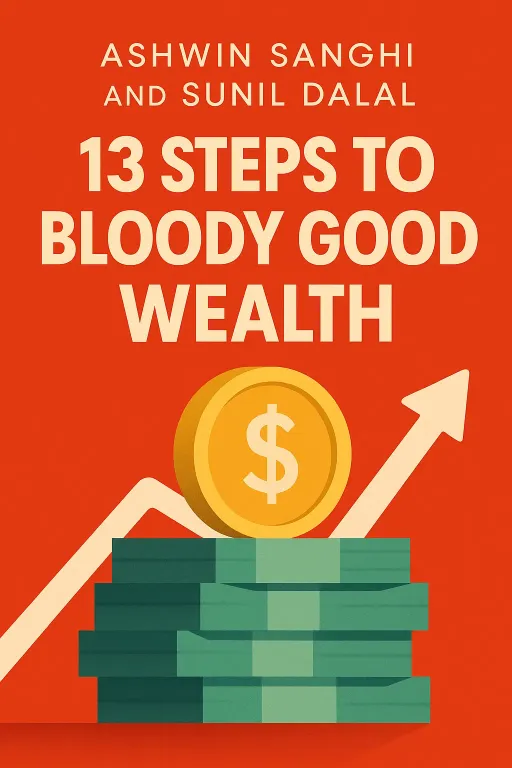
Shakespeare: Jeremiah, as a product manager, your world is one of roadmaps, of turning a spark of an idea into a tangible, successful product. But what if the most important product you'll ever manage isn't an app or a piece of software, but your own financial future? Most of us treat it like a vague wish, but the book we're discussing today, "13 Steps to Bloody Good Wealth," argues we should treat it like an engineering project: with a blueprint, a growth engine, and a solid operating system.
Jeremiah Jacob: That’s a powerful way to frame it, Shakespeare. We spend so much time optimizing products for users, but often neglect to apply that same rigorous, systematic thinking to our own lives. The idea of a personal financial 'sprint' or 'roadmap' is instantly appealing.
Shakespeare: Precisely. And the authors, Ashwin Sanghi and Sunil Dalal, are the perfect guides. They're not Wall Street bankers talking down to us. Dalal, in particular, built his family’s wealth through practical, real-world experience. He’s an outsider who cracked the code. Today we'll dive deep into this from two perspectives. First, we'll explore the 'product definition' phase: how to architect your wealth by moving from vague dreams to a quantifiable roadmap.
Jeremiah Jacob: The architecture, the blueprint. I love it. The foundation of any good build.
Shakespeare: Exactly. Then, we'll discuss the 'growth engine': how to build real momentum through the incredible power of compounding and smart asset acquisition. So, let's start building.
Deep Dive into Core Topic 1: Architecting Your Wealth
SECTION
Shakespeare: So, let's begin at the beginning, with the book's very first step: Define what wealth means to you. It’s a question that seems simple, but the book tells a wonderful story about a lively dinner party where the host poses this very question to his guests. And the answers are not what you'd expect.
Jeremiah Jacob: I'm guessing it wasn't just about having a billion dollars, or the 'three-comma club' as they say in Silicon Valley.
Shakespeare: Not at all. At first, the answers were stilted, predictable. But as the evening wore on, the real definitions emerged. For one person, it was about experiences, seeing the world. For another, it was knowledge. A third said it was simply health and family. One guest, a 36-year-old, defined it as earning money ethically and being content with what he had. No two people had the same answer. It was a mosaic of personal values.
Jeremiah Jacob: That's fascinating. It's exactly like a product kickoff. We call this qualitative user research. You're trying to understand the user's 'job to be done.' What problem are they trying to solve? What feeling are they chasing? The feature they for isn't always what they truly. The dinner party is the user interview, getting to the core emotional driver behind the desire for 'wealth'.
Shakespeare: A perfect analogy. A beautiful vision, but a vision without a plan is but a dream. And this is where the book gets incredibly practical with Step 2: Make a Plan. It argues that to make the dream real, you must quantify it. They offer a simple, almost startlingly direct formula for people over 40 to get a baseline. It’s called the Target Net Worth Formula.
Jeremiah Jacob: Okay, you've got my attention. I'm a fan of any formula that cuts through the noise. What is it?
Shakespeare: It's your age, multiplied by your annual income, divided by ten. So, for a 40-year-old earning, say, $100,000 a year, their target net worth would be around $400,000. The book has a more detailed version including investments, but this is the core. It’s a starting point, a number on a map.
Jeremiah Jacob: That's exactly right. We call this moving from the 'Vision' to the 'Strategy'. The dinner party is the qualitative vision—what do people they want? The formula is the first KPI, a North Star metric. It's not perfect, but it gives you a number to anchor your roadmap. Without that, you're just shipping features into the void, hoping something sticks.
Shakespeare: So for a product manager, a vague goal like 'I want to be rich' is a non-starter?
Jeremiah Jacob: Completely. It's a useless project brief. It's like a stakeholder saying 'I want to build a successful app.' What does that mean? How many daily active users? What's the target engagement rate? What's the churn rate we're aiming for? The Target Net Worth formula, as simple as it is, gives you a concrete target to build your financial 'sprints' and 'epics' around. It turns a wish into a project.
Shakespeare: I love that. Turning a wish into a project. It demystifies the entire process. It makes it manageable.
Jeremiah Jacob: It makes it buildable. You can't build what you can't define.
Deep Dive into Core Topic 2: Building the Growth Engine
SECTION
Shakespeare: A brilliant connection. So once we have our blueprint, our roadmap, we need an engine to power the construction. This brings us to what the book calls the 'eighth wonder of the world'—compounding. The authors tell an ancient story to illustrate its almost unbelievable power. It’s the tale of a king and a poet.
Jeremiah Jacob: I think I've heard a version of this, but I have a feeling your telling will be more... dramatic.
Shakespeare: One can hope. A poet presents a beautiful verse to a generous king. The king, delighted, tells the poet to name his reward. The poet, with a humble bow, asks for a simple gift. He points to a chessboard and says, "Your Majesty, give me but one grain of rice for the first square, two for the second, four for the third, and so on, doubling the amount for each of the 64 squares."
Jeremiah Jacob: Seems like a modest request. The king must have been relieved.
Shakespeare: He was! He laughed at the poet's simplicity and immediately ordered his treasurer to pay the man. But a few hours later, the treasurer and all the kingdom's mathematicians came running back, their faces pale. They told the king that the request was impossible to grant. The amount of rice required for just the first half of the board was significant, but for the 64th square alone, the number was astronomical. The total sum was over 18 quintillion grains of rice. That’s a pile of rice larger than Mount Everest. The king had been bankrupted by mathematics.
Jeremiah Jacob: Wow. Hearing it laid out like that... it's staggering. It’s a perfect illustration of exponential growth. We see this in tech with viral loops or network effects. A product that gets slightly better with each new user doesn't grow linearly; it explodes. That chessboard is the 'why'—it shows the exponential growth model.
Shakespeare: Precisely. That's the power of compounding. But it needs fuel. And that fuel, the book argues, comes from acquiring true assets. This is Step 7: Build assets, not expenses. And to explain this, the book shares an incredible modern-day parable, the story of a barber from India named Ramesh.
Jeremiah Jacob: From a king to a barber. I'm intrigued.
Shakespeare: Ramesh’s father passed away when he was a boy, leaving the family with only a small haircutting salon. For years, Ramesh worked there, cutting hair. He was a good barber, but he realized his income was capped. He could only cut so much hair in a day. His income was directly tied to his time.
Jeremiah Jacob: The classic scalability problem.
Shakespeare: Exactly. So, he saved his money diligently for three years and bought a car—a Maruti Omni. But he didn't use it for his family. An employer of his mother's suggested he lease the car to her company, Intel, to transport employees. Suddenly, he had an asset that was earning him money even when he wasn't driving it. That was the spark. He started a company, Ramesh Tours & Travels. He bought more cars. He leased them out. Today, his company owns a fleet of over 250 luxury cars, including a Rolls-Royce, BMWs, and Mercedes. And the best part? He still goes to his original salon to cut hair for his regular customers. His assets work for him, but he continues to do the work he loves.
Jeremiah Jacob: That is an incredible story. It’s the perfect real-world application of the chessboard principle. The chessboard is the 'why,' and the barber's story is the 'how.' He identified that his initial 'product'—the salon—wasn't scalable. His time was the bottleneck.
Shakespeare: A bottleneck. I like that term. So the car...?
Jeremiah Jacob: The car was his first truly scalable asset. It decoupled his income from his time. He essentially built a platform—Ramesh Tours & Travels—and the cars were the income-generating units. He went from being a service provider to a platform owner. In the tech world, that's the holy grail. It's the difference between being a freelance coder, who gets paid for their hours, and building a SaaS company, a software-as-a-service, that generates recurring revenue from thousands of customers while you sleep. Ramesh built a 'Transportation-as-a-Service' business.
Shakespeare: So the book’s definition, inspired by Robert Kiyosaki, is that an asset is something that puts money your pocket, and a liability is something that takes money. Your primary home, your personal car—those are liabilities. Ramesh's cars were assets.
Jeremiah Jacob: It's a ruthless but clarifying definition. We think about this constantly when evaluating new features or tools—will this generate revenue or just add to our operational cost and tech debt? A true asset has a positive ROI and generates cash flow. A liability is pure cost. Ramesh understood that instinctively. He stopped selling his time and started building a system.
Synthesis & Takeaways
SECTION
Shakespeare: So, the lessons from the book, when viewed through your lens, are remarkably clear. First, architect your life's most important product—your wealth—with a clear definition and a quantifiable plan. Don't just wish for a castle; draw the blueprint.
Jeremiah Jacob: Exactly. Define your 'Wealth MVP'—your Minimum Viable Product for financial freedom. Then build the systems to scale it. It's about moving from active work, like the barber cutting hair, to building assets that work for you, like his fleet of cars.
Shakespeare: A perfect summary. So, for everyone listening, especially those of you who love a good plan, here is the call to action from the book. Take just thirty minutes this week. Forget the numbers. And simply write down your answer to Step 1: What does wealth mean to? What freedom, what experiences, what peace of mind does it represent?
Jeremiah Jacob: That’s the most important part of the product brief. The 'user story'.
Shakespeare: Indeed. Because as any good product manager knows, you can't build a great product until you truly understand the 'why'.