

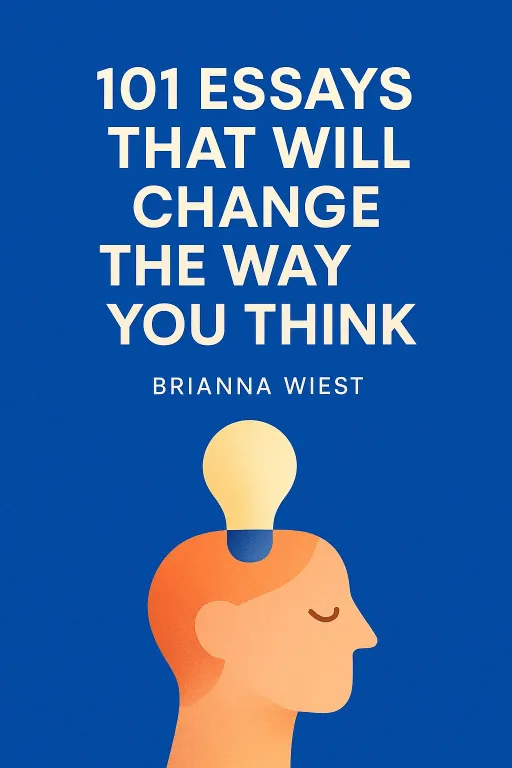
Debugging the Mind: An Operations Leader's Guide to Upgrading Your Mental OS
Golden Hook & Introduction
SECTION
Dr. Warren Reed: Steven, you're an experienced leader in one of the fastest-moving industries on the planet. You've seen smart, talented people—maybe even yourself—who know what they need to do to solve a problem or reach the next level. Yet, they don't. They get stuck. It’s like a bug in our human operating system. Why does this happen?
Steven: That’s a powerful question, Warren. It’s something I see all the time in operations. You can have the most elegant process mapped out, the clearest data, and a team that intellectually agrees on the path forward, but there's this invisible friction that causes stalls. It’s the ghost in the machine, and it’s endlessly fascinating and frustrating.
Dr. Warren Reed: It is. And that's the central question we're exploring today, using Brianna Wiest's fantastic book,. It's less a single narrative and more of a user manual for the mind. It helps us find and fix those very bugs.
Steven: A user manual for the mind. I like that. We could all use one of those.
Dr. Warren Reed: Absolutely. So, we're going to tackle this from two angles. First, we’ll debug that 'Knowing-Doing Gap' and the psychology of why we get stuck. Then, we'll challenge a sacred cow of modern culture and discuss a crucial leadership upgrade: why logic, not just passion, is the real key to a well-lived, effective life.
Steven: Excellent. Let's get into the code.
Deep Dive into Core Topic 1: The Operational Bug: Why We Get Stuck
SECTION
Dr. Warren Reed: Perfect. So, this first bug, this 'Knowing-Doing Gap.' Wiest’s diagnosis is surprisingly simple. The root cause is our brain's wiring. It's not designed to make us happy; it's designed to keep us safe. And it does that by seeking one thing above all else: comfort.
Steven: Comfort. That seems straightforward enough. We all want to be comfortable.
Dr. Warren Reed: We do. But here's the catch Wiest points out. The brain can't actually differentiate between 'good' and 'bad.' It only knows 'comfortable' and 'uncomfortable.' And 'comfortable' often just means 'familiar.' This leads to a state she calls "familiar discomfort." We stay in a situation that makes us unhappy—a dead-end job, an unfulfilling routine—because the discomfort of it is known. The discomfort of change, of the unknown, is scarier.
Steven: So we choose the devil we know.
Dr. Warren Reed: Precisely. Wiest tells this great little story in the book about an aspiring novelist, let's call him John. John knows, logically, that to write his novel, he needs to sit down and write every day. That's the path to his dream. But every evening, he sits at his desk, stares at the blank page, and this wave of discomfort hits him. The fear of not being good enough, the sheer effort of creating something from nothing... it's overwhelming.
Steven: I think every creative person, every innovator, knows that feeling. The blank page is terrifying.
Dr. Warren Reed: It is. And what's more comfortable, more familiar, than that terror? The couch. The TV. Social media. So John gets up, walks away from the desk, and spends the night watching Netflix. He feels a momentary sense of relief, of comfort. But it's layered with the guilt and frustration of not writing. He's chosen familiar discomfort over the discomfort of growth. And this cycle repeats, night after night. The novel never gets written. He's stuck.
Steven: That's fascinating, Warren. It sounds exactly like the concept of 'technical debt' in software development.
Dr. Warren Reed: Tell me more. How does that work?
Steven: Well, a development team knows they have old, clunky code in their system. It's inefficient, it's prone to breaking, and it's making everything slower. The right thing to do, the thing that will make the system healthier in the long run, is to stop everything and 'refactor' that code. To rebuild it properly. But that's a huge, 'uncomfortable' task. It doesn't produce a shiny new feature for the customer. It's just hard, internal work.
Dr. Warren Reed: So what do they do instead?
Steven: They take the 'comfortable' path. They build the next new feature on top of that shaky foundation. It's easier in the short term, it feels like progress. But they're just accumulating debt. And you do that for long enough, choosing that 'familiar discomfort' of working around the bad code, and eventually, the whole system grinds to a halt. It becomes unmanageable. It's the exact same pattern Wiest describes. We're choosing short-term comfort at the cost of long-term system integrity, whether that system is a software platform or our own life.
Dr. Warren Reed: That's a perfect analogy. You're not solving the root problem; you're just patching the symptoms because it's easier. And that leads directly to the second big idea, which is a real system upgrade for our thinking.
Deep Dive into Core Topic 2: The Leadership Upgrade: Logic Over Passion
SECTION
Dr. Warren Reed: We're told constantly, "follow your passion." It's the mantra of our generation. But Wiest makes a compelling, almost heretical argument: logical people actually lead better, more effective lives.
Steven: That's definitely counter-cultural. The narrative is always about the passionate founder, the artist starving for their craft. Logic sounds... cold, uninspired.
Dr. Warren Reed: It can sound that way, but Wiest reframes it. She says, "Passion is a manner of traveling, not a means to determine a destination." Passion is an emotion, a feeling. It's the high. But feelings are fleeting and often irrational. Logic, on the other hand, is what allows you to build a purpose. Purpose is the kindling that keeps the fire burning long after the initial spark of passion has faded.
Steven: So passion is the 'what' and logic is the 'how' and 'why.'
Dr. Warren Reed: Exactly. Passion is reactive. Logic is proactive. Wiest uses the example of a student who is 'passionate' about, say, art history. They love it, it gives them a high. So they follow that passion, take out $150,000 in student loans for a degree with limited job prospects. They make a life-altering decision based on a feeling. The logical person, however, would ask different questions. "Why do I love this? What is the purpose I want to serve? How can I build a sustainable life around this interest?" Maybe the answer is becoming a museum curator, or a graphic designer, or a high school teacher. Logic builds the bridge between the feeling and a functional reality.
Steven: That makes a lot of sense. It separates the emotional response from the strategic plan. You know, it reminds me of how people talk about innovators like Steve Jobs.
Dr. Warren Reed: He's often the poster child for passion, isn't he?
Steven: He is, but I think that misses the point of his genius. Yes, he was passionate, but his passion was a byproduct of a deep, almost obsessive, logical. His core principle was that technology should be intuitive and empowering for the user. Everything, from the curve of the first iMac to the swipe motion on the iPhone, was driven by a ruthless logic about the user's experience. He didn't just follow a feeling; he built an entire ecosystem, a system, based on a logical first principle.
Dr. Warren Reed: So the passion wasn't the starting point.
Steven: I don't think so. I think the purpose was the starting point. The passion was the fuel that he used to execute on that purpose, but logic was the engine and the GPS. It's what allowed him to make hard decisions, to cut projects he didn't believe in, to say 'no' a thousand times. A purely passion-driven leader is volatile. A purpose-driven, logical leader can build something that lasts. They're playing the long game.
Dr. Warren Reed: And that's Wiest's point. Passion is about the person you are now, what feels good in this moment. Logic is about making decisions for the person you hope to become. It's about building a future, not just chasing a high.
Synthesis & Takeaways
SECTION
Dr. Warren Reed: So, if we put these two ideas together, a fascinating picture emerges. To break out of that 'Knowing-Doing Gap,' that state of being stuck, we don't need more willpower or even more passion. We need a better, more logical framework. We need a purpose.
Steven: It's about debugging our own code. The 'comfort-seeking' is a bug that leads to technical debt in our lives. And the 'passion-only' mindset is like running outdated software. It's not optimized for the best long-term results. The upgrade is installing a logic-and-purpose-driven operating system.
Dr. Warren Reed: Perfectly said. It's about conscious design, not reactive feeling. Now, Wiest's book is full of these kinds of mental tools. But there's one in particular I think an analytical mind like yours would appreciate. It's a technique for dealing with the fear of the unknown, which is what keeps us stuck in 'comfort.' She calls it 'Negative Visualization.'
Steven: Sounds ominous.
Dr. Warren Reed: It's actually incredibly empowering. In the tech and business world, you'd probably call it a 'pre-mortem.'
Steven: Ah, okay. I know that. You imagine the project has already failed, and you work backward to figure out why.
Dr. Warren Reed: Exactly. Instead of just hoping for the best, you logically and calmly map out the absolute worst-case scenario. What if you take the new job and you hate it? What if you start the business and it fails? You write it down, step-by-step. Then, you create a plan for how you would handle each of those steps.
Steven: You're taking the 'unknown' and making it 'known.' You're removing the fear by confronting it with a logical plan.
Dr. Warren Reed: You've got it. The fear isn't of the thing itself, but of our inability to handle it. By proving to yourself that you handle the worst-case scenario, you neutralize the fear. It's a powerful way to get unstuck and make a bold, logical leap, rather than staying in a state of familiar discomfort.
Steven: That's a fantastic tool. It's practical, it's strategic, and it turns anxiety into a data point for a better plan. That's an upgrade any leader can use, in their projects and in their own life.
Dr. Warren Reed: And that's the power of changing the way you think. Steven, this has been a great discussion.
Steven: It really has, Warren. A lot to think about.









