

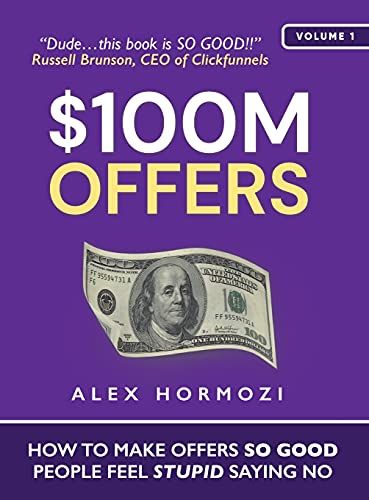
$100M Offers
How To Make Offers So Good People Feel Stupid Saying No
Introduction
Nova: Welcome back to Aibrary, where we distill the world's most impactful books into conversations that actually stick. I'm Nova, and today we're diving into a book that has sold over five million copies and spent more than four years as a number one Amazon bestseller. It's called $100M Offers by Alex Hormozi, and its subtitle is as audacious as it gets: How to Make Offers So Good People Feel Stupid Saying No.
Nova: : That subtitle alone is quite the promise. I mean, making someone feel stupid for saying no? That's a bold claim, even for a business book. Who is Alex Hormozi, and what gives him the credibility to make that kind of statement?
Nova: Great question. Hormozi is not one of those gurus who made their money selling courses about making money. He built real businesses. He started a chain of gyms, then launched Gym Launch to help other gym owners grow. At one point he was nearly broke, using credit card loans to stay afloat. Then he turned everything around, reached three million in profit in one year, and eventually crossed a hundred and twenty million in sales. By the time he published this book, his business portfolio was generating about one point six million per week.
Nova: : Okay, that's legit. So what makes $100M Offers different from every other marketing book out there?
Nova: Most marketing books focus on how to get more leads or how to close more sales. Hormozi flips the script entirely. His core argument is that your offer itself, the thing you're actually selling, is far more important than your sales skills or your lead generation tactics. If your offer is good enough, selling becomes almost effortless. He calls this a Grand Slam Offer, something so unique and valuable it exists in a category of one.
Nova: : A category of one. I like that. So today we're going to unpack how anyone can build one of these offers, from solo freelancers to big companies. Let's get into it.
Why Market Selection Trumps Everything
The Starving Crowd
Nova: Hormozi opens the book with what might be the single most important business lesson he has to offer, and it's illustrated with a story. A marketing professor asks his class: if you were opening a hot dog stand, what is the one advantage you would want? Better hot dogs? A nicer cart? A better location?
Nova: : I would probably say location. That's the classic real estate answer, right?
Nova: That's logical, but the professor says the correct answer is a starving crowd. If you have a starving crowd, your hot dogs can be mediocre, your cart can be falling apart, and you still sell out. Hormozi translates this into a hierarchy for business success, and it goes: Market is greater than Offer Strength, which is greater than Persuasion Skills.
Nova: : So the market comes first by a long shot. What exactly makes a market a starving crowd?
Nova: Hormozi lays out four specific indicators. Number one: massive pain. Your customers shouldn't just want what you sell, they should desperately need it. The depth of the pain directly correlates with the price you can charge. Number two: purchasing power. As Hormozi bluntly puts it, solve rich people's problems, they pay better.
Nova: : That's refreshingly direct. What about the other two?
Nova: Number three: easy to target. Your audience should be findable through associations, mailing lists, social media groups, or channels they all watch. And number four: growing. You want a tailwind, not a headwind. He gives this fascinating example: if you're a relationship coach, you're better off focusing on seniors seeking companionship later in life rather than college students. Why? More people are turning sixty-five each year than turning twenty in the United States. Seniors have more pain around loneliness, more purchasing power, and they're easier to find through targeted communities.
Nova: : That's incredibly counterintuitive but makes total sense once you hear it. Are there markets that always work?
Nova: Hormozi identifies three evergreen markets that have existed throughout human history: health, wealth, and relationships. Everyone wants to be healthier, wealthier, and have better connections with others. These markets never go away. But here's the key: you don't just pick one and go broad. You niche down dramatically within that market.
Nova: : So instead of being a general fitness coach, you become something much more specific?
Nova: Exactly. Hormozi gives an example that really drives this home. A generic weight loss program might sell for nineteen dollars. But a fitness program designed and marketed exclusively to shift nurses, with the exact same core principles of eat less and move more, could sell for nearly two thousand dollars. Same product, same principles, but because it's hyper-niched to a specific group with specific pain points, the perceived value skyrockets.
Nova: : That is a wild pricing differential. So the narrower you go, the more you can charge?
Nova: For anyone doing under ten million a year in revenue, Hormozi says niching down will almost always make you more money. He wants you to be the person who solves this type of problem for this specific type of person in this unique counterintuitive way that reverses their deepest fear. And here's a phrase he uses with his coaching clients: don't make me niche slap you. Too many entrepreneurs try one offer in one market, don't become millionaires overnight, and conclude the market is bad. Most of the time, they just haven't found the right Grand Slam Offer yet.
The Mathematical Blueprint for an Irresistible Offer
The Value Equation
Nova: This next part is the heart of the book and honestly, what made Alex Hormozi famous on the internet. It's called the Value Equation, and it's deceptively simple. Ready?
Nova: : Hit me.
Nova: Value equals Dream Outcome multiplied by Perceived Likelihood of Achievement, divided by Time Delay multiplied by Effort and Sacrifice. So you've got two things you want to increase on top, and two things you want to decrease on the bottom.
Nova: : Okay, let's break that down piece by piece. What's the dream outcome?
Nova: The dream outcome is what your customer actually wants, not what you think you're selling. Hormozi learned this lesson running his gyms. He realized he wasn't selling gym memberships. He wasn't selling the plane ride. He was selling the vacation. People don't want to go to the gym, they want to lose twenty pounds and feel attractive. Airlines don't sell plane tickets, they sell arriving at a destination. And here's a deeper layer: the dream outcome that most increases a person's status will be the one they value most.
Nova: : So you're not selling the widget, you're selling the transformation and the status that comes with it.
Nova: Exactly. And the second variable on top is perceived likelihood of achievement. Even if someone desperately wants your dream outcome, if they don't believe they can achieve it with your help, they won't buy. This is where testimonials, case studies, social proof, and your guarantee come in. You have to communicate that success isn't just possible, it's probable.
Nova: : That makes sense. Now the bottom of the equation, time delay and effort. Why are those so critical?
Nova: Because they're the hidden costs that make people hesitate. The faster someone gets results, the more valuable the offer feels. Hormozi talks about creating big emotional wins early, ideally within the first seven days after purchase. When he was running his gym business, they would get new weight loss clients to meet someone else immediately so they felt social connection, and they'd put them on a more aggressive initial diet so they'd see fast results.
Nova: : So you manufacture a quick win to build momentum.
Nova: Right. And the effort and sacrifice variable is arguably the most powerful lever. This is why done-for-you services cost dramatically more than do-it-yourself solutions. Hormozi makes this brilliant comparison: the supplement industry is a hundred and twenty-three billion dollar industry, while the health club industry is only sixty-two billion. They both promise the same outcomes, being healthy and looking good, but supplements require dramatically less effort. Pop a pill versus spend hours at the gym every week.
Nova: : That is a staggering difference. Same perceived goal, but one path feels effortless. And I guess that's why Xanax is a multibillion-dollar product while there are almost no multibillion-dollar meditation businesses, even though they both address anxiety.
Nova: That's Hormozi's exact example. You just stole my line. But the real insight here is that most beginner marketers focus entirely on the top of the equation, making bigger and bigger claims about dream outcomes. It's easy and it's lazy. The best companies in the world, like Amazon, focus relentlessly on the bottom: making things immediate, seamless, and effortless.
Nova: : So if you can make the time delay zero and the effort zero, you theoretically have infinite value.
Nova: That's the ultimate goal. Imagine clicking purchase on a weight loss product and instantly seeing a six-pack. Or signing a contract with a marketing firm and your phone starts ringing with new clients the moment you put the pen down. That's infinite perceived value. Obviously, you can rarely get to actual zero. But every reduction on the bottom of that equation dramatically increases what you can charge.
The Counterintuitive Pricing Lesson
Charging Premium Without Apology
Nova: Here's where things get really interesting. Most entrepreneurs think the path to more sales is lowering prices. Hormozi says the opposite: charge more and deliver so much value that people feel like they got a bargain even at a premium price.
Nova: : That seems like a tough sell, literally. How do you convince someone your high price is actually a bargain?
Nova: Hormozi has a concept called the expensive bargain. The goal is to charge so much more than the competition that a potential customer thinks to themselves: this is so much more expensive, there must be something entirely different going on here. You're not competing on price at all. You're signaling a different category of value.
Nova: : But doesn't that only work if you can actually deliver that value?
Nova: Absolutely, and that's the foundation. Hormozi says you should never charge more than your product is worth, but you should charge far more than it costs to fulfill. The gap between price and value is where the magic happens. When he was running Gym Launch, clients were paying him a fraction of what they made using his system. They were paying, say, forty-two thousand dollars per year, but adding hundreds of thousands in new revenue. The value-price gap was enormous.
Nova: : So the client still feels like they got a steal, even though they paid a premium.
Nova: Exactly. And there's a psychological benefit to charging more that most people miss. Hormozi says those who pay the most, pay the most attention. When someone invests heavily in your solution, they're more committed to making it work. A nineteen-dollar program gets abandoned in a week. A two-thousand-dollar program gets taken seriously.
Nova: : That's true. I've bought cheap online courses I never even opened.
Nova: Everyone has. But Hormozi also acknowledges this requires deep conviction. He says you must believe so deeply in your solution that when you look at yourself in the mirror at night, alone, your conviction remains unshakable. You have to outwork your self-doubt. Experience is what gives you the conviction to ask for someone's entire year's salary as payment.
Nova: : There's a moral dimension here too, right? You can't just slap a high price on garbage and call it premium.
Nova: Completely. Hormozi is very clear: competing on price is a race to the bottom. Competing on value is a race to the top. The only way to win sustainably is to genuinely create more value than anyone else in your space. Then you charge accordingly, and the virtuous cycle continues. You charge the most, deliver the most, and clients become your best marketers because they can't stop talking about the return they got.
The Five-Step Creation Process
Building Your Grand Slam Offer
Nova: So now we get to the practical part. How do you actually build one of these offers? Hormozi lays out a five-step process. Step one: define the dream outcome with extreme clarity.
Nova: : Give me an example of what that clarity looks like.
Nova: Instead of help you get fit, it's lose twenty pounds in six weeks so you can walk into your high school reunion and have everyone's jaw drop. Notice how that second version includes a specific metric, a time frame, and a status component with the reunion reaction. That's what Hormozi means by selling the vacation, not the plane ride.
Nova: : Okay, step two?
Nova: List every single problem your customer will face on the way to that outcome, in obsessive detail. And I mean obsessive. If you're selling weight loss, you don't just list exercise and eat better. You list: buying healthy food is confusing, cooking healthy food takes too long, eating healthy is expensive, my family won't eat what I eat, what happens when I travel, I don't know what to do at restaurants, I'll lose motivation after two weeks, and on and on.
Nova: : So you basically map out every reason someone might fail or quit.
Nova: Yes, and you organize those problems using the four value drivers. For each problem, ask: does this relate to their dream outcome not being worth it? Does it relate to the likelihood of it not working for them specifically? Does it make the effort seem too high? Does it make the time commitment feel overwhelming?
Nova: : Then step three must be turning each problem into a solution.
Nova: Exactly. The simplest way is to flip each problem into a how to statement. I don't know what to buy at the grocery store becomes how to buy healthy food quickly and cheaply, even for busy moms. I can't cook becomes how to prepare healthy meals in under fifteen minutes that your whole family will actually enjoy. Every single problem gets a corresponding solution.
Nova: : But you can't possibly deliver all of those solutions individually, can you?
Nova: That's step four: defining your delivery vehicles. For each solution, you figure out how you'll actually deliver it. Will it be one-on-one coaching, small groups, one-to-many through video? Will it be done for them, done with them, or a do-it-yourself framework? Hormozi gives this great exercise: ask yourself, if a client paid me ten times my price, what would I provide? And then flip it: if they paid one-tenth my price, how could I still make them successful? Stretching in both directions reveals creative delivery options.
Nova: : And step five?
Nova: Trim and stack. You look at every solution through the lens of cost to you versus value to the customer. You cut the high-cost, low-value items first. Then cut the low-cost, low-value filler. You keep the low-cost, high-value gems, and you keep the high-cost, high-value differentiators that justify your premium price. Then you bundle everything together into a cohesive offer with compelling names for each component.
Nova: : So the final offer ends up looking like a stacked package of named solutions, all addressing specific pain points.
Nova: Exactly. And Hormozi emphasizes that when you present a single price for this comprehensive bundle, it's far more valuable than if you sold each component separately. The whole becomes greater than the sum of its parts because the prospect sees that every single one of their objections has been anticipated and solved.
Scarcity, Urgency, Bonuses, and Guarantees
The Psychology Multipliers
Nova: Once you have your core offer built, Hormozi introduces what I think of as psychological multipliers. These are the tools that make an already great offer feel irresistible. The first is scarcity.
Nova: : Scarcity can feel manipulative, though. You know, the classic only three spots left when there are really unlimited spots.
Nova: Hormozi distinguishes between fake scarcity and real scarcity. Real scarcity means you are genuinely the only person who can solve a specific problem in a specific way. For example, there are many people who can help you make ten thousand dollars a month. But far fewer who can say: I will help you add five million in profit without adding any extra product lines to your business. That's true scarcity based on unique expertise.
Nova: : That feels entirely different from fake countdown timers.
Nova: It is. And he offers ethical ways to create scarcity: a total business cap where you only accept a certain number of clients at a time, a growth rate cap where you only onboard a set number per week, or a cohort cap per class or group. When demand increases, you cut supply. It's better to sell out consistently and create a waiting list than to always have availability.
Nova: : What about urgency?
Nova: Urgency is about time, while scarcity is about units. Hormozi identifies four types: a deadline for the offer itself, a deadline for a specific bonus that comes with the offer, a deadline for the pricing tier, and a deadline based on a cohort starting date. The key is that the urgency must be real. If you say the price goes up on Friday, the price has to actually go up on Friday.
Nova: : So bonuses are a big part of this too.
Nova: Massive. Hormozi says a single offer is less valuable than the same offer broken into its component parts and stacked as bonuses. Imagine you're selling a coaching program. The core program is valuable. But then you add: bonus one, a private community of peers. Bonus two, monthly expert masterclasses. Bonus three, done-for-you templates. Bonus four, direct access to me via weekly office hours. Each bonus gets named and presented with its own standalone value. When you stack them all together, the total perceived value can easily be five or ten times the price.
Nova: : And then the guarantee ties it all together by removing the last bit of risk.
Nova: Exactly. Hormozi talks about two foundational guarantee types: unconditional guarantees, where you simply offer a full refund no questions asked, and conditional guarantees, where you promise a specific outcome or you'll do something to make it right. Then you can stack guarantees. His classic example from Gym Launch: you will get twenty new clients in your first thirty days, or we will give you your money back plus cover your advertising spend. That's a conditional guarantee with teeth. It completely reverses the risk.
Nova: : That is seriously compelling. If someone promises to not just refund me but also cover my costs, what do I have to lose?
Nova: That's exactly the psychological effect. You go from I might lose my money to I literally cannot lose. And finally, Hormozi emphasizes naming. He created the MAGIC formula for naming your offers, where each letter stands for a principle that makes names more compelling. A great name signals to your ideal customer: this is specifically for people like me. It's not about clever wordplay. It's about your target customer instantly recognizing that what you have is built for them.
Nova: : So the full Grand Slam Offer is a hyper-niched, value-stacked, premium-priced package with stacked bonuses, a risk-reversing guarantee, and a name that makes the right people lean in.
Nova: That's it. And when you put all those pieces together, you get what Hormozi calls a category of one. Your offer becomes genuinely incomparable.
Conclusion
Nova: Let's pull this all together. $100M Offers by Alex Hormozi rests on a few foundational principles that anyone can apply, whether you're running a billion-dollar company or just starting out as a freelancer.
Nova: : Walk me through the big ones.
Nova: First, market matters more than anything. Find a starving crowd with massive pain, purchasing power, easy accessibility, and growth potential. Second, use the Value Equation as your North Star: increase the dream outcome and perceived likelihood of achievement, while decreasing time delay and effort. Third, niche down relentlessly. The narrower your focus, the more you can charge. Fourth, build your offer by solving every single problem your prospect faces, then trim and stack into a cohesive bundle. And fifth, enhance it with real scarcity, urgency, bonuses, and guarantees that remove all risk.
Nova: : What I find most powerful about this book is that it reorients you away from hustle and persuasion and toward genuine value creation. It's not about being a better salesperson. It's about building something so good that selling becomes a natural consequence.
Nova: That's exactly right. Hormozi even says that if you don't believe in what you're selling, you'll self-sabotage. The conviction has to be real. You have to genuinely believe that the value you're providing far exceeds the price you're charging. When that's true, asking for the sale isn't pushy. It's almost a disservice not to.
Nova: : And I think the biggest mindset shift for me is the pricing philosophy. Most of us are terrified of charging what we're worth. Hormozi reframes it: you're not being greedy by charging premium prices. You're being fair to yourself while creating an obligation to deliver outsized value in return.
Nova: The virtuous cycle. Higher prices fund better service, which generates better results, which attracts more customers, which allows you to charge even more. It's the opposite of the race to the bottom most businesses are stuck in.
Nova: : If listeners take away just one thing from this episode, what should it be?
Nova: I'd say this: the single highest-leverage activity in your business is improving your offer. Not getting more leads. Not running more ads. Not becoming a better closer. If you make your offer so valuable that people feel stupid saying no, everything else becomes easier. So open up a notebook, write down your Value Equation, list every problem your customers face, and start solving them one by one. That's how you build something worth a hundred million dollars.
Nova: : This is Aibrary. Congratulations on your growth!