The ROI of Calm: Finding Your 10% Edge in a High-Stakes World
Golden Hook & Introduction
SECTION
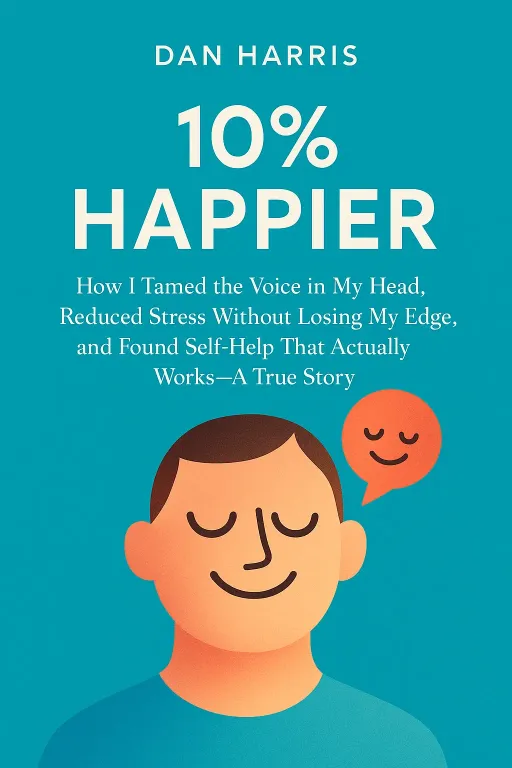
Nova: Imagine you're at the peak of your career. You're live on national television, speaking to millions... and suddenly, your brain short-circuits. Your heart hammers, your lungs seize, and the words on the teleprompter become a foreign language. This isn't a nightmare; it's what happened to news anchor Dan Harris, and it was the catalyst for a journey that's incredibly relevant for any of us in high-pressure jobs. He was a deep skeptic who stumbled upon an ancient practice and found it gave him a 10% edge.
Nova: Today we'll dive deep into his book, "10% Happier," from three perspectives. First, we'll explore the high-achiever's breaking point and what happens when ambition backfires. Then, we'll discuss the pragmatist's toolkit, looking at meditation as a simple exercise with a surprising ROI. And finally, we'll focus on the art of being a 'corporate samurai'—how to balance inner calm with the demands of a competitive career.
Nova: And I'm so thrilled to have Rosel here to unpack this with me. With her background as a Product Manager in the fast-paced world of finance, she lives at the intersection of high-stakes, data-driven decisions and, well, the very human pressures we're talking about. Welcome, Rosel!
Rosel: Thanks for having me, Nova. That intro really hits home. That fear of your own internal system failing you under pressure is something I think we all can relate to, even if it's not on live TV.
Deep Dive into Core Topic 1: The High-Achiever's Breaking Point
SECTION
Nova: Let's start right there, with that moment. Dan Harris calls it 'air hunger.' It's June 2004, and he's filling in as the news reader on. He's in the iconic glass-encased studio in Times Square, he's ambitious, he's a war correspondent, but he's also been secretly self-medicating his underlying depression and stress with drugs. He starts reading the headlines, and on the second story, it hits him. He describes it as a sudden, overwhelming wave of panic. His heart is racing, his mouth is bone dry, and he feels like he's being stabbed in the brain with pure fear.
Rosel: Wow.
Nova: He starts stumbling over his words. The teleprompter becomes gibberish. At one point, instead of talking about a medical story, he makes a bizarre reference to 'cancer production.' He knows millions are watching this meltdown. He's so panicked that he just abruptly ends the entire news segment several minutes early, saying something like, 'Uh, that does it for news,' and throws it back to the main anchors, leaving them completely bewildered.
Rosel: It's such a powerful story because it's a total system failure. In product management, we talk about stress-testing our applications and infrastructure to find the breaking point. His personal operating system just crashed. And when you read it, it doesn't feel like a moral failing; it feels like a resource-management problem. His ambition was a feature, but it consumed all the processing power, leaving no room for error handling or recovery.
Nova: That's the perfect way to put it! A resource-management problem. And his first instinct, as you'd expect, was to find an external 'fix'—he went to a psychiatrist, thinking a pill could solve it. But that only started him on a much longer journey into the world of self-help, a world he had always openly mocked.
Rosel: Which makes complete sense for an analytical person. You don't want vague promises; you want a solution with clear inputs and outputs. But as he describes in the book, he first had to wade through what he calls 'Happiness, Inc.'—all these gurus making wild, unprovable claims. For a skeptic, that's like walking into a minefield. You're immediately looking for the catch.
Nova: He interviews figures from the movie who claim you can think your way to a new car, and he sees the dark side of that—the implication that victims of tragedy somehow attracted it. He's just not buying it. He wants something that works, something that's grounded.
Rosel: He's looking for the evidence, the data. He's trying to separate the signal from the noise, which is a daily task in my job. There are a million opinions, but what does the data actually say? For him, the data was the science, and his own direct experience.
Deep Dive into Core Topic 2: The Pragmatist's Toolkit
SECTION
Nova: And that skepticism is so important, because it's what led him to the core idea of the book. After being frustrated by all the over-the-top gurus, he landed on a much more modest, almost mathematical proposal. He had this epiphany when trying to explain his new meditation habit to a colleague. He just blurted it out: "It makes me 10% happier."
Rosel: I love that framing. It's so much more credible than promising enlightenment. '10% Happier' is like an MVP—a Minimum Viable Product for well-being. It's not a total life transformation on day one; it's an iterative improvement. In finance, a 10% return is huge. In life, a 10% reduction in reactivity or a 10% increase in focus? That's a massive ROI.
Nova: Exactly! And it compounds. He says the 10%, like a good investment, compounds annually. He backs this up by digging into the neuroscience. He finds studies from Harvard and Yale showing that meditation can literally rewire your brain—it can shrink the amygdala, which is your brain's panic button, and strengthen parts associated with focus and self-awareness. It's not magic; it's neuroplasticity.
Rosel: See, that's the evidence-based approach that would convince someone like me. It's not just a feeling; it's a physiological change.
Nova: And then he gets to this even more radical idea, which he learns from interviewing the Dalai Lama. He asks him, essentially, isn't being a little selfish necessary to succeed? And the Dalai Lama laughs and says yes, but we should be "wise selfish, rather than foolish selfish." His argument is that practicing compassion is ultimately for benefit.
Rosel: That's brilliant. It reframes the entire concept. In business, everything is driven by incentives. This provides a clear, logical incentive for pro-social behavior. It's not just a mandate to 'be nice.' It's 'be nice because the science shows it lowers your own stress hormones like cortisol and makes you a clearer, better decision-maker.' That's an ROI you can actually get behind.
Nova: And the 'how' was the biggest surprise for him. He found that all these benefits came from a ridiculously simple exercise: just sitting for a few minutes a day, feeling the sensation of his breath, getting lost in thought, and then gently starting over. Again and again. He calls it a 'bicep curl for the brain.'
Rosel: That's the key. It demystifies it. It's not about achieving some mystical state of 'no-thought.' The practice the act of returning. It's a rep. It's a process you can follow and expect a predictable, if small, outcome. That really appeals to the product manager in me.
Deep Dive into Core Topic 3: The Corporate Samurai
SECTION
Nova: But this brings us to the million-dollar question, and the book tackles it head-on with such honesty. You start doing this practice, you feel a bit calmer... and then your boss thinks you've lost your fire. How do you actually apply this in the real, competitive world without getting steamrolled?
Rosel: The fear of 'going soft.' It's a real concern.
Nova: It is! And it happened to him. A new, hard-charging boss named Ben Sherwood took over ABC News. Dan, trying to be all 'Zen' and 'let go,' became passive. He stopped hustling for big assignments. And he got sidelined. He wasn't sent to cover the massive protests in Egypt or the earthquake in Japan. He was in a professional crisis.
Rosel: So his new practice was actually hurting his career.
Nova: Initially, yes. Until he finally has a meeting with his boss, and Ben tells him bluntly, "Stop being so Zen." He needed to find his hustle again. That same night, Dan has dinner with his psychiatrist and Buddhist mentor, Mark Epstein, and tells him the story. And Epstein gives him this game-changing piece of advice: "Hide the Zen."
Rosel: 'Hide the Zen.' What does that mean exactly?
Nova: It means you don't have to broadcast your inner state. In a competitive environment, being too placid can be perceived as weakness or disengagement. The goal is to maintain your internal equanimity while projecting the energy and assertiveness the situation requires. It's about being effective, not just being calm.
Rosel: That's a perception management problem. It's about code-switching. The internal state of calm is a strategic asset, but if it's as disengagement, it becomes a liability. As a PM, you're constantly managing perceptions with stakeholders, so that makes perfect sense.
Nova: But the final piece of the puzzle was even more profound. Epstein helped him understand the concept of 'nonattachment to results.' You can—and should—strive, hustle, and fight for what you believe in. But you have to decouple your effort from your emotional attachment to the outcome.
Rosel: This is the most crucial part for anyone in a leadership or creative role. That's the real unlock. As a Product Manager, you pour your heart and soul into a product launch. If it fails, or if the market doesn't respond, it can feel like a deep, personal failure. This framework reframes it: your job is to execute the process with excellence. The outcome is subject to a thousand variables you don't control—market shifts, competitor moves, stakeholder whims.
Nova: It's the difference between caring and clinging.
Rosel: Exactly! You care deeply about the work, but you don't cling to the specific outcome. It's what allows you to learn from failure and pivot, instead of being crushed by it. That's the very essence of agility, not just in software development, but in a career. It builds incredible resilience.
Synthesis & Takeaways
SECTION
Nova: It's such a powerful arc. So we've really gone from a crisis born of unchecked ambition, to a practical, skeptic-friendly toolkit for a 10% gain, and finally to this sophisticated strategy for being a resilient 'corporate samurai' in the modern workplace.
Rosel: It's a complete mental model. And for me, it all comes back to a simple diagnostic question that Harris learned from one of his meditation teachers, Joseph Goldstein, during a silent retreat.
Nova: I remember that part. It's so practical.
Rosel: It is. When you find yourself spinning out, worrying about a project, a big presentation, or a difficult conversation, you just have to ask yourself one thing: 'Is this useful?'
Nova: Is this useful?
Rosel: Right. If it's constructive planning, if you're problem-solving, it's useful. Keep going. But if it's the seventeenth time you're replaying a negative scenario in your head, or imagining a future catastrophe you can't control, it's not useful. And that's the moment. That's the moment you have the choice to gently let it go and come back to the breath, even for a second. That, right there, is the 10% edge.
Nova: A powerful and practical place to end. Rosel, thank you so much for bringing your sharp insights to this.
Rosel: My pleasure, Nova. It was a great conversation.