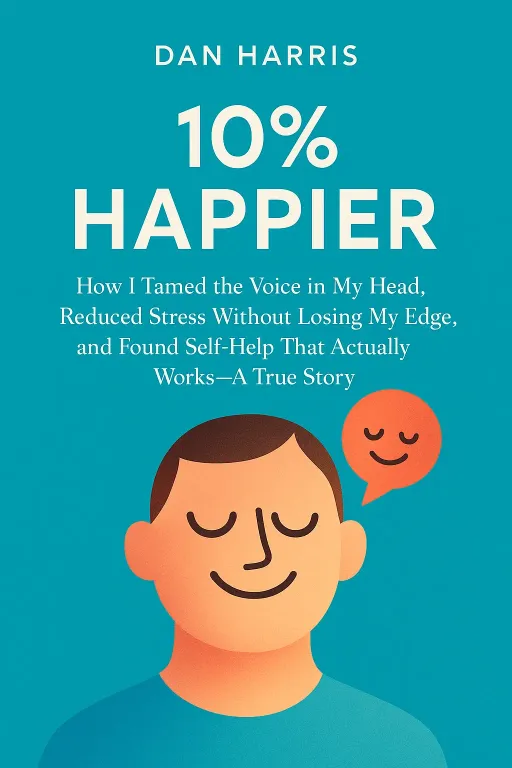
The 10% Edge: A Skeptic's Guide to Balancing Ambition and Inner Peace
Golden Hook & Introduction
SECTION
Nova: What if the very voice in your head that pushes you to succeed, to be a great leader, to be more creative, is also the one secretly engineering your downfall? Imagine this: you're a news anchor on. Millions are watching. And in the middle of a sentence, your lungs seize up, your mind goes blank, and you have a full-blown panic attack, live on air. That's not a hypothetical; it's exactly what happened to Dan Harris, and it became the catalyst for a journey that every ambitious person needs to hear about.
Yuan : It’s a nightmare scenario for any professional, the ultimate loss of control in a high-stakes moment.
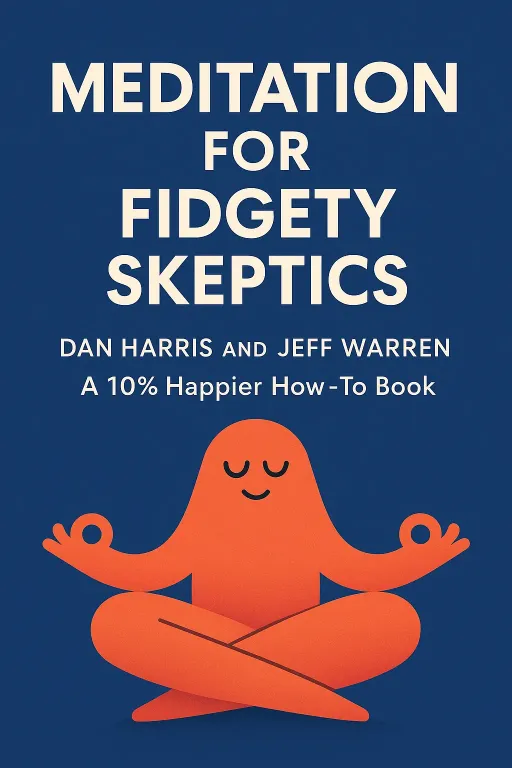
Nova: Exactly. And that's why we're so excited to have you here today, Yuan. As someone who thinks deeply about leadership and creativity, this story is more than just a dramatic anecdote. It's a case study. Today, we're diving into Dan Harris's book,, to explore this from three perspectives. First, we'll explore that dark side of ambition and what happens when it backfires spectacularly.
Yuan : I’m ready. It’s a critical topic.
Nova: Then, we'll discuss how to use mindfulness as a secret weapon for performance, not passivity. And finally, we'll uncover the surprisingly self-interested case for making compassion a core part of your leadership toolkit. This is a journey for the skeptics, the high-achievers, and anyone trying to find that delicate balance between work and life.
Deep Dive into Core Topic 1: The Ambition Paradox
SECTION
Nova: So, Yuan, let's start with that moment. Because it's so visceral. This wasn't just a bad day at the office. Dan Harris is at the peak of his career, a correspondent for ABC News. But internally, he's a wreck. He'd been a war correspondent in Afghanistan and Iraq, and to cope with a subsequent depression, he started using cocaine and ecstasy. He was driven by this internal motto he got from his father: "The price of security is insecurity."
Yuan : That motto alone sounds exhausting. It’s like telling yourself you have to be in a constant state of anxiety to be safe.
Nova: Precisely. And it all comes to a head on June 7, 2004. He's filling in on, reading the news updates. He gets through the first item, but on the second, his whole world collapses. He describes his heart hammering, his mouth going dry, his lungs constricting. He can't get air. He starts stumbling over his words on the teleprompter, saying things that make no sense. He knows millions are watching this train wreck. In a moment of sheer panic, he just cuts it short, minutes early, and throws it back to the main anchors.
Yuan : Wow. That's terrifying. It sounds less like a failure of skill and more like a total system overload. It makes me think about leadership pressure. There's this expectation to be invulnerable, but that story shows the immense internal cost. That inner voice he talks about—the one driving him with that 'insecurity' motto—it's the same one that so many of us feel is necessary for motivation, right? We think that inner critic is what keeps us sharp.
Nova: That’s the heart of the paradox! We think it’s our ally. But for him, it was a tyrant. And what’s so fascinating is that even after this wake-up call, after he gets help and starts exploring meditation, the lesson doesn't fully land. Years later, he finally gets his dream job as a weekend co-anchor on GMA. He thinks, "This is it. I've made it. Now I'll be happy."
Yuan : And I'm guessing that's not what happened.
Nova: Not at all. He describes this one morning where he has to do a segment on "Irwin the paralyzed kangaroo," who has a special custom suit. And as he's making some jovial on-air comment, his inner voice, his ego, is just hissing at him, "You are a dope. This is what you've become." It's this perfect illustration that achieving the goal, getting the promotion, doesn't silence the inner critic.
Yuan : That's a key insight for self-confidence. We think, 'if I just get that promotion, or finish that project, or hit that target, I'll finally feel secure.' But Harris's story suggests the goalposts just move. The validation is temporary, but the inner voice is permanent. The real work has to be internal. So, if hustling harder and achieving more isn't the answer, what is?
Deep Dive into Core Topic 2: The 10% Edge
SECTION
Nova: That is the perfect question, and it leads right to the most counterintuitive part of his journey. He's been meditating for a while, he's feeling a bit calmer, but his career starts to drift. He thinks being mindful means being passive. And then he gets this incredibly blunt feedback from his new boss, the president of ABC News, Ben Sherwood. Ben pulls him into his office and says, essentially, "You've lost your hunger. Stop being so Zen."
Yuan : "Stop being so Zen." That's incredible. So his attempt at finding balance was actually hurting his performance?
Nova: In a way, yes! He had confused "letting go" with "going soft." So he goes to his psychiatrist and meditation teacher, Mark Epstein, and tells him this story. And Epstein gives him this brilliant piece of advice: "Hide the Zen." He says in a competitive environment like a newsroom, being too serene can be read as weakness. You need to be a 'corporate samurai'—maintain your inner calm, but project competence and drive on the outside.
Yuan : That's a much more nuanced take on work-life balance. It's not about choosing one or the other; it's about integrating them. It reminds me of the idea of 'code-switching'—adapting your communication style to your environment without losing your authentic self. But the core question remains, how do you strive for success without getting consumed by the stress of it?
Nova: And the answer he lands on is "nonattachment to results." This was a game-changer for him. It doesn't mean you don't care. It means you work your tail off, you prepare, you do everything in your power to succeed. But you consciously decouple your self-worth and your emotional stability from the final outcome, because the outcome is often out of your control. He quotes President Obama's campaign manager, David Axelrod, who said, "All we can do is everything we can do."
Yuan : I love that. 'Nonattachment to results.' In a creative field, or even in tech development, that's huge. The fear of failure can absolutely paralyze creativity. If you're worried about whether your idea will be a hit, you'll never propose the truly innovative, risky one. But if you detach from the outcome, you're free to experiment, to fail, to learn. But... how do you practice that? It sounds great in theory, but in a performance review, results are all that matter.
Nova: Right, it's not magic. That's where the '10% Happier' idea comes in. Harris frames meditation not as some grand spiritual quest, but as a simple mental exercise. Just five or ten minutes a day. He says it's like a bicep curl for your brain. Every time your mind wanders and you gently bring it back to your breath, you're building a muscle. It doesn't stop the stressful thoughts from coming, but it creates a tiny bit of space between the stimulus—like a critical email from your boss—and your reaction.
Yuan : Ah, so it's about response, not reaction.
Nova: Exactly! That space is where you get to choose to respond thoughtfully instead of reacting emotionally. That's the 10% edge. It’s not a huge, life-altering enlightenment. It's a small, manageable, but significant improvement.
Yuan : So it's a practical skill, not a personality transplant. That makes it so much more accessible for analytical people. It's a system you can implement, not a belief you have to adopt. I can see how that would directly impact motivation—you're less afraid of setbacks, so you're more willing to keep going.
Deep Dive into Core Topic 3: Wise Selfishness
SECTION
Nova: Exactly, it's a system. And the final piece of that system is maybe the most surprising, especially for a competitive environment. It's compassion.
Yuan : Okay, now that's where a lot of skeptics, especially in business, might check out. Compassion can sound... soft.
Nova: And that's exactly what Dan Harris thought! He was deeply skeptical. But then he gets the chance to interview the Dalai Lama. He goes in ready for a fight, planning to ask tough questions. But the Dalai Lama completely disarms him. First, Harris asks if his mind is always calm, and the Dalai Lama just laughs and admits, "Oh no, I lose my temper sometimes!"
Yuan : That's refreshingly honest. It humanizes him immediately.
Nova: Totally. And then Harris asks him about this idea that self-centeredness is the root of suffering. He asks, "But don't we need to be self-centered to succeed?" And the Dalai Lama gives this incredible answer. He says, "Yes. We are selfish. But be wise selfish, rather than foolish selfish."
Yuan : 'Wise selfish.' What does that mean?
Nova: Foolish selfish is chasing your own gratification at the expense of others, which ultimately makes you miserable because you're always anxious and comparing. Wise selfish is realizing that actively caring for the well-being of others is one of the best things you can do for.
Yuan : That reframes compassion entirely. It's not just a 'soft skill'; it's a strategic choice for your own mental health. The book mentions the science behind this, right? I remember reading that it can lower stress hormones.
Nova: It does! Studies show that practicing compassion can reduce cortisol, the stress hormone. It also activates the same pleasure centers in the brain as eating chocolate. For Harris, this was the key. He could approach compassion from a place of self-interest. And he found it transformed his relationships. He talks about how this practice made him a better husband and a much nicer colleague. It's the foundation for better love relationships and, frankly, better leadership.
Yuan : It makes perfect sense. A leader who operates from a place of compassion builds trust and psychological safety. That environment is where creativity and motivation thrive. And in a personal relationship, it's the difference between reacting to a conflict and responding with a genuine desire to understand your partner's perspective. It's all connected. The inner work leads to better external results.
Synthesis & Takeaways
SECTION
Nova: It really is. So we've gone on this whole journey with Dan Harris. From a crisis of ambition that led to an on-air meltdown, to finding a practical toolkit for performance with the '10% edge' of mindfulness, and finally landing on this powerful, pragmatic idea of 'wise selfishness.' It's a complete system for thriving in a demanding world without burning out.
Yuan : I think the biggest takeaway for me is that this isn't about becoming someone else. It's not about chanting or giving up your ambition. It's about becoming more aware of the 'you' that's already there—that voice in your head, your reactions, your patterns. For anyone listening who's analytical or skeptical, the challenge isn't to believe anything. It's just to run an experiment.
Nova: I love that. An experiment.
Yuan : Yes. Try five minutes of just sitting and noticing your thoughts. Don't judge them, don't try to fix them. Just see what's there. What does that voice in your head actually say all day? For a curious, analytical mind, that's a fascinating data set to collect. And that simple act of observation, as Harris shows, might just be the first step to being 10% happier.
Nova: A perfect place to end. Yuan, thank you so much for these incredible insights.
Yuan : This was fantastic. Thank you, Nova.