

Stop Chasing Trends, Start Building Legacies: The Guide to Enduring Creativity
8 minGolden Hook & Introduction
SECTION
Nova: Atlas, quick-fire association. What's the very first word that pops into your head when I say "creative project"?
Atlas: Excitement! And then… a very quiet, insidious dread.
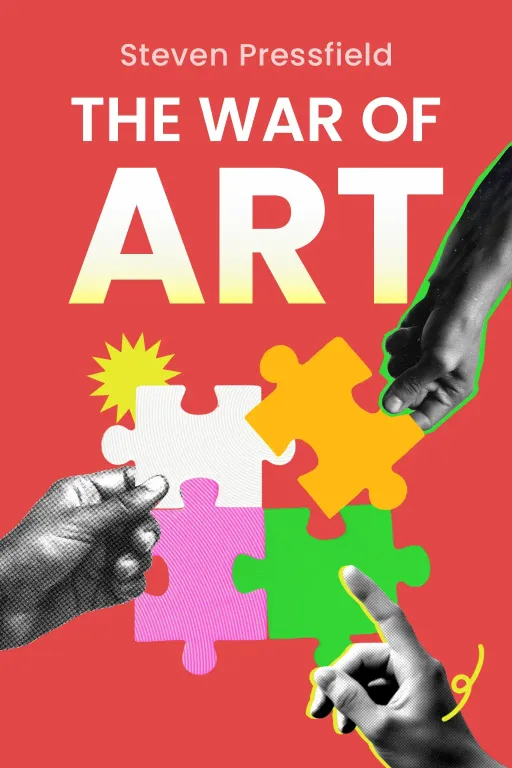
Nova: Oh, I love that. "Quiet, insidious dread." It’s almost poetic. And that dread, that feeling you just described, often has a name, an invisible foe that Steven Pressfield, a former advertising copywriter who famously struggled for years with creative blocks before finally breaking through with books like, masterfully dissected in his groundbreaking work,. He wrote it almost as a battle plan for himself, from a place of deep personal struggle.
Atlas: That makes sense. It’s a book born of direct experience, not just theory. And we’re pairing that with Austin Kleon’s, a book from an artist who's basically built a career around proving that sharing your creative journey is a superpower. It’s like the perfect tactical manual to Pressfield’s strategic battlefield analysis, isn’t it?
Nova: Absolutely. Today, we're unmasking that invisible foe, which Pressfield calls 'Resistance,' then arming you with the professional and community-driven antidotes. It’s about understanding why brilliance often stalls and how to actually build that lasting legacy.
The Invisible Foe: Unmasking 'Resistance' in Creative Work
SECTION
Nova: So, let's talk about 'Resistance.' Pressfield describes it as an external, malevolent force, almost a living entity, specifically designed to prevent us from doing our most important work. It’s not just procrastination, Atlas. It’s the force that whispers, "You're not good enough," or "Start tomorrow," or suddenly makes cleaning the entire house feel like the most urgent task on Earth when you're supposed to be writing that strategic brief.
Atlas: Wait, so it's not just procrastination? That sounds a bit out there. Are you saying it's... conscious? Like a little devil on your shoulder, but for your creative output? As a strategist, I thrive on identifying clear obstacles. This sounds… squishy.
Nova: That’s a great way to put it, "squishy." But Pressfield makes it incredibly tangible. He emphasizes that Resistance always points in one direction: towards growth. It shows up most powerfully when you're about to do something significant, something that moves you from a lower to a higher plane. It attacks writers, painters, entrepreneurs, even leaders about to launch a bold new initiative. Like that moment you’re about to send a truly innovative proposal, and suddenly you're overcome with the urge to meticulously reorganize your entire desktop.
Atlas: Oh, I know that feeling. Honestly, that sounds like my Monday mornings trying to start a big project. I always find a hundred administrative tasks that suddenly become 'critical.' So, for a conscientious leader, this 'Resistance' isn't just about avoiding discomfort; it's actively trying to keep us from making impact?
Nova: Exactly. It’s a force that wants to keep you small, safe, and unchanged. Pressfield says it operates on a simple principle: the more important an endeavor is to your soul's growth, the more Resistance you will feel towards it. It's why starting a new business feels terrifying, but scrolling social media feels effortless. One is growth, the other is stagnation.
Atlas: That makes me wonder, how do strategists, who often pride themselves on logic and planning, get blindsided by this invisible force? We plan for market shifts, competitive threats, but not for this internal sabotage. It almost feels like a betrayal from within.
Nova: Precisely. Because it masquerades as rational thought. "I need more research," "I'm not ready," "It’s not perfect yet." All seemingly logical, but often just Resistance in disguise, keeping you from the blank page, the difficult conversation, the innovative leap. The common thread is always avoidance of the work itself. It's the moment before you commit to the actual act of creation or delivery.
Atlas: So, it's not the external critics we should fear most, but the internal saboteur that stops us before we even get to the critics. That's a powerful reframing. It turns the fight inward, which is much harder to strategize against.
The Antidote: Professionalism, Process, and the Power of Sharing
SECTION
Nova: So, if Resistance is this formidable, internal foe, how do we actually fight back? Pressfield offers a deceptively simple solution: turn pro. It means showing up daily, regardless of inspiration, treating your creative work like a job. You don't wait for the muse; you put in your hours. A professional doesn't take Resistance personally; they just work through it.
Atlas: Okay, so Pressfield says 'suffer alone, but show up.' That sounds like the ultimate self-discipline, which I can appreciate as a leader. But how do you sustain that against an invisible enemy that's constantly whispering doubts? Isn't that deeply isolating?
Nova: That's where Austin Kleon’s comes in, beautifully complementing Pressfield. Kleon, as an artist, argues that sharing your process, not just the finished product, is a powerful antidote to that isolation and a way to build momentum. It’s about being transparent about the messy middle. He says, "Share what you're learning. Share your inspirations. Share your frustrations."
Atlas: That’s a great way to put it. So, Pressfield gives you the mindset to show up, and Kleon gives you the method to keep showing up by inviting others into the journey. But for a conscientious leader, someone trying to build ethical business models, how do you balance the vulnerability of showing "unfinished" work with maintaining a professional image? Isn't there a risk of looking incompetent?
Nova: That’s a critical question. Kleon isn't advocating for dumping unedited thoughts onto the internet. He's talking about intentional, thoughtful sharing. It’s about showing the – the sketches, the drafts, the iterations, the questions you're asking, the resources you're using. For a leader, this could mean sharing early strategic frameworks, outlining the challenges of a project, or even just sharing the books and articles that are informing your thinking. It builds trust, attracts collaborators, and provides valuable feedback loops.
Atlas: I can see that. It shifts from "I have all the answers" to "here’s how I'm trying to find the answers, come along." That builds a different kind of authority, one based on transparency and continuous learning. It's a strategic move to foster innovation and collective intelligence. It makes the journey part of the value proposition.
Nova: Exactly. And Nova's Take, from our main content, synthesizes this perfectly: "Consistent, shared creative effort is the antidote to the paralyzing fear of starting and the isolation of creation." It’s the professional discipline of showing up, combined with the courage and generosity of sharing the journey. That combination is incredibly powerful for building any lasting body of work, whether it's a painting, a company, or a strategic vision.
Atlas: That's actually really inspiring. It means the struggle isn't just a personal burden; it can be a shared experience that strengthens the work itself. It turns the invisible foe into an opportunity for connection.
Synthesis & Takeaways
SECTION
Nova: So, the real legacy isn't just the pristine, finished product, Atlas. It's the consistent showing up, day after day, regardless of how you feel. And it’s the courage to share the messy middle, the process, the learning, with others. That’s how you build something enduring that truly resonates.
Atlas: That makes sense. It's about turning the internal war of Resistance into a collaborative journey. And for our listeners, The Strategist, The Innovator, The Conscientious Leader, that means not just leading the team, but visibly leading the creative process itself, showing that impact is a journey, not just a destination.
Nova: Absolutely. So, for your tiny step this week: Identify one creative project you've been putting off. Maybe it's a challenging report, a new initiative you've been hesitant to launch, or even a personal creative pursuit. Commit to working on it for 15 minutes today. And then, share a tiny piece of that process—a thought, a rough draft, a challenge you faced—with one colleague. Just one. See what happens when you invite someone into your process.
Atlas: That's a tangible first step, and a powerful way to start chipping away at Resistance. And we want to hear about it. Share your insights, your struggles, your tiny steps with us and the Aibrary community.
Nova: This is Aibrary. Congratulations on your growth!









