The Financial Engineer's Masterplan: Cracking the Code to Simple Wealth
10 minGolden Hook & Introduction
SECTION
Nova: In software engineering, the most elegant solution is almost always the simplest. A clean, efficient algorithm will outperform a complex, bloated one every time. But what if that same principle applies to one of life's most complex problems: building wealth?
Dylan: It's a fascinating question. We spend so much time optimizing systems for performance and reliability, it seems natural to apply that same thinking to our own finances.
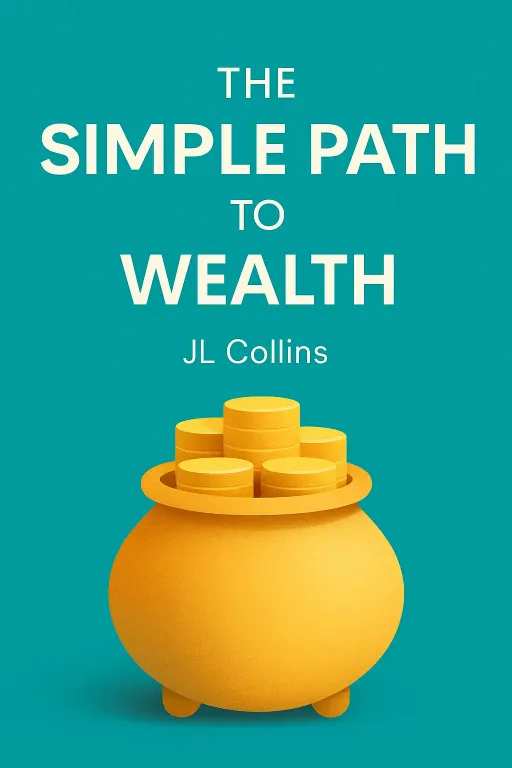
Nova: I'm so glad you said that. Today, we’re exploring JL Collins's 'The Simple Path to Wealth,' a book that argues for a radically simple financial 'algorithm.' And I'm thrilled to have Dylan, a software engineer and analytical thinker, here to help us deconstruct it. Welcome, Dylan!
Dylan: Thanks for having me, Nova. I'm excited to dig in. The premise of simplifying a complex domain is right up my alley.
Nova: Perfect. Today we'll dive deep into this from two perspectives. First, we'll redefine the goal of wealth, moving from 'retirement' to the powerful concept of 'F-You Money.' Then, we'll unpack the simple, elegant 'algorithm' to get there, and why it's the preferred strategy of masterminds like Warren Buffett. It’s going to be a fascinating discussion.
Deep Dive into Core Topic 1: The 'Why': Redefining Wealth as 'F-You Money'
SECTION
Nova: So Dylan, let's start with the 'why.' The book isn't really about 'retirement' in the traditional sense. It's about something Collins provocatively calls 'F-You Money.' It sounds aggressive, but the concept is pure freedom.
Dylan: I've heard the term. It’s about having the power to say no, right?
Nova: Exactly. And Collins tells this incredible personal story that makes it so real. Early in his career, in the 1980s, he was working a job he liked, but he wanted to take four months of unpaid leave to go travel in Europe. He'd managed to save up about five thousand dollars, which was a decent amount back then.
Dylan: Okay, so he has a small buffer.
Nova: A very small buffer. He goes to his boss, makes the request, and the boss just flat-out refuses. Says it's unheard of. So Collins goes home, and for a week, he's agonizing over it. He likes the job, he's afraid he won't find another one. But in the end, he decides the freedom to travel is more important. He walks back in, ready to quit.
Dylan: And what happens?
Nova: The moment he says he's resigning, the entire dynamic shifts. His boss, suddenly faced with losing a good employee, offers to negotiate. They end up agreeing on a six-week leave. Collins gets his trip, and he writes that in that moment, he realized he would never be a slave to his job again. That five thousand dollars wasn't just money; it was power. It was his first taste of F-You Money.
Dylan: That's a powerful shift in perspective. It's not about the absolute amount, but the optionality it creates. In tech, we talk about avoiding vendor lock-in, where you're so dependent on one piece of technology that you can't leave. This is like avoiding 'employer lock-in.' The money is a decoupling mechanism.
Nova: A decoupling mechanism! I love that. So you see it as less of a financial state and more of a strategic advantage?
Dylan: Precisely. It’s a feature you build into your life's operating system. It changes the power dynamic in any negotiation. It gives you the leverage to optimize for what you actually —whether that's more interesting projects, better work-life balance, or the ability to just walk away from a toxic environment.
Nova: Which is so relevant in a demanding field like tech.
Dylan: Absolutely. Burnout is real. Having that buffer means you can make decisions based on your well-being, not just your next paycheck. When you think about it, it's the ultimate form of self-care, which is something I'm really interested in improving. It's not about bubble baths; it's about structural freedom.
Nova: Structural freedom. That's brilliant. It's not an escape, it's a system upgrade for your life.
Dylan: Exactly. You’re no longer running on legacy code dictated by others. You have the resources to refactor your own life.
Deep Dive into Core Topic 2: The 'How': The Elegant Algorithm of Index Investing
SECTION
Nova: And that leverage, that structural freedom, is built on a surprisingly simple 'how.' This is where the book gets really interesting for analytical minds, because Collins argues that the financial industry intentionally overcomplicates things to profit from the confusion.
Dylan: That sounds familiar. Complexity is often a great way to hide fees and inefficiencies.
Nova: You've nailed it. He uses this great analogy: the beer and the foam. Imagine you're pouring a glass of beer. The 'beer' is the actual, tangible value of the underlying businesses in the economy. It's the factories, the patents, the profits. The 'foam' is all the noise on top—the daily stock price fluctuations, the news headlines, the frantic trading. Collins says the financial industry wants you to focus on the foam, but real wealth is built by buying the beer.
Dylan: So, how do you 'buy the beer'?
Nova: You buy the whole keg! Instead of trying to pick which individual company will do well, you buy a total stock market index fund, like Vanguard's VTSAX. It's a single fund that owns a tiny piece of every publicly traded company in the U. S. You're not betting on one horse; you're betting on the whole American economy. And the data is just staggering. The book cites a study showing that over a 15-year period, 82% of professional, actively-managed funds—the so-called experts who chase the foam—failed to do better than a simple, unmanaged index.
Dylan: Wow. So, 82% of the time, paying an expert to manage your money leads to a worse outcome. That’s a massive system failure.
Nova: Isn't it? How do you see that from an engineering standpoint?
Dylan: This resonates so much. It's the difference between focusing on a system's core architecture versus chasing every minor performance blip. An actively managed fund sounds like a piece of legacy software. It's complex, it's opaque, it's expensive to maintain with all its fees, and it's full of dependencies and single points of failure—like a star manager leaving.
Nova: And the index fund?
Dylan: An index fund is like a clean, well-designed, open-source API. You make one simple call—'buy VTSAX'—and you get reliable, predictable access to the entire market's performance. It's efficient, it's low-cost, and it's robust. It just works. You set it, and you can trust the system to do its job.
Nova: And it's a strategy famously endorsed by someone you're interested in, Warren Buffett.
Dylan: Yes! And that, to me, is the ultimate validation. This isn't just some fringe idea. Warren Buffett, who is arguably the greatest stock-picker in history, has explicitly stated in his shareholder letters that the instructions for his wife's trust are to put 90% of the money in a very low-cost S&P 500 index fund.
Nova: That’s incredible. He’s basically saying "don't do what I do."
Dylan: It's more profound than that. He's essentially saying, 'I am a world-class, five-star Michelin chef. I've spent my life mastering this craft. But for most people, including my own family, the most nutritious, reliable, and ultimately successful long-term meal is this simple, pre-packaged one.' It's a stunning admission about the futility of trying to beat the system for the average person. It’s the ultimate life hack from the master himself.
Nova: So the 'mastermind' strategy, for an INTJ like yourself, is to try to be the mastermind?
Dylan: Exactly! The smartest move, the true master plan, is to acknowledge the system is too complex to consistently outwit. So instead of trying to beat the market, you simply the market at the lowest possible cost. You let the system work for you.
Synthesis & Takeaways
SECTION
Nova: I think that's the perfect place to land. It brings everything together so beautifully. To recap for everyone, the path Collins lays out is incredibly simple. First, you redefine the goal: you're not just saving for retirement, you're building a 'freedom fund'—what he calls F-You Money.
Dylan: You're engineering optionality into your life.
Nova: Yes! And second, the 'how' isn't some secret, complex formula. It's a simple, elegant algorithm: live on less than you make—he pushes for a 50% savings rate—and invest that surplus consistently into a low-cost, broad-market index fund.
Dylan: It's about building a robust, fault-tolerant system for your life. The goal is autonomy, and the method is disciplined simplicity. It’s a beautiful design.
Nova: It really is. So, for everyone listening, especially our fellow analytical thinkers, here's the challenge we want to leave you with. The book makes it clear that the hard part isn't finding a more complex strategy. The hard part is having the discipline to execute the simple one.
Dylan: The execution is everything.
Nova: So, here's a thought. Don't go looking for a 'better' investment. Instead, ask yourself one simple, data-driven question: What is one expense I can cut this month to increase my savings rate and build my own 'freedom fund'?
Dylan: And I'll add one more. What's one piece of financial 'foam'—a scary market headline, a hot stock tip from a friend—that you can consciously choose to ignore this week? Focus on the beer, not the foam.
Nova: Focus on the beer. I love it. Dylan, this has been an absolutely fantastic conversation. Thank you so much for bringing your engineering brain to the table.
Dylan: My pleasure, Nova. It was great fun deconstructing the system with you.