The Art of Simplicity: How Less Becomes More in UI Design
9 minGolden Hook & Introduction
SECTION
Nova: Ever stared at a beautifully designed app, only to realize the sheer number of options is actually making you feel… overwhelmed? That dizzying array of toggles, buttons, and menus that promises "more power," but delivers a headache?
Atlas: Oh man, Nova, it's like being handed a remote control for a spaceship when all you want to do is change the channel. You know there's incredible functionality there, but the cognitive load just to the right button feels like a barrier, not an enhancement. It almost makes you question if more is always, well,.
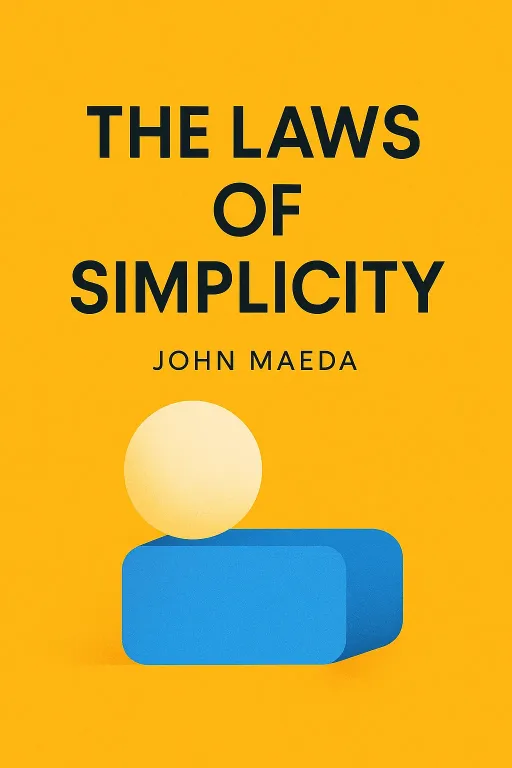
Nova: Exactly! And that feeling, that subtle, insidious user fatigue, is precisely what we're dissecting today. We're challenging that default impulse to add, add, add. Today, we're diving into a profound, counter-intuitive idea from a true pioneer: John Maeda's seminal work, The Laws of Simplicity.
Atlas: Maeda. He’s the one who bridges the gap between art and code, right? I remember reading about his work at MIT. He has this way of making complex ideas incredibly elegant.
Nova: Absolutely. Maeda isn't just a designer; he's a former MIT Media Lab associate director and a leading voice in design and technology, known for his unique blend of art, engineering, and philosophical insight. He didn't just talk about simplicity; he built a framework for it, grounded in deep thought. His perspective helps us strip away unnecessary clutter, allowing the core purpose of any UI to shine through. It's about making designs feel effortless and intuitive by focusing on what truly matters.
The Blind Spot: The Illusion of More Power
SECTION
Nova: So, let's talk about this "blind spot." It's a common trap for designers, isn't it? This pursuit of comprehensive functionality, where we believe more options automatically mean more power for the user. We're taught to cater to every edge case, every potential need.
Atlas: I’ve been there. You get a request for a new feature, or you see a competitor adding something, and the immediate thought is, "We need that too!" It feels like you're empowering the user by giving them more control, more choices. But you're suggesting that's not always the case?
Nova: What really happens is that while it like more power, it often leads to confusion, decision paralysis, and ultimately, user fatigue. Think about an app that tries to do absolutely everything. You open it, and you're immediately hit with a dozen different icons, notifications, and menu items. Each one represents a "power," but collectively, they dilute the user's focus. The true power, the actual utility, gets buried under a mountain of options.
Atlas: That makes me wonder, how do you balance robustness with this 'elegant restraint'? Because users need powerful tools. Take a professional design software, for instance. It to have a ton of features, otherwise it's useless to a pro. So how does "less is more" apply there? Are you saying we should just remove advanced features?
Nova: That’s a great question, and it's where Maeda's concept of "intelligent organization" comes in. It's not about dumbing down or removing truly essential functions. It's about recognizing that complexity can be hidden, or presented in a progressive manner. Think about a well-designed camera app. You can point and shoot with minimal effort, but if you want manual controls, they're there, tucked away in a logical, non-obtrusive menu. The core purpose – taking a photo – is always front and center.
Atlas: So it's not about making something simplistic, but making it simple. The complexity is still there, for those who need it, but it’s not shouting at you from the main screen. That’s a subtle but powerful distinction. It means the designer has to anticipate user needs and progression, rather than just dumping everything on them.
The Shift: Maeda's Laws and Intelligent Simplification
SECTION
Nova: Precisely. This is where John Maeda steps in, offering not just an idea, but a tangible framework for achieving simplicity. He distills complexity into ten actionable laws. We can't cover all ten today, but let's touch on a couple that really drive this home.
Atlas: Let’s do it. I'm curious about the 'scent' of unnecessary complexity. How does a designer, a "scent chaser" as it were, identify what's clutter versus what's truly core?
Nova: A key one is Maeda's first law:. It’s about achieving apparent simplicity by reducing. The easiest way to make something simple is to thoughtfully remove what isn't absolutely necessary. It's an active, almost surgical process. Think about stripping down a cluttered website. You remove banner ads, redundant navigation links, excessive text. The goal is to make the primary call to action, the main content, immediately obvious.
Atlas: That’s a great way to put it. It’s like finding the elegant equation in design, where every element serves a precise purpose, almost like a beautiful piece of architecture. Every line, every shape has intent. But how do designers identify what's clutter and what's core? Is there a method, a "scent" for unnecessary complexity?
Nova: There definitely is! Another of Maeda’s laws,, speaks directly to this. When you can't reduce further, organize. This means grouping related functions, creating clear hierarchies, and using visual cues to guide the user's eye. Imagine a complex data dashboard. Instead of cramming all the graphs and numbers onto one screen, you might organize them into logical tabs or collapsible sections. The information is still available, but the user can access it progressively, without being overwhelmed initially.
Atlas: So, it's about creating order from potential chaos. That resonates deeply with me, the idea of building order. It implies a deeper understanding of information architecture and user flow. It's not just about aesthetics; it's about making the of the interface beautiful and intuitive.
Nova: Exactly! It's about making your designs feel effortless and intuitive by focusing on what truly matters. It’s intelligent organization, not just pretty pictures. It allows for that "sensory pleasure" of effortless interaction you mentioned, where the user doesn't even have to about how to use the interface; it just.
Deep Question: Radical Simplification as Enhancement
SECTION
Nova: This brings us to a profound thought experiment, a challenge Maeda often implicitly poses. Let's bring this home with a direct challenge to our listeners, especially designers.
Atlas: I'm ready. Lay it on me.
Nova: Look at a feature in your UI that feels overly complex. If you had to remove half of its elements – not just hide them, but them – what would remain? And how might that radical simplification actually enhance the user's experience?
Atlas: Whoa. Half? That's… that's quite a cut. My immediate reaction is, "That's impossible, it'll break everything!" But then, I think about a notoriously complex settings menu in an application. You know, the one with 50 options, and you only ever touch three. If you removed half, maybe you'd be forced to identify the essential settings, or group related ones in a way that makes the remaining options incredibly clear.
Nova: Precisely. It’s a creative constraint, forcing you to distill the essence. It's about finding the core purpose and ruthlessly eliminating anything that doesn't serve it directly, or can be handled in a smarter, less intrusive way. Does this process also reveal what truly connects the user to the product?
Atlas: I think it does. It forces you to ask, "What is the absolute fundamental interaction we want the user to have here?" And if you can achieve that with half the elements, you've probably made the experience more direct, more focused, and ultimately, more satisfying. It could create a "sensory pleasure" of effortless interaction, where the user isn't fighting the interface, but flowing with it. It’s the logic of beauty in action.
Synthesis & Takeaways
SECTION
Nova: What we've been talking about today, this art of simplicity, isn't a superficial aesthetic choice. It's a deep, deliberate design philosophy that demands courage and a profound understanding of user needs. It's about challenging our own impulses to add more, and instead, seeking the elegant restraint that truly empowers users. The real power isn't in the quantity of features, but in the clarity of purpose.
Atlas: Absolutely. It’s about designing with intention, not just accumulation. My challenge to all of our listeners is to take Nova's thought experiment seriously. Pick one overly complex feature in your design today. Imagine you to remove half its elements. What stays? What goes? And how does that radical shift in perspective change your understanding of its core value? You might be surprised at the hidden elegance you uncover.
Nova: We'd love to hear what you discover. Share your radical simplification stories with us. What did you remove, and how did it change everything for the better?
Atlas: This is Aibrary. Congratulations on your growth!