

The Inner Game: How Mental Strength Fuels Creative Resilience
7 minGolden Hook & Introduction
SECTION
Nova: Most people think their biggest enemy is the competition, or tight deadlines, or that one impossible client. But what if your most formidable opponent is actually the voice inside your own head?
Atlas: Oh man, that hits home. I can imagine a lot of our listeners, especially those building something significant, feel that constant internal chatter. That little voice that asks, "Are you sure this is good enough? Can you really pull this off?" It's relentless.
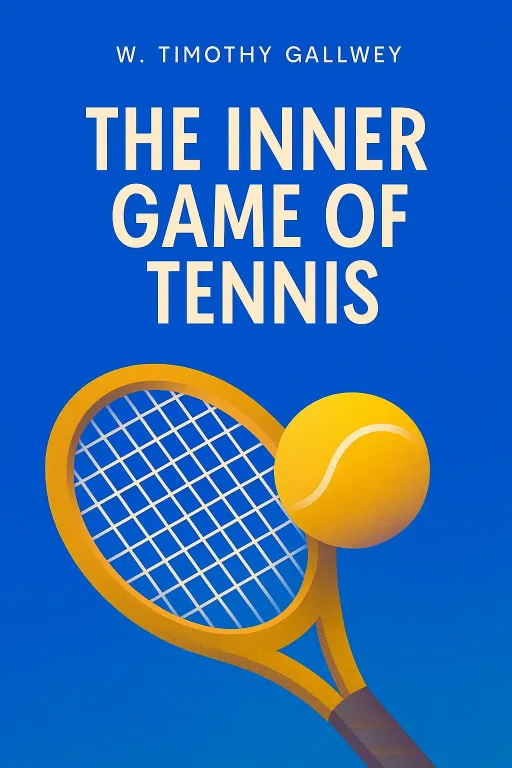
Nova: Absolutely, Atlas. And that internal struggle, what we're calling "the doubting self," isn't just annoying; it actively saps energy and stifles creativity. It's the "blind spot" that often prevents us from reaching our full potential. Today, we're diving into, a concept deeply rooted in the work of W. Timothy Gallwey and further illuminated by Carol S. Dweck.
Atlas: Right. And Gallwey's original book,, is fascinating because it wasn't just for athletes. It completely revolutionized sports psychology and even corporate training, showing these principles are universally applicable. It's about mastering your internal state, whether you're serving an ace or launching a startup.
Nova: Exactly. And the power of that concept is what we're unpacking. Because when you learn to quiet that inner critic, you don't just feel better; you unlock a far more fluid and effective approach to your work.
The Internal Adversary: Battling the Doubting Self
SECTION
Atlas: So, let's talk about this "doubting self." How does it actually interfere? Because for someone who's used to problem-solving with data and logic, trusting an 'inner game' might feel a bit abstract. How do you which part of your mind is helping and which is hindering?
Nova: That's a great question, Atlas. Gallwey introduced this brilliant framework of 'Self 1' and 'Self 2.' Think of 'Self 1' as your conscious, judging mind. It's the one that's constantly evaluating, criticizing, instructing, and often, interfering. Then there's 'Self 2,' which is your unconscious, intuitive performer—the part of you that just how to do things, whether it's playing a sport or sketching an innovative design.
Atlas: Okay, so 'Self 1' is like the overbearing coach in your head, and 'Self 2' is the natural talent trying to execute?
Nova: Precisely! Imagine an architect, deep in the flow of designing a complex new system. 'Self 2' is in charge—the ideas are flowing, the solutions are elegant. But then 'Self 1' jumps in: "Is this innovative enough? What will the critics say? This isn't perfect." And suddenly, that fluid creative process grinds to a halt. The energy that should be going into creation is now diverted into internal arguments.
Atlas: That sounds like a classic scenario for anyone trying to build something from the ground up, whether it's a product or a community. The pressure to deliver, to innovate, can trigger that 'Self 1' interference, making you second-guess every decision. How do you quiet that critic without suppressing necessary self-correction or critical thinking? Because we still need to be analytical, right?
Nova: Absolutely. It isn't about turning off your critical thinking. It's about recognizing when 'Self 1' is rather than. When you're in the process of creation, 'Self 1' often gets in the way of 'Self 2's' natural ability to perform. Gallwey's whole teaching is about learning to trust your natural abilities, to observe without judgment. It's like watching a skilled musician play: they're not thinking about each note; they're just performing. The music flows.
Atlas: So, the goal is to create space for that intuitive flow, rather than letting the analytical mind micromanage every single step. For someone who's all about building robust systems, this sounds like building a robust system, where intuition and conscious thought work in harmony, not conflict.
Unlocking Intuition & Embracing Growth: The Inner Game Shift
SECTION
Nova: That's exactly it. And the power to quiet that internal critic isn't just about "getting out of your own way," it's fundamentally about how you view your potential. This brings us to another titan in this field, Carol Dweck, and her groundbreaking work on "Mindset."
Atlas: Ah, fixed versus growth mindset. That's a concept I can see resonating with our 'Architect' and 'Cultivator' listeners. But for someone whose entire career might feel built on proving their 'fixed' intelligence—their innate talent—how do you even begin to cultivate a growth mindset? It sounds great in theory, but what does it look like when a project fails, and your immediate thought is "I'm not good enough"?
Nova: That's the crux of it, isn't it? The fixed mindset believes abilities are inherent and unchangeable. So, a setback confirms "I'm not smart enough," or "I lack talent." But a growth mindset, on the other hand, sees abilities as something that can be developed through dedication and hard work. It views challenges as opportunities to learn and grow.
Atlas: What's a real-world example of that shift? Because when you're leading a team and a major initiative hits a roadblock, the pressure is immense.
Nova: Imagine a team launching a new feature, and it completely flops. A leader with a fixed mindset might blame individuals, declare the idea a failure, and retreat. They might say, "Well, we just don't have the right people for this kind of innovation." But a leader with a growth mindset would see it differently. They'd gather the team, analyze what went wrong, identify the lessons learned, and use that knowledge to iterate and improve. They'd frame it as, "This didn't work, what can we learn to make the next version better?"
Atlas: That's a profound difference. It shifts the focus from an outcome being a judgment of inherent ability to an outcome being a data point for future improvement. It's about sustainable growth, not just immediate success.
Nova: Exactly. Dweck's research shows that a growth mindset is crucial for overcoming setbacks and fostering resilience in creative or intellectual endeavor. It's the engine for continuous learning and improvement. When we talk about cultivating lasting value, it starts with cultivating that internal belief in our capacity to grow and adapt.
Atlas: So, the deep question from the book—"What is one limiting belief about your own abilities that you could challenge this week?"—becomes incredibly relevant here. For our listeners who are constantly pushing boundaries, that's not just a philosophical exercise; it's a practical tool for resilience. It's about trusting your intuition as much as your data, and using reflective journaling to process those wins and lessons.
Synthesis & Takeaways
SECTION
Nova: Absolutely. When you synthesize Gallwey and Dweck, you see that the inner game of trusting your intuition and the power of a growth mindset are two sides of the same coin. Both are absolutely essential for creative resilience. When you learn to manage your internal dialogue, you free up immense mental capacity to cultivate and create without unnecessary friction.
Atlas: It seems like this 'inner game' isn't just about feeling better, but about building more robust systems and vibrant communities by first building a robust internal landscape. It's about developing that mental strength to not just survive the highs and lows, but to truly thrive and grow through them.
Nova: Resilience isn't about avoiding the fall, it's about how you choose to land, learn, and then soar again. It's about recognizing that the biggest battle isn't out there, it's within, and it's a battle you have the power to win.
Atlas: So, for everyone listening, consider that deep question this week: What is one limiting belief about your own abilities that you could challenge? Just identifying it is the first step towards a massive shift.
Nova: A powerful challenge for a growth-oriented mind.
Atlas: Definitely.
Nova: This is Aibrary. Congratulations on your growth!









