

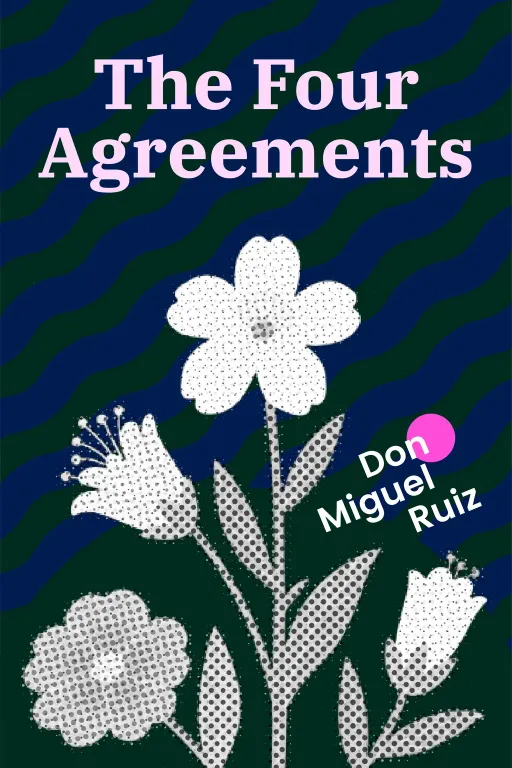
Dreaming a New Family: A Parent's Guide to The Four Agreements
9 minGolden Hook & Introduction
SECTION
Nova: We spend our whole lives trying to unlearn the rules we were taught as kids. But what happens when you're about to become the one who writes the rules? Don Miguel Ruiz, in his book 'The Four Agreements,' calls this process 'domestication'—the way we're trained to fit into the 'dream of the planet.' It sounds a little intense, but for a new parent, it's a profound reality. How do we guide our children without accidentally programming them with our own fears and limitations?
Simons: That question is everything right now. It’s one thing to analyze your own upbringing, but it’s another thing entirely to be on the cusp of creating a new person’s foundational reality. It’s… a heavy responsibility.
Nova: It really is. And that’s exactly why I’m so excited to talk about this with you today, Simons. As a soon-to-be parent, but also as an experienced Product Manager in the education space, you literally build learning systems for a living. This idea of 'programming' a young mind must hit differently for you.
Simons: It absolutely does. It reframes the entire endeavor from just 'raising a kid' to 'designing an initial human experience.' No pressure, of course.
Nova: Right, no pressure at all! Well, today, we're going to tackle this book from two powerful angles for anyone building a family. First, we'll explore that profound responsibility of being a 'domesticator' and how to program our children's beliefs with love, not fear. Then, we'll discuss how the first two agreements can serve as a practical 'operating system' for communication in your new family.
Deep Dive into Core Topic 1: The Parent as the 'Domesticator'
SECTION
Nova: So let's dive right into that big, scary word: 'domestication.' How does that concept land with you, Simons?
Simons: Honestly, it's both unsettling and incredibly clarifying. Unsettling because it sounds so clinical, like training an animal. But clarifying because… well, it’s true. We are teaching a being how to function within a complex system—our family, our culture. My job is to design intuitive educational products, and this feels like the ultimate design challenge.
Nova: I love that framing. And Ruiz would agree. He says the 'dream of the planet'—which is the collective dream of society with all its rules, laws, and beliefs—is taught to us through this process of domestication. He compares it directly to training a dog. When we do something our parents approve of, we get a reward: a smile, a treat, a 'good girl'. When we do something they disapprove of, we get a punishment: a frown, a scolding, a time-out.
Simons: And eventually, the trainer doesn't even need to be there. We internalize the rules.
Nova: Exactly! That's the crucial step. We internalize this big 'Book of Law,' and with it, two key players: the inner 'Judge,' who constantly measures us against that law, and the inner 'Victim,' who takes the punishment and feels the shame when we fall short. Ruiz gives this really clear example of how it happens. A child is praised for sharing their toys, so they learn 'sharing is good.' Then, the same child draws on the wall and gets scolded, so they learn 'drawing on walls is bad.' These simple inputs create a complex internal rulebook.
Simons: It’s like we’re designing the initial user interface for our child's consciousness. And every interaction, every word of praise or correction, is a design choice that shapes their internal world. The 'Book of Law' is their first operating system. And if that OS is loaded with bugs from the start—like 'I'm not good enough unless I'm perfect' or 'I must please everyone to be safe'—it's going to affect every 'application' they try to run for the rest of their life.
Nova: Wow, 'designing the user interface for their consciousness.' That is such a powerful way to put it. It completely shifts the perspective, doesn't it? It’s not just about stopping bad behavior. It's about considering the long-term belief you're installing. How does that change how you might view, say, a crying baby or a toddler's tantrum?
Simons: It changes everything. A tantrum is no longer just a 'behavior to be managed.' It's data. It's the user telling you the system is failing them in some way. They can't express a need, they're overwhelmed, they don't have the words. My job isn't to punish the 'error message,' but to understand the underlying need. To help them build a better system for emotional regulation, not just install a rule that says 'crying is bad.'
Nova: Which is a perfect transition, because if we're the programmers, what's the code we should be writing? This is where the agreements themselves become so practical and so important.
Deep Dive into Core Topic 2: The Agreements as a Family Operating System
SECTION
Nova: Let's start with the very first agreement, which Ruiz says is the most important: Be Impeccable with Your Word. He describes the word as 'pure magic,' a force that can create a beautiful dream or destroy everything. He says we're constantly casting 'spells' on each other.
Simons: That feels very true. In management, the right words at the right time can unlock a team's potential. The wrong words can crush morale for weeks. The 'spell' analogy is spot on.
Nova: And with children, the spells are a thousand times more potent. He tells this absolutely devastating story. A mother comes home from a long, stressful day at work. She has a splitting headache. Her young daughter, who is just full of life and joy, is singing and jumping around. The sound is grating on the mother's frayed nerves. In a moment of anger, she just snaps and yells, "Shut up! You have an ugly voice. Can you just shut up!"
Simons: Oh, no.
Nova: Right. And Ruiz explains that for this little girl, her mother's word is gospel. It's the word of God. So she believes her. She makes an agreement with herself in that moment: "My voice is ugly. I shouldn't sing." And the book says she grew up and never sang again. She became shy, had trouble even speaking to others. The mother, in a single moment of carelessness, cast a spell that defined a huge part of her daughter's life.
Simons: That's heartbreaking. It's a perfect, terrifying example of the power we hold. One off-hand comment, born of our own stress and not even really about the child, can become a core belief—a line of code in their operating system—that they carry forever. It makes you want to be so, so careful.
Nova: It really does. But here's the beautiful flip side. The book gives us a tool for ourselves, for when we're on the receiving end. This is the Second Agreement: Don't Take Anything Personally. This one feels like the ultimate survival tool for new parents.
Simons: Tell me more. I think I'm going to need it.
Nova: We all do! Ruiz says that nothing other people do is because of you. It is because of themselves. All people live in their own dream, in their own mind. When your sleep-deprived partner snaps at 3 a. m., it's not about you. It's a projection of their exhaustion, their stress, their own 'dream.' When your baby is screaming for the third hour straight, they aren't doing it you. They are communicating a need from within their own reality. By not taking it personally, you become immune to that 'poison.' You don't have to react.
Simons: That connects directly to managing high-stress situations at work. When a product launch is going wrong and people are panicking, the sharp words and blame aren't personal attacks. They're data about that person's fear or stress level. Seeing it that way allows you to de-escalate the situation instead of defending yourself. You can respond to the actual problem, not the emotional noise. It's the same in a family. My partner's stress isn't an indictment of me; it's a signal that they need support.
Nova: Yes! You just described the entire principle perfectly. It's about responding to the signal, not reacting to the noise. And it preserves so much energy that would otherwise be wasted on hurt feelings and pointless conflicts.
Synthesis & Takeaways
SECTION
Nova: So when you put it all together, it feels like we have this incredible, dual role as parents. On one hand, we have to be so incredibly mindful of our words, knowing we are casting these powerful 'spells' that will help shape our child's reality.
Simons: We're the conscious programmers, choosing the code with care.
Nova: Exactly. And on the other hand, we have to build this personal shield, this commitment to not taking things personally, so we can navigate the inevitable stress and emotional noise without getting wounded or creating useless drama. It's both an immense responsibility and a profound act of self-care.
Simons: It really is. The whole book reframes these challenges not as burdens, but as opportunities for a higher level of consciousness. It makes me think... what's one 'agreement' I made as a child, one piece of faulty code, that I definitely don't want to pass on?
Nova: That's the question, isn't it?
Simons: I think for me, it might be the idea that you have to be 'perfect' to be loved or that your value comes from achievement. It's a common one, I think. But this book gives us a framework to consciously choose a different dream for our own family. A dream where love isn't conditional and your best is always good enough. And that feels like an incredible gift to give.
Nova: An incredible gift, indeed. Simons, thank you so much for dreaming with us today. This has been a beautiful conversation.
Simons: Thank you, Nova. This was exactly what I needed to hear.









