The Adaptable Mind: Rewiring Your Brain for Innovation
12 minGolden Hook & Introduction
SECTION
Socrates: Alex, let me ask you a question that gets to the heart of innovation. What if our brains aren't fixed hardware, but are actually running on infinitely upgradeable software? We spend so much time upgrading our phones, our computers... but what if the most profound upgrade is the one we can perform on ourselves?
Alex Teo: That's a powerful way to put it. In the tech world, we're obsessed with hardware specs and software updates, but we often treat the human element—the user, the creator—as a constant. The idea that the creator is also a dynamic, updatable system... that changes the game entirely.
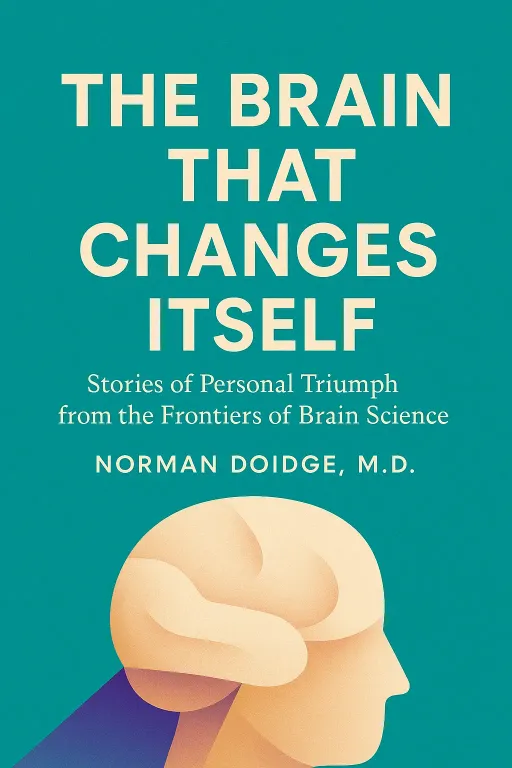
Socrates: It really does. And it's the central premise of Norman Doidge's incredible book, "The Brain That Changes Itself." He introduces us to a group of neuro-pioneers who, much like the tech visionaries you admire, completely rejected the established dogma of their time. The dogma was that the brain's structure is fixed from childhood. They proved it wasn't.
Alex Teo: So they were essentially hackers, but the system they were hacking was the human brain itself. I love that.
Socrates: Exactly. And their discoveries have profound implications for anyone interested in innovation. Today we'll dive deep into this from two perspectives. First, we'll explore how the brain can be rewired to accept entirely new kinds of information, literally learning to 'see' with the tongue.
Alex Teo: Okay, you have my attention.
Socrates: Then, we'll discuss how we can use targeted training to sharpen our mental processing speed and build expertise, based on a principle called 'competitive plasticity.' It's a journey into the ultimate adaptable machine.
Deep Dive into Core Topic 1: The Brain as a Universal Processor
SECTION
Socrates: So, let's start with an idea that completely shatters the old model of the brain. For over a century, the prevailing view—what scientists call 'localizationism'—was that the brain is like a complex machine with highly specialized parts. The visual cortex is for seeing, the auditory cortex for hearing, and so on. If a part breaks, the function is lost. Period.
Alex Teo: Like a motherboard with a fried chip. You can't just ask the graphics card to start handling audio processing.
Socrates: Precisely. But what if you could? To understand how, I want to introduce you to a woman named Cheryl Schiltz. In 1997, after a routine surgery, she was given a high dose of an antibiotic, gentamicin, that had a devastating side effect: it destroyed her vestibular system, the part of the inner ear that gives us our sense of balance.
Alex Teo: So, the gyroscope in her head was just... gone.
Socrates: Completely gone. And the effect was terrifying. She described it as feeling like she was "perpetually falling." Even when lying down, she felt like she was tumbling through space. She said, "I literally lose the sense of the feeling of the floor... and an imaginary trapdoor opens up and swallows me." She couldn't walk, she couldn't work, she couldn't live a normal life. She became what she called a "Wobbler."
Alex Teo: That's a nightmare. It's a loss of the most fundamental human orientation to the world.
Socrates: It is. And for years, medicine had no answer for her. Her hardware was broken. But then she met a neuro-pioneer named Paul Bach-y-Rita. He was a firm believer that the brain was plastic, not a fixed machine. He had a radical idea. He built a device for Cheryl—it was a simple construction helmet with an accelerometer, the same kind of sensor that orients the screen on your smartphone.
Alex Teo: Okay, so it measures the orientation of her head.
Socrates: Right. And it sent that information not to her ears, but to a small, flat square of 144 electrodes that she placed on her tongue. He called it a tongue display unit. If she tilted her head forward, a pattern of electrical tingles would pulse on the front of her tongue. If she tilted back, it would pulse on the back.
Alex Teo: He was trying to give her a new kind of balance signal, but through taste and touch? That seems... bizarre.
Socrates: It sounds bizarre, but think about it. The brain is just an organ sitting in a dark, silent skull. All it ever knows is electrical signals. Bach-y-Rita's bet was that the brain wouldn't care where the signals came from, as long as they were consistent and meaningful. So Cheryl puts on the device. At first, nothing. But then, after about twenty minutes, she's standing in the lab, and for the first time in five years, she feels... grounded. The feeling of falling stops. Her brain, in real-time, was interpreting the tingling on her tongue as balance information.
Alex Teo: That's incredible. So the brain didn't care that the balance data was coming from the tongue instead of the inner ear? It just saw a coherent data stream and adapted?
Socrates: It just saw a coherent data stream and adapted. Bach-y-Rita’s famous quote was, "We see with our brains, not with our eyes." He argued the sensory organ is just a data port. The eye, the ear, the tongue... they're just peripherals. The real processing happens in the central unit.
Alex Teo: That is such a powerful reframe for innovation. We often get obsessed with perfecting the existing 'data port'—making a better camera, a better microphone, a more intuitive user interface. Bach-y-Rita's approach was to find a completely new, unconventional data port to solve the problem. It's about being input-agnostic and focusing on the processing power of the system itself.
Socrates: And here's the most amazing part. They discovered something they called the "residual effect." After Cheryl used the device for a while and took it off, the feeling of balance would remain for a few minutes, then a few hours. Her brain was physically changing, rewiring itself to hold onto that new skill. After about a year of training, she no longer needed the device at all. Her brain had built a new, permanent pathway for balance.
Alex Teo: She downloaded the software patch from the device directly into her own wetware. That's the ultimate form of learning. It's not just memorization; it's structural change.
Deep Dive into Core Topic 2: Competitive Plasticity
SECTION
Socrates: And that idea of the brain as an adaptable processor that undergoes structural change leads directly to our second point. If the brain is so flexible, how do we guide that flexibility? This is where the work of another pioneer, Michael Merzenich, comes in. His work is built on a simple, powerful rule: "Use it or lose it."
Alex Teo: A classic principle. But it sounds like he took it to another level.
Socrates: He did. He first proved the "lose it" part in a now-famous experiment. He meticulously mapped the part of a monkey's brain that corresponded to its hand. Then, he severed the median nerve, which carries sensation from the middle fingers. When he came back two months later and re-mapped the brain, that area wasn't dead. It had been completely taken over by the brain maps for the adjacent fingers.
Alex Teo: The neural real estate was re-zoned. The unused property was claimed by its neighbors.
Socrates: Exactly. He called it "competitive plasticity." Your brain is in a constant, quiet war for resources. The skills and functions you use are constantly expanding their territory, and the ones you don't use are being conquered. But Merzenich was more interested in the other side of the coin: "Use it to it."
Alex Teo: The offensive strategy, not just the defensive one.
Socrates: Precisely. He co-developed a program called Fast ForWord, designed for children with language-processing disorders. These kids often struggle because their brains can't distinguish between fast-spoken sounds, like "ba" and "da." Their auditory processor is just a little too slow. So, what did the program do?
Alex Teo: Let me guess. It didn't just make them listen to words over and over. It must have manipulated the input, like Bach-y-Rita did.
Socrates: You're on the right track. The program takes speech sounds and digitally modifies them. At first, it slows them down and exaggerates the differences, making them incredibly easy for the brain to distinguish. A child plays a simple computer game where they have to click on the right image for the sound they hear. Because the sounds are so clear, they get it right.
Alex Teo: So it guarantees initial success and starts building a new pathway.
Socrates: Yes. And as the child gets better, the software subtly speeds the sounds up, bringing them closer and closer to normal speed. It's a targeted workout. The book tells the story of a seven-year-old named Willy Arbor, who was failing kindergarten. He couldn't follow instructions or learn to read. After eight weeks on Fast ForWord, a hundred minutes a day, his brain had rewired. He started bringing home A's and B's. His auditory system had been trained to be faster and more accurate.
Alex Teo: So this is essentially targeted, high-intensity interval training for the brain. It's not just 'practice,' it's practice designed to push a specific neural pathway to its limits and force it to adapt. It's the difference between randomly browsing the internet for information and running a targeted algorithm to find a specific piece of data.
Socrates: That's a perfect analogy. Merzenich proved that focused attention is the key. When you pay close attention, you are essentially telling your brain, "This is important. Allocate resources here. Win this battle for neural real estate." What are the implications of that for how we learn and innovate in the tech world?
Alex Teo: It's huge. It validates the idea of 'deep work.' It suggests that multitasking and distracted 'learning' are incredibly inefficient because you're not giving your brain a clear signal about what to prioritize. To truly master a new coding language, a new design system, or a complex business strategy, you need focused, dedicated blocks of time where you are pushing your cognitive limits. You're not just learning; you're actively creating the conditions for that 'competitive takeover' in your own brain map. You're telling your brain to build a superhighway to that new skill, not just a dirt path.
Synthesis & Takeaways
SECTION
Socrates: So we're left with these two incredible, complementary ideas from the book. First, from Bach-y-Rita, the brain as a universal, input-agnostic processor.
Alex Teo: Which is a lesson in finding novel solutions by changing the input, not just refining the existing process.
Socrates: And second, from Merzenich, the power of focused attention to drive competitive plasticity and build expertise.
Alex Teo: Which is a lesson in improving the system itself by deliberately training the processor. Both are absolutely core to the spirit of innovation.
Socrates: They really are. It reframes learning and problem-solving from abstract mental activities into tangible, biological processes that we can influence. The brain isn't just a vessel for our thoughts; it is actively shaped by them.
Alex Teo: It makes you realize that the most advanced piece of technology we'll ever work with is the one between our ears. And most of us have never even read the instruction manual. This book feels like the first chapter of that manual.
Socrates: I couldn't agree more. So the question for all of us, and especially for an innovator like you, Alex, is this: What 'unsolvable' problem in your world could be cracked by finding a completely new data stream? And what single skill, if you gave it Merzenich-level focused attention, could you train to fundamentally upgrade your own internal software?
Alex Teo: Those are the right questions to be asking. It's not just about the next product or the next line of code. It's about building a better thinker. And that's a project that never ends.