The Antifragile Advantage: Thriving on Disorder, Not Just Surviving It
7 minGolden Hook & Introduction
SECTION
Nova: What if everything you've been told about stability and safety is actually making you? What if the very things we try to avoid are precisely what we need to truly thrive?
Atlas: Whoa, Nova. That's a bold claim right out of the gate! I imagine a lot of our listeners, especially those building robust systems, are constantly striving for stability. Are you saying that's the wrong approach?
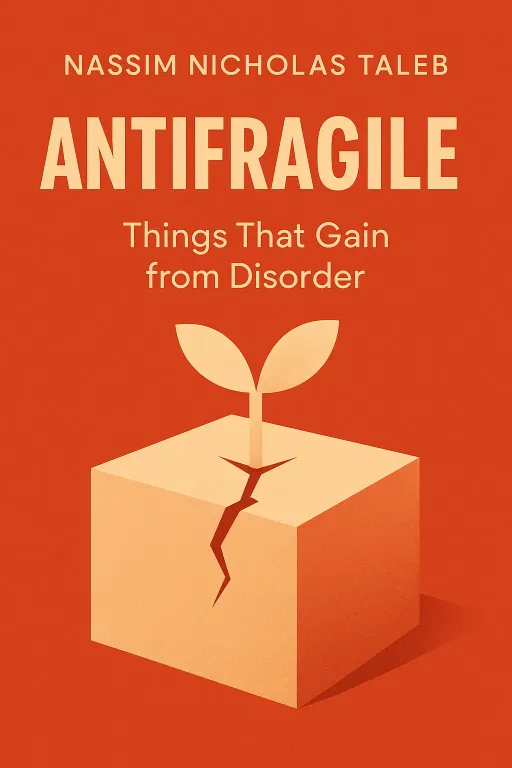
Nova: Well, it's certainly a limited one, according to our guide for today: Nassim Nicholas Taleb, and his groundbreaking book,. Taleb, a former options trader and risk analyst, brings a uniquely practical yet philosophical lens to how we deal with uncertainty. He's known for challenging conventional wisdom, and this book is a masterclass in rethinking what strength truly means.
Atlas: That makes perfect sense, given his background. He's seen firsthand how unpredictable markets can be, and how quickly perceived stability can crumble. So, he's basically saying we've been looking at 'strength' all wrong?
Nova: Precisely. We often aim for resilience, hoping to withstand shocks. But Taleb argues that true long-term strength comes from gaining from disorder. Relying on stability alone leaves you vulnerable to the unexpected. We need to embrace volatility to grow stronger.
Understanding Antifragility: Beyond Resilience
SECTION
Nova: So, let's break down what Taleb means by "antifragile." Imagine three types of systems. First, you have the. Think of a delicate glass vase. If you drop it, it breaks. It hates stress.
Atlas: Right, avoid at all costs. That's pretty intuitive.
Nova: Then you have the. Picture a rubber ball. You drop it, it bounces back to its original shape. It can withstand shocks, but it doesn't get better from them. It just returns to baseline.
Atlas: Okay, so resilience is about enduring. It's what many of us aim for in our plans and organizations. We want to bounce back from setbacks.
Nova: Exactly. But then there's the third category: the. This is something that doesn't just resist shocks, it actually when exposed to them. It gets stronger, smarter, more robust. Think of a package that says, "Handle with Care, or even better, mishandle it!"
Atlas: That sounds a bit out there, Nova. What's a real-world system that's antifragile? How is it different from something merely resilient?
Nova: A classic example is the human immune system. When it's exposed to pathogens, it doesn't just "bounce back" to its previous state. It learns, it adapts, it creates antibodies, becoming stronger and more capable of fighting off future threats. It gains from disorder, within limits.
Atlas: Oh, I see! So, it's not just surviving the illness; it's using the illness to become more robust for the future. That’s a powerful distinction.
Nova: Another one of Taleb's favorite examples is biological evolution. It thrives on random mutations and environmental stressors. Species don't just survive; they innovate, adapt, and become more complex and efficient over generations due to chaos.
Atlas: That's fascinating! So, for someone building systems or cultivating communities, how do you even begin to for that? It sounds counter-intuitive to invite chaos into a foundational approach. We're usually trying to minimize risk, not seek it out.
Embracing Disorder: The Black Swan Context
SECTION
Nova: And that naturally leads us to the second key idea we need to talk about, which often acts as the driving force for antifragility: understanding the world of "Black Swans." Taleb's earlier book,, highlighted the impact of highly improbable, unpredictable events. These are the game-changers.
Atlas: Okay, so we're talking about things like the 2008 financial crisis, or a global pandemic, or a sudden technological disruption. Events you can't predict, but completely change the game.
Nova: Precisely. Understanding Black Swans makes you realize that merely surviving isn't enough. You need to build systems that from randomness, because these unpredictable events are inevitable, and their impact is massive. Antifragility isn't about predicting the next Black Swan; it's about being positioned to gain from Black Swan.
Atlas: That makes me wonder, if you can't predict them, how do you prepare to gain from them? It feels like trying to catch lightning in a bottle.
Nova: It's about cultivating what Taleb calls "optionality." This means having many small, frequent experiments or ventures with limited downside but large potential upside. Think of it like venture capital: most startups fail, which is fragile at the individual startup level. But the of investments, because of the massive returns from the few successes, becomes antifragile.
Atlas: Wow, that's a powerful idea. So, instead of trying to predict the unpredictable, we're building in mechanisms to from it. It's about maximizing exposure to positive randomness while minimizing exposure to negative randomness.
Nova: Exactly. Another example is a decentralized network. If one node fails, the whole system doesn't collapse. Instead, other parts of the network might even adapt and find more efficient routes, making the overall system stronger. Look at the internet itself; it's a massively antifragile network.
Atlas: That's a great way to put it. For our listeners who are Architects or Cultivators, how does this translate into actionable steps? How do you build "optionality" into a plan or a team structure, or even a personal growth strategy? It sounds like you're suggesting we actively seek out small, manageable doses of disorder.
Synthesis & Takeaways
SECTION
Nova: You've hit on the core of it, Atlas. The deep question Taleb asks is: What aspect of your current plan could be re-designed to gain from unexpected disruptions, rather than merely endure them? It's about identifying where you might be fragile and introducing small, controlled stressors or "optionality" to transform that fragility into antifragility.
Atlas: So, it's not about avoiding all risks, but intelligently inviting small-scale volatility to inoculate ourselves and even find hidden opportunities within the chaos. It's about designing systems that learn and evolve, that get better with every unexpected twist.
Nova: Precisely. Nova's Take: Cultivating an antifragile mindset ensures that every challenge becomes an opportunity for growth, making your endeavors more robust over time. It's a fundamental shift from merely surviving to actively thriving.
Atlas: That's a question that really forces you to rethink everything. It's about building a legacy that truly endures and grows, even when the world throws its worst at you. It’s about sustainable growth and profound impact.
Nova: Indeed. It's moving from merely surviving to actively thriving. It's a fundamental shift in how we approach life and work.
Atlas: And a powerful one at that. A truly antifragile approach for anyone seeking lasting value.
Nova: This is Aibrary. Congratulations on your growth!