Stop Chasing, Start Building: The Guide to Sustainable AI Innovation.
9 minGolden Hook & Introduction
SECTION
Nova: Atlas, quick game. When I say "AI innovation and risk-taking," what's the first image that pops into your head? No filter.
Atlas: Oh, man. Immediately, I see a giant, shiny AI model, probably on a pedestal, and a tiny, nervous engineer frantically trying to patch a smoking wire before the whole thing crashes spectacularly while investors watch. It's all about avoiding that catastrophic failure, right?
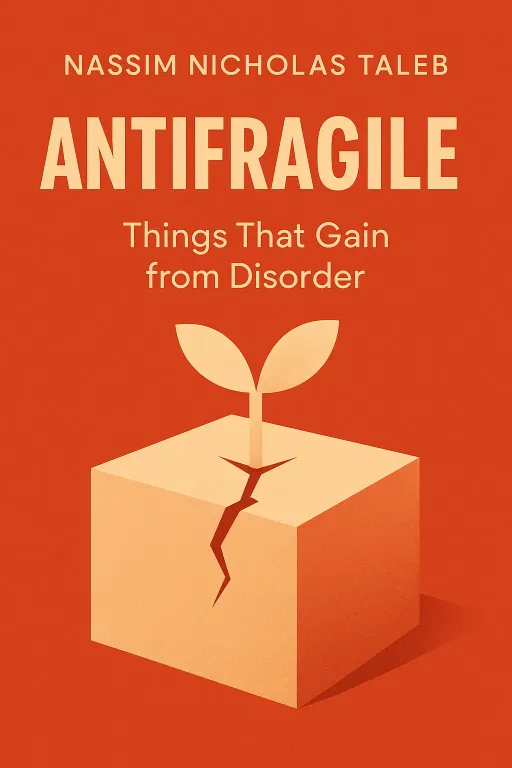
Nova: Exactly! That gut-level, white-knuckle fear of the crash. And that's precisely what we're going to dismantle today with a truly revolutionary idea from Nassim Nicholas Taleb's groundbreaking work,.
Atlas: Taleb! The Black Swan guy? I know his work is famous for challenging how we think about risk and unpredictability. It’s definitely shaken up a lot of fields.
Nova: Absolutely. His ideas have deeply influenced everything from finance to philosophy, consistently poking holes in our conventional wisdom about stability and prediction. And for us, for the AI pioneers out there, his insights are not just relevant, they’re transformative. The cold, hard fact is, building in the AI frontier isn't about avoiding risks. It's about becoming stronger when faced with uncertainty. True resilience comes from embracing unpredictability, not fighting it.
Antifragility vs. Robustness in AI
SECTION
Atlas: Okay, so you’re saying my frantic engineer should be about that smoking wire? That feels… counter-intuitive, to say the least. Most of us are striving for robust, stable AI systems, right?
Nova: That's the conventional wisdom, Atlas, and it makes sense on the surface. We build robust systems to withstand shocks, to bounce back. Think of a robust package: you drop it, and it doesn't break. That’s good! But Taleb introduces a third category: antifragility. An antifragile package would not only break when dropped, it would actually or its contents from the impact.
Atlas: Whoa. So it’s not just about surviving the storm, it's about gaining new sailing skills of the storm. That’s a fundamentally different way to look at stress.
Nova: Precisely. It’s about systems that benefit from disorder, stress, volatility, and even attacks. They don't just resist damage; they get with it. Now, apply that to AI. Imagine an AI startup building a new language model. A robust system would have redundancies, fail-safes, backups to prevent data corruption or model drift. But an antifragile AI system would intentionally introduce small stressors.
Atlas: Intentionally? You mean, like, sabotage your own work? That sounds a bit out there.
Nova: Not sabotage, but strategic, controlled chaos. Think of it like a controlled burn in a forest to prevent a massive wildfire. Let's say this AI startup, instead of just preventing outages, runs continuous "chaos engineering" experiments. They might intentionally corrupt a small percentage of their training data for specific modules, or simulate network outages during inference for certain microservices.
Atlas: So they’re basically stress-testing their own system, but not just to see if it breaks, but to see when pushed?
Nova: Exactly! The goal isn't just to identify vulnerabilities, but to design the system so that when those small, intentional failures happen, it learns, adapts, and actually its algorithms, its error handling, its data validation processes. Maybe it develops new, more robust neural pathways or even discovers novel ways to interpret noisy data.
Atlas: That’s fascinating. Instead of building a fortress that nothing gets in, you’re building a living system that uses every little crack and tremor to reinforce itself. It’s like the AI is doing its own evolutionary training in real-time.
Nova: It’s a profound shift. It moves us from a mindset of prediction and prevention, which often fails against true uncertainty, to one of active cultivation and growth through exposure to variability. The cold fact is, true resilience comes from embracing unpredictability, not fighting it.
Gaining from Black Swans & Embracing Unpredictability in AI
SECTION
Atlas: So, if we embrace these small stressors, what happens when a truly massive, unpredictable event hits? A "Black Swan," as Taleb calls them. You know, those rare, high-impact shocks that change everything.
Nova: That's where the concept deepens even further. Taleb’s highlights how these rare, unpredictable events have massive impact. Understanding them helps you design systems that gain from unexpected shocks, rather than being destroyed by them. The antifragile system isn't just prepared for small failures; it's structured to from the truly unforeseen.
Atlas: But how do you design for something you can't predict? That feels like trying to catch smoke.
Nova: You don't predict the specific event, Atlas. You design for the of unpredictability. Nova's Take on this is crucial: it fundamentally shifts your focus from predicting the future to designing a system that thrives on its inherent unpredictability. Instead of building an AI that's optimized for a perfectly forecasted market, you build one that can rapidly pivot and adapt when the market does something completely insane.
Atlas: Give me an example. What does an antifragile AI look like when a Black Swan event hits?
Nova: Okay, imagine an AI company that develops personalized learning platforms. Most competitors build their AI around established educational curricula and known learning patterns, constantly trying to predict the next big trend in pedagogy. They're robust, they handle the expected well. But then, a global pandemic hits, completely disrupting traditional education, forcing everyone online, and creating unprecedented shifts in learning behaviors and content needs. That's a Black Swan.
Atlas: Right, suddenly all their carefully predicted trends are out the window.
Nova: Exactly. Now, an antifragile AI learning platform, instead of trying to predict the pandemic, would have been built with highly modular, adaptable AI agents. These agents are designed to rapidly reconfigure, to ingest completely novel data sets—like new, unstructured content from emergent online learning communities—and to learn from unexpected user behaviors at an accelerated pace.
Atlas: So, while the robust systems are scrambling to adapt their rigid structures, the antifragile one is already learning from the chaos, identifying new patterns in this disrupted educational landscape.
Nova: It's not just identifying; it's. It might quickly discover entirely new, effective pedagogical methods emerging from the chaos, integrate them, and offer personalized learning paths that are far superior to anything pre-pandemic. This company, because its AI was designed to gain from disorder, could capture significant market share while its "robust" competitors are still trying to figure out what just happened.
Atlas: That’s actually really inspiring. It sounds like the ultimate competitive advantage in a world that's only getting more volatile. So, where does an AI pioneer even begin to intentionally introduce stressors, as the book suggests? How do you even start building that kind of system?
Nova: That's the tiny step. Identify one area in your current AI project where you can intentionally introduce small stressors to test its antifragility. It could be deliberately feeding it slightly corrupted data, or stress-testing a model with edge cases you never thought possible, or even just building in a 'random failure' module that occasionally shuts down a non-critical component. The point is to make your AI system learn to love the unexpected.
Synthesis & Takeaways
SECTION
Atlas: This fundamentally shifts my perspective. My mental image of the nervous engineer is gone. Now I’m seeing an AI system that's almost… playful with uncertainty.
Nova: It's a powerful reframe, isn't it? The real deep insight here is that for AI pioneers, for independent builders, for those who truly want to break boundaries and build the future, the goal isn't to create a perfectly stable, predictable AI. That's a fool's errand in a fundamentally unpredictable world. The goal is to cultivate an AI that is, in essence, a living, evolving entity – one that uses every jolt, every surprise, every piece of noise as information, as fuel, as an opportunity to become something stronger, more intelligent, and more capable than it was before.
Atlas: So, it's about building an AI that's not just smart, but in the face of chaos. It learns not despite the disorder, but of it.
Nova: Exactly. It's about designing for evolution, not just survival. And for all our listeners out there, the AI pioneers and cognitive explorers, I challenge you: take that tiny step. Identify one area in your current AI project where you can intentionally introduce small stressors to test its antifragility. See what surprising strengths emerge when you stop chasing stability and start building for growth through disorder.
Atlas: That’s a challenge I can get behind. Let us know how it goes!
Nova: This is Aibrary. Congratulations on your growth!