Beyond the Battlefield: Mastering Conflict Resolution Through Historical Lenses
9 minGolden Hook & Introduction
SECTION
Nova: We often hear "conflict is inevitable," but what if that statement, while true, is also our biggest blind spot? What if our to conflict is what's truly inevitable, and disastrously wrong? Today, we're flipping that script.
Atlas: Whoa, that's a bold claim, Nova. I mean, it like conflict is always just around the corner, doesn't it? Whether it's a debate at work or a disagreement with family, my first instinct is usually to either brace for impact or just try to disappear.
Nova: Absolutely. And that instinct, that gut reaction to either avoid or dominate, is precisely what we're going to challenge. Because when we view conflict through that narrow lens, we miss out on incredible opportunities for mutual gain and deeper understanding. It's like trying to navigate a dense fog with blinders on.
Atlas: That makes sense. I can definitely relate to the exhaustion of trying to 'win' every argument, or the frustration of avoiding one only for it to fester. So, what are we talking about today then?
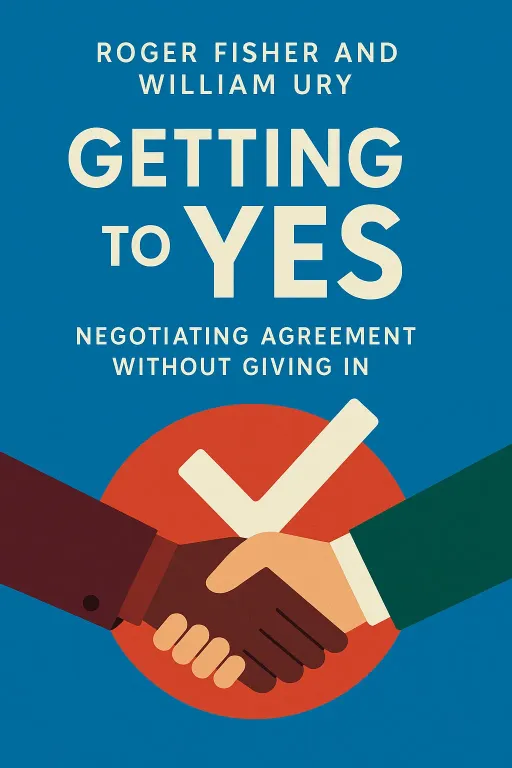
Nova: Today, we're diving into "Beyond the Battlefield: Mastering Conflict Resolution Through Historical Lenses." We'll be drawing profound insights from two seemingly disparate, yet deeply complementary, works: "Getting to Yes" by Roger Fisher and William Ury, and the timeless "Art of War" by Sun Tzu.
Atlas: Fisher and Ury, the negotiation experts, and Sun Tzu, the ancient military strategist? That's an intriguing pairing! I know Fisher was a Harvard Law professor, and his work in negotiation is highly regarded. I remember hearing he played a role in the Camp David Accords, which shows his principles weren't just theoretical. And Sun Tzu's wisdom, well, it's been influencing business leaders for centuries, not just generals.
Nova: Exactly! It's that blend of modern diplomacy and ancient strategic thinking that makes this so powerful. We're going to explore how both these texts, despite their origins, converge on a revolutionary approach to disagreement. But first, let's talk about that initial blind spot. Atlas, how do most people typically approach conflict in their daily lives?
The Blind Spot: Moving Beyond Adversarial Conflict
SECTION
Atlas: My gut tells me it's usually about being. Or, if you're like me, just wanting it to go away. I imagine a lot of our listeners feel that tension between wanting to stand their ground and just wanting peace.
Nova: Right? And that's exactly the blind spot. We're conditioned to see conflict as a zero-sum game, a battle where there must be a winner and a loser. This narrow view, as Fisher and Ury point out, often leads us to positional bargaining. We dig in on our stated positions—"I want this price," "I demand this concession"—rather than exploring the underlying reasons we want those things.
Atlas: Okay, so it's like everyone's wearing boxing gloves before they even start talking, as I said. That sounds rough. What kind of outcomes does that typically lead to?
Nova: Suboptimal, at best. Let me give you a vivid example. Imagine a fast-growing tech startup, let's call them 'InnovateX,' being acquired by a larger corporation, 'GlobalTech.' InnovateX's founders were passionate, brilliant, but deeply entrenched in their valuation. GlobalTech, meanwhile, had a firm budget limit.
Atlas: Classic standoff. Both sides are probably thinking, "This is my bottom line."
Nova: Precisely. InnovateX's position was a specific dollar amount for the acquisition. GlobalTech's position was a lower, fixed number. The negotiation quickly devolved into a tug-of-war over these two figures. Emotions ran high; founders felt undervalued, GlobalTech felt the startup was being unrealistic. They were so focused on their positions that they almost walked away from a deal that could have been incredibly synergistic.
Atlas: That's agonizing. So, they were so focused on they wanted, the price, that they weren't thinking about they wanted it?
Nova: Exactly! The underlying were completely obscured. InnovateX wanted financial security for their team and the resources to scale their vision. GlobalTech wanted to acquire cutting-edge technology and talent to stay competitive. The price was just one manifestation of those deeper interests. Because they were stuck in that blind spot, almost losing a synergistic partnership, they were on the verge of collapsing the entire deal.
The Shift: Principles for Strategic Collaboration
SECTION
Atlas: That story hits home for anyone who's been in a high-stakes negotiation. But what if there's a different way to step into that ring, not to fight, but to build?
Nova: That's where the shift comes in. Fisher and Ury's principled negotiation offers a powerful alternative. Their approach is built on four pillars: first,. Don't let personal animosity or ego hijack the issue. Second,. Ask 'why' until you understand the true motivations. Third,. Brainstorm solutions that benefit everyone. And fourth,. Let facts and fair standards guide the decision, not arbitrary demands.
Atlas: So, it's like, instead of just shouting 'no' or 'my way,' you're asking 'why not, and what work for both of us?' That's a profound reframe.
Nova: It fundamentally changes the dynamic. Now, intertwining with this, we have Sun Tzu's ancient wisdom from "The Art of War." While it's a military treatise, its core philosophy is about strategic non-confrontation. Sun Tzu famously said, "The supreme art of war is to subdue the enemy without fighting."
Atlas: That sounds a bit out there. 'Subdue without fighting?' In modern conflict, it often feels like you to fight. How does that align with mutual gain? Doesn't 'subduing' imply one side still wins over the other?
Nova: That’s a crucial question, and it really highlights the depth of his thought. Sun Tzu isn't advocating for passive surrender. He's advocating for such a profound understanding of yourself and your 'opponent,' and such superior strategy, that direct, destructive confrontation becomes unnecessary. It’s about manipulating the conditions, understanding the terrain, and knowing your adversary's true objectives so well that you can achieve your aims without a costly battle.
Atlas: Okay, so it’s not about tricking someone into losing, but about understanding their motivations so deeply that you can find a path where their needs are met, or their resistance is naturally diffused. Can you give an example of 'strategic non-confrontation' in a modern context?
Nova: Absolutely. Think about a community dispute over land use. Initially, you have residents protesting 'no development', and a developer insisting on 'full development'. A traditional conflict would be endless lawsuits, protests, and a bitter, drawn-out fight.
Atlas: Which sounds like a lose-lose, or at best, a Pyrrhic victory for one side.
Nova: Exactly. Now, apply the shift. The principled negotiation approach would have both sides focusing on interests. Residents might be interested in preserving green space, maintaining property values, and ensuring community well-being. The developer might be interested in profitability, efficient use of land, and positive public relations.
Atlas: And Sun Tzu? How does he fit in there?
Nova: Sun Tzu's wisdom would guide the developer, for instance, to deeply understand the community's concerns, their 'terrain,' and their 'strengths and weaknesses'—their passionate commitment to green space, their political influence. Instead of just pushing for their initial plan, a Sun Tzu-inspired strategy would involve redefining the playing field.
Atlas: So, find a solution that satisfies the deeper interests of both, perhaps even creating new options.
Nova: Precisely. They might invent options for mutual gain: perhaps a hybrid development that incorporates significant green spaces, community gardens, or even dedicates a portion of profits to a local environmental fund. The developer 'subdues' the initial 'enemy' of community opposition not by fighting them, but by strategically aligning with their deeper interests and redefining the victory condition. They achieve their goal of development, but in a way that respects and even enhances the community's interests, leading to a win-win outcome that no one initially thought possible. It's understanding an opponent's true objectives to identify shared interests.
Synthesis & Takeaways
SECTION
Atlas: That’s a powerful synthesis. It feels like both Fisher and Ury and Sun Tzu are telling us that conflict isn't just about what's, but what's and. It's not about being right, but about being effective and wise.
Nova: That's the profound insight, Atlas. Both texts, from different eras and contexts, offer a unified approach: conflict isn't about winning at all costs, but about understanding, strategy, and collaboration. It's about transforming a potentially destructive force into an engine for innovation and stronger relationships. This shift in perspective isn't just for high-stakes business deals or international diplomacy; it's a skill that enriches every interaction, from boardroom negotiations to family discussions.
Atlas: That gives me chills, honestly. Because we all face challenges, big and small, where we feel stuck. So, if we apply these insights, what's one current challenge in our lives where we might be stuck in the 'blind spot,' and how could we reframe it as an opportunity for strategic collaboration?
Nova: It’s a question worth asking, because even a small shift in how we approach disagreement can unlock massive potential for connection and progress.
Nova: This is Aibrary. Congratulations on your growth!