Beyond the Canvas: How to Cultivate a Creative Mindset
8 minGolden Hook & Introduction
SECTION
Nova: What if I told you that 'creative genius' isn't some lighting bolt from the heavens, but a skill, a muscle, that you can actually train and build? Forget the myth of the tortured artist; today, we're talking about deliberate design for innovation.
Atlas: Whoa, really? Because I think for so many people, myself included, creativity feels like this elusive muse that just decides to visit you on a Tuesday morning if you’re lucky. The idea of for it feels almost... heretical to the romantic notion.
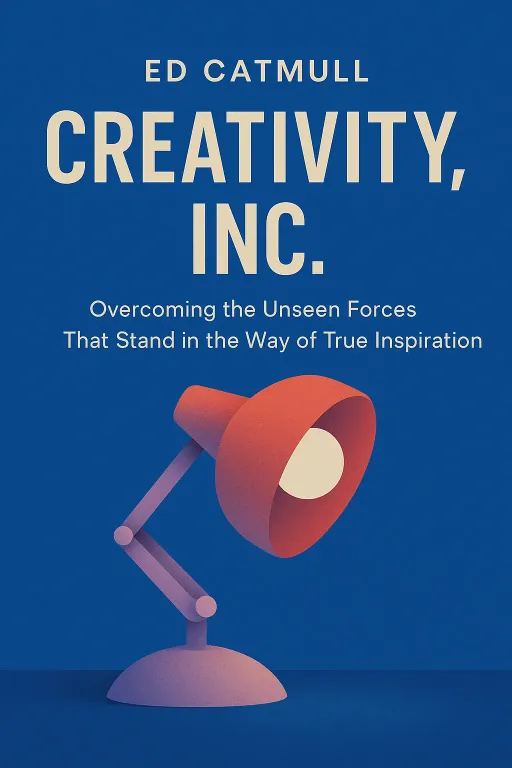
Nova: Exactly! That romantic notion is what "Beyond the Canvas: How to Cultivate a Creative Mindset" aims to dismantle, or perhaps, reframe. This insightful work draws heavily from the titans of innovation, notably Ed Catmull, the co-founder of Pixar, and the profound wisdom of Rosamund Stone Zander and Benjamin Zander from "The Art of Possibility." It's a modern guide for demystifying what often feels like an elusive process, giving us the tools to move from random creative moments to consistent, innovative output.
Atlas: Okay, so it’s not just about waiting for inspiration to strike, but actively making it happen. But how does one cultivate a? That still sounds like a rather abstract concept. How do we get from abstract idea to tangible creative breakthrough?
Deep Dive into Creativity as a Nurturable Process
SECTION
Nova: That's precisely where we start. The cold, hard fact, as our book highlights, is that creativity isn't just a sudden spark; it's a process that can be nurtured and managed. Many believe it’s purely innate, but you can build environments that foster it deliberately. Think of it like this: a gardener doesn't just hope for beautiful flowers; they prepare the soil, ensure the right light, and provide consistent care. Catmull and Pixar did just that, but for ideas.
Atlas: Hold on, Pixar is famous for its groundbreaking animation and incredible storytelling. They’re full of brilliant artists and storytellers. Isn't that just proof that creativity innate, and they just hired the right people? Or had the right kind of talent from the get-go?
Nova: That’s a common interpretation, but Catmull’s genius, as detailed in "Creativity, Inc.," was understanding that even the most brilliant individuals can be stifled by the wrong environment. He didn’t just hire talent; he a culture where that talent could truly flourish. The core of it was creating psychological safety and a culture of candid feedback. Imagine a place where everyone feels safe to speak up, to challenge ideas, and even to admit mistakes, all without fear of reprisal. That’s the rich soil.
Atlas: That sounds almost revolutionary compared to how most organizations operate, especially in high-stakes creative fields where ego can run rampant. How does 'psychological safety' actually manifest in a meeting at Pixar? What does it look like on the ground?
Nova: It manifests most famously in their "Braintrust" meetings. These aren't just polite critiques; they're intense, no-holds-barred discussions where even a director's most cherished scenes or story beats are fair game for rigorous feedback. The critical point is that the feedback is always focused on the, not the person. The goal is to make the film better, not to tear down the director. It’s about being brutally honest with compassion, and everyone understands that. There’s a fundamental trust that everyone in that room is striving for the same perfection.
Atlas: So, it’s not about being 'nice,' but about being 'effective' in a way that allows for growth. That’s a powerful distinction. A historian would note how often innovation has been stifled by rigid hierarchies and fear of challenging authority. So, how do you even begin to implement that in a world that often rewards individual glory over collective improvement?
Deep Dive into Cultivating Creative Environments
SECTION
Nova: And that naturally leads us to the second crucial layer: what we cultivate within ourselves. Because while Catmull builds the external scaffold, Rosamund and Benjamin Zander, through "The Art of Possibility," give us the internal toolkit. They offer practices for bringing passion and imagination to everyday tasks, reframing challenges as opportunities for creative breakthroughs.
Atlas: "The Art of Possibility." That title sounds a bit... ethereal, almost like self-help mantras. How does something like that connect to the nitty-gritty of consistent innovation and problem-solving?
Nova: It connects by shifting our fundamental perspective. The Zanders introduce powerful concepts like "framing" and "reframing." Instead of viewing a mistake as a failure, they suggest we reframe it as an "interesting phenomenon." One of their most impactful practices is "giving an A," which means approaching every person, every situation, with the assumption of their highest potential, as if they already have an 'A' for their effort and intention.
Atlas: Giving an A? So, it’s about assuming the best, even when faced with challenges or clear shortcomings? That feels counter-intuitive to a critical, analytical mind. Doesn't that just lead to complacency or, frankly, lower standards? If everyone has an 'A', what's the motivation to improve?
Nova: It’s not about lowering standards at all, Atlas. It’s about removing the paralyzing fear of failure. When you start with the assumption of an 'A,' you're not judging; you're inquiring. You're asking, "Given that this person is capable of an 'A,' what might be getting in the way? How can we unlock that potential?" It shifts the focus from judgment to possibility, from fear to curiosity. Think of a scientist: a 'failed' experiment isn't a personal failure; it's data that tells them what work, guiding them to new avenues. It’s a profound philosophical reframing of perception.
Atlas: So, it's about changing the internal narrative, not just the external environment. A philosopher would certainly appreciate that reframing of perception. But how does this apply to someone facing a complex, real-world problem right now, not just an abstract challenge? Give me a concrete example.
Nova: Let's say you're an engineer facing a persistent design flaw in a product, or a leader struggling with a demotivated team. Instead of the internal monologue, "I've failed, this is a disaster," the Zanders encourage you to say, "This design is offering interesting data on what to do. How can I reframe this as an opportunity for an entirely new solution?" Or, "My team is showing interesting resistance; what if they're trying to tell me something vital that I haven't heard yet?" It's about proactive curiosity, not reactive despair. It’s about seeing the problem not as an end, but as a beginning.
Synthesis & Takeaways
SECTION
Nova: So, when we connect Catmull’s insights on psychological safety and candid feedback with the Zanders’ practices of reframing and "giving an A," we see a powerful synergy. The external environment supports the internal mindset, and the internal mindset empowers us to engage with that environment productively. Creativity, then, becomes less about waiting for inspiration and more about designing the conditions, both cultural and personal, for inspiration to consistently find us.
Atlas: That’s a really compelling synthesis. It means whether you're trying to foster innovation in a large organization or just trying to be more creative in your daily problem-solving, it’s about designing for possibility, both culturally and personally. It demystifies creativity from a random occurrence to a deliberate, learnable skill.
Nova: Exactly. It's about understanding that creativity isn't a random event, but a deliberate act of design and cultivation. The ability to innovate consistently isn't reserved for a select few; it's available to anyone willing to cultivate the right environment and adopt a mindset of possibility.
Atlas: So, for our listeners, the challenge is simple: as "Beyond the Canvas" suggests, identify one area in your daily routine where you can intentionally invite new perspectives or ideas. Just one. See what happens when you proactively seek opportunity, rather than waiting for it to land in your lap.
Nova: Because true understanding, true growth, and ultimately, true innovation, often come from those moments where we dare to reframe, to nurture, and to build the conditions for the unexpected. It’s about expanding your worldview, not just by learning new facts, but by adopting new ways of seeing.
Atlas: This is Aibrary. Congratulations on your growth!