

Beyond the Canvas: How Artistic Thinking Shapes Strategy and Culture
10 minGolden Hook & Introduction
SECTION
Nova: What if I told you that your biggest business problem isn't a problem at all, but a disguised opportunity? And that the key to unlocking it lies not in spreadsheets, but in the stroke of a painter's brush or the swirl of a conductor's baton?
Atlas: Whoa, that sounds like a bold claim, Nova. My quarterly reports definitely don't have a 'paint by numbers' section. Are we talking about adding more pastels to our strategic planning now?
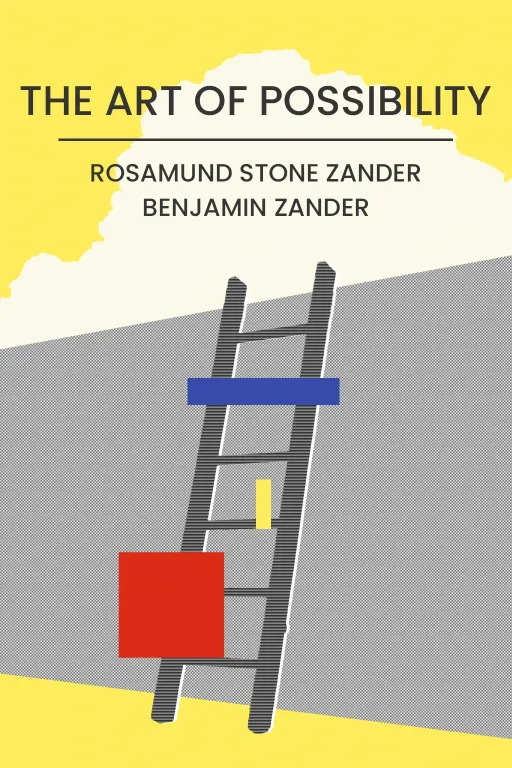
Nova: Not quite pastels, Atlas, but definitely a shift in perspective. Today, we're diving into a book that fundamentally challenges how we view challenges: "The Art of Possibility" by Rosamund Stone Zander and Benjamin Zander. What's truly fascinating about this book, and why it resonates so deeply, is the unique blend of its authors. Rosamund is a family therapist, and Benjamin is a world-renowned orchestra conductor.
Atlas: A therapist and a conductor? That’s an unexpected pairing for a book on what sounds like strategic thinking. Usually, you expect an MBA or a tech mogul.
Nova: Exactly! And that unexpected pairing is precisely why their ideas resonate so profoundly. It brings an extraordinary blend of psychological insight into human potential, combined with the creative leadership and structural understanding required to orchestrate complex systems, like an orchestra or, dare I say, a business. They’re not just talking about business theory; they're exploring a profound human capability.
Atlas: I'm curious. Usually, in business, art and strategy are seen as completely separate endeavors. One is about logic and data, the other about emotion and expression. How do they bridge that gap?
Nova: They argue that the perceived gap is a blind spot. They show us that artistic thinking, with its focus on possibility and framing, isn't some fluffy concept. It's a potent tool for a growth strategist looking to shape dynamic approaches and nurture innovation. And it all starts with reframing.
Deep Dive into Reframing Constraints as Opportunities
SECTION
Atlas: Reframing. I hear that term a lot, but what does it really mean in a high-stakes strategic context? Because when you're facing a budget cut, or a market disruption from a new tech giant, that feels less like a canvas and more like a cliff you're about to fall off.
Nova: That's a perfect way to put it, Atlas. And that's exactly where the Zanders' work shines. Reframing, in their view, isn't naive optimism. It's a deliberate, active choice to shift your perspective on a situation. They view constraints not as barriers that limit action, but as "frames" that define possibility. Think about it: a musical score has constraints—notes, tempo, rhythm—but those aren't limits, they're the very structure that allows for harmony and expression. A painter's canvas has edges, but those edges don't restrict the art; they define the space within which creativity flourishes.
Atlas: I guess that makes sense. The blank page is often harder than a page with some initial guidelines. But how does this work when you're facing a real, tangible business threat? Can you give me a concrete example where this isn't just a philosophical exercise?
Nova: Absolutely. Let's imagine a mid-sized tech company, a leader in its niche, suddenly faces an aggressive new competitor. This competitor is well-funded, has a massive marketing budget, and is rapidly gaining market share. The traditional strategic response might be panic, trying to match them dollar-for-dollar, feature-for-feature, which could quickly drain resources and morale.
Atlas: Right. The classic "fight fire with fire" strategy, which often just burns everyone out.
Nova: Exactly. But applying artistic thinking, the leadership team reframes this aggressive competitor not as a death sentence, but as an "opportunity to innovate with agility and focus." They ask: "What unique strengths do we have that a massive, slow-moving competitor easily replicate?" They realize their agility, their deep understanding of a very specific customer pain point, and their tight-knit, innovative culture are their true assets.
Atlas: So, instead of trying to be a bigger version of the competitor, they lean into what makes them different?
Nova: Precisely. They stop trying to beat the competitor at game and start defining a new game. They pour their limited resources into developing a lean, disruptive product that addresses that specific customer pain point in a radically new way, something the larger competitor, burdened by its own scale and processes, can't pivot to quickly. The outcome? They don't just survive; they carve out a new, highly profitable market segment, becoming an indispensable partner to their core users, effectively out-innovating the giant not by outspending them, but by out-thinking them. They turned a perceived threat into a catalyst for a unique growth trajectory.
Atlas: That sounds great on paper, and it makes sense when you lay it out like that. But changing an entire organizational mindset from "problem-solving" to "possibility-seeking" must be incredibly difficult. What's the first step to even begin that shift?
The Practice of "Giving Up Control" and "Stepping into the World of 'Could Be'"
SECTION
Nova: That leads us to another powerful practice from the Zanders’ book, which might sound counter-intuitive at first, especially for strategists. It's the idea of "giving up control" not as surrender, but as an act of opening to new possibilities, and "stepping into the world of 'could be'." Conventional strategic planning often tries to control every variable, predict every outcome, and minimize every risk. While understandable, this often stifles the very creativity needed for breakthrough growth.
Atlas: Giving up control? For a growth strategist, that sounds like heresy! Our job is literally to the narrative, the market, the trajectory. How do you reconcile that with 'possibility' and still build for impact? It sounds like a recipe for chaos.
Nova: It's a fundamental redefinition of control. It’s not about letting go of responsibility or direction. It’s about letting go of the of absolute control over unpredictable external factors. Instead, you focus your control on your own response, your own frame, and your own capacity to adapt and innovate. Benjamin Zander, as a conductor, understands this intimately. He doesn't control every note played by every musician; he creates a frame, an intention, and then allows the musicians to bring their individual brilliance within that frame, leading to something far richer than if he micromanaged every sound.
Atlas: Okay, so it’s less about rigid command-and-control, and more about creating an environment where possibility can emerge. Still, in a high-stakes environment, that feels risky. Can you give an example of this "giving up control" in a place where the stakes are incredibly high?
Nova: Let's consider an international aid organization responding to a complex humanitarian crisis, say, a natural disaster in a politically unstable region. The situation is constantly evolving, resources are scarce, and local dynamics are unpredictable. A traditional approach might involve rigid, pre-planned logistical protocols and top-down decision-making, designed for maximum control. However, in such a fluid environment, this often leads to delays, inefficiencies, and solutions that don't fit the ground reality.
Atlas: I can see that. Trying to impose a rigid plan on chaos usually just adds to the chaos.
Nova: Exactly. So, a leader adopting this "art of possibility" mindset would "give up control" of the precise, minute-by-minute outcome. Instead, they would focus on empowering local teams, trusting their on-the-ground intelligence, and rapidly adapting their strategy daily based on emergent needs and opportunities. They might decentralize decision-making, provide broad guidelines rather than strict mandates, and foster a culture of rapid experimentation and learning.
Atlas: So, rather than saying, "We deliver 10,000 tents by Tuesday," they're saying, "Our goal is to provide shelter, and we trust our local teams to find the most effective way to do that, even if it means building temporary structures or leveraging community resources we hadn't planned for."
Nova: Precisely. The outcome is not less effective; it's often more resilient, more responsive, and more locally appropriate. The organization builds stronger relationships with the affected communities, learns faster, and ultimately achieves a more sustainable impact than if they had clung to a rigid, top-down "control" model. It's about intelligent responsiveness and allowing solutions to emerge, rather than forcing them.
Atlas: I'm starting to see that this isn't about being passive or chaotic, but about intelligent responsiveness. It's almost like a jazz musician, right? You have a structure, but you're constantly improvising within it, letting the music lead you sometimes.
Nova: That's a perfect analogy, Atlas! Jazz musicians don't abandon structure, but they embrace improvisation, listening, and responding to each other in real-time. The Zanders would say that's exactly the kind of dynamic interplay between structure and freedom, between intention and emergence, that fosters true innovation and possibility in any field, including strategic growth.
Synthesis & Takeaways
SECTION
Nova: So, what we've really explored today is how artistic thinking isn't about ignoring problems, but about actively choosing a frame of infinite possibility. It's about leadership that cultivates growth by seeing beyond the immediate challenge to the inherent potential that lies within any constraint.
Atlas: And for our listeners who are constantly synthesizing complex ideas, who are building for impact and shaping the future, this is about trusting your inherent wisdom to see the bigger picture, even when the immediate canvas looks daunting. It’s about not just solving problems, but them into opportunities for creation.
Nova: It’s a daily practice, not a one-time event. It empowers leaders to shape the future with not just strategy, but with profound creativity and even joy. It’s about moving from a mindset of scarcity to one of boundless possibility.
Atlas: Consider a current challenge you're facing. How would reframe it as an 'opportunity for possibility,' drawing inspiration from an artist's exploration?
Nova: This is Aibrary. Congratulations on your growth!









