The Hidden Power of Constraints: Why Limitations Fuel Innovation in Art.
9 minGolden Hook & Introduction
SECTION
Nova: Everyone says, "Think outside the box." You hear it in every brainstorm, every creative meeting. But Atlas, what if the box is actually your greatest superpower? What if true genius thrives the lines?
Atlas: Oh man, that's a contrarian challenge if I've ever heard one! I imagine a lot of our listeners, the Visionaries and Architects among them, are probably scratching their heads. We're constantly told to seek boundless freedom, to break free from limitations to truly innovate. Why would anyone willingly put themselves a box? That sounds like a recipe for mediocrity.
Nova: Exactly! It counterintuitive, doesn't it? But today, we're diving into a concept that flips that idea on its head: the hidden power of constraints. We're talking about how limitations aren't obstacles to creativity, but often the very fuel for truly original and impactful work. And much of this insight is beautifully articulated by the contemporary artist and author, Austin Kleon, whose work like really makes you rethink everything you thought you knew about creativity.
Atlas: Okay, I'm intrigued. So, we're saying that endless possibilities might actually be the enemy of innovation? That's a big claim.
The Paradox of Freedom: How Constraints Spark Creativity
SECTION
Nova: It sounds like it, but think of it this way: imagine a chef with an unlimited pantry. Every ingredient imaginable, every spice, every piece of equipment. What do they make? Often, it's paralysis. Too many choices, too much freedom. Now, imagine that same chef on a cooking show, given a "mystery box" with only five random ingredients and 30 minutes. Suddenly, their creativity is forced to ignite. They have to be ingenious, resourcefu, and incredibly focused.
Atlas: That makes sense. I can definitely see how having too many options can just lead to decision fatigue, whether you're trying to cook a meal or design a new strategic marketing campaign. But wait, for people striving for truly innovative solutions, doesn't setting limits feel... counterproductive? Like you're handicapping yourself before you even start?
Nova: It absolutely can feel that way. We're conditioned to believe more is always better. But let me tell you about a brilliant example: Dr. Seuss. Yes, Dr. Seuss. His editor, Bennett Cerf, once made a bet with him. Cerf bet Seuss couldn't write a book using only 50 distinct words.
Atlas: No way! is iconic. How many words is that book?
Nova: Exactly 50. The book we all know and love,, was born from that incredibly tight constraint. Seuss, whose usual style was wildly imaginative and linguistically expansive, was forced to simplify, to distill his storytelling to its absolute essence. The cause was a playful bet, the process was a struggle to fit his genius into this tiny box, and the outcome was a timeless classic that not only sold millions but also taught generations of children to read with its repetitive, yet utterly engaging, rhythm and vocabulary. The limitation wasn't a barrier; it was the very engine that produced its unique charm and memorability.
Atlas: Wow. That's incredible. It makes you rethink everything. I mean, we often associate simplification with a lack of depth, but in that case, it created a masterpiece. Is there another instance where a seemingly impossible limitation led to something groundbreaking?
Nova: Absolutely. Consider the Oulipo group, a collective of French writers and mathematicians founded in the 1960s. They deliberately imposed bizarre, often mathematical, constraints on their writing to spark new forms of expression. One of their most famous works is Georges Perec's novel,, which was written entirely without using the letter 'e.'
Atlas: Without the letter 'e'? That's... unthinkable for a full novel! How do you even construct a sentence, let alone a whole story, without one of the most common letters in the alphabet?
Nova: Precisely! The constraint wasn't about making it harder for difficulty's sake. It was about forcing their minds down entirely new linguistic pathways. They had to invent unique vocabulary, restructure sentences, and find creative workarounds. This artificial boundary pushed them far beyond conventional writing, resulting in prose that was undeniably original and often surprisingly beautiful, born directly from the limitation itself. It shows how constraints can literally reshape the way we think and create, leading to forms and ideas that would never emerge from unbridled freedom.
Strategic Borrowing: Reframing Influence as Innovation
SECTION
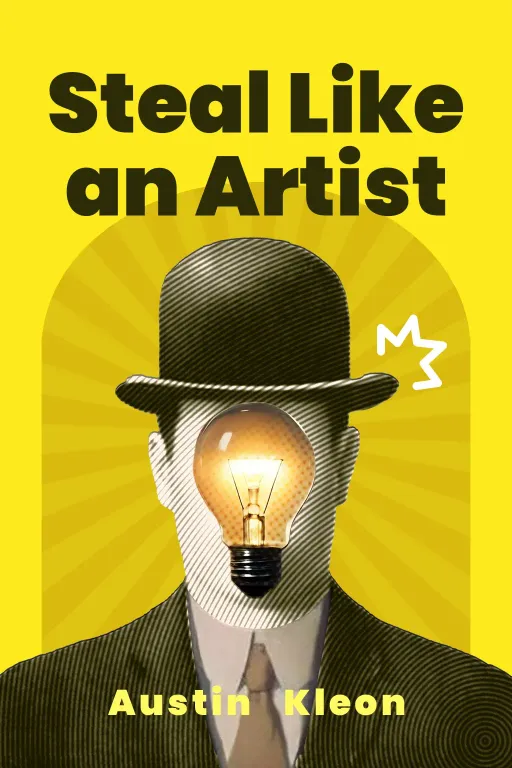
Nova: Speaking of unique pathways and pushing boundaries, that naturally leads us to a second powerful idea that often complements the power of constraints: the art of strategic borrowing. This is where Austin Kleon's "Steal Like an Artist" truly shines.
Atlas: I've heard that phrase before, but it always makes me a little uneasy. 'Steal' sounds a bit... unoriginal, even unethical to some. For someone trying to build a lasting legacy, or an organization focused on sustainable growth, isn't the goal to be completely unique, to build a foundation from scratch?
Nova: That's a common misconception, and Kleon addresses it head-on. He's not advocating for plagiarism; far from it. His core message is that nothing is truly original in a vacuum. Every new idea stands on the shoulders of countless others. True originality isn't about creating something from absolutely nothing, it's about embracing influence, studying what you love, dissecting its components, and then creatively remixing, curating, and transforming those existing ideas into something new. Think of a brilliant DJ taking existing tracks and blending them to create an entirely new soundscape, or a chef taking classic ingredients and combining them in a novel way for a groundbreaking dish.
Atlas: I guess that makes sense. Even Shakespeare borrowed plots for many of his plays. So, it's about being a conscious curator and transformer of information, rather than a solitary inventor. How does someone in a strategic role, say, developing a new market strategy, apply this 'stealing' idea without just copying competitors?
Nova: That's a fantastic question, and it's where the "art" comes in. It's not about direct imitation. It's about identifying what resonates, understanding the underlying principles or mechanics of a successful idea, and then reassembling or applying them in a novel context. For a market strategist, it might mean looking at a successful community-building strategy from a gaming company and adapting its core principles to, say, a B2B SaaS product. Or taking a customer engagement tactic from a non-profit and seeing how it could revolutionize internal team dynamics. It’s about cross-pollination, seeing patterns, and connecting disparate influences to forge something genuinely fresh and impactful.
Atlas: So it's about seeing the fundamental structures and then translating them, almost like a code, into a different language or context. That requires a deep understanding of the 'why' behind things, not just the 'what.' And it fundamentally helps you reframe limitations – like having to work with existing market data or a predefined budget – not as obstacles, but as powerful prompts that can guide and sharpen your creative output.
Nova: Exactly! It's about recognizing that creativity isn't a mystical, spontaneous burst from nothingness. It's often a deliberate, iterative process of working within perceived limitations and intelligently building upon what already exists. It’s about seeing the constraints as a framework, and the existing ideas as a rich palette, rather than an empty canvas.
Synthesis & Takeaways
SECTION
Nova: Ultimately, both embracing constraints and strategic borrowing come down to reframing our relationship with creativity. They turn perceived limitations into powerful prompts, pushing us to be more ingenious, more focused, and ultimately, more original. It’s a mindset shift that can unlock incredible potential.
Atlas: That’s a powerful reframing. For our listeners, the Visionaries, the Architects, the Cultivators, who are constantly seeking to innovate and build, what's a tiny step we can take this week to put this into practice? Something tangible to start with.
Nova: My challenge for everyone this week is simple: Choose one of your current creative projects. It could be anything—a presentation you're preparing, a new product idea you're sketching out, even a difficult conversation you need to navigate. Now, introduce a deliberate constraint. Maybe you can only use three bullet points for that presentation, or you have to develop the product concept using only resources you already possess, or you have to communicate your message in 60 seconds or less. See what ingenuity it sparks.
Atlas: That’s brilliant. It's not about being less creative; it's about channeling that creative energy more effectively, turning pressure into a diamond. It teaches us to trust our inner wisdom, even when the path feels unfamiliar, because often, the most brilliant solutions emerge when we're forced to think differently.
Nova: And that's where true innovation lies. It's not about the absence of boundaries, but the mastery within them.
Atlas: What a fantastic insight. Thank you, Nova, for shedding light on the hidden power of constraints.
Nova: My pleasure, Atlas.
Atlas: This is Aibrary. Congratulations on your growth!