

The Decision Matrix: Crafting Your Mindset from the Courtroom to the Civil Rights Movement
11 minGolden Hook & Introduction
SECTION
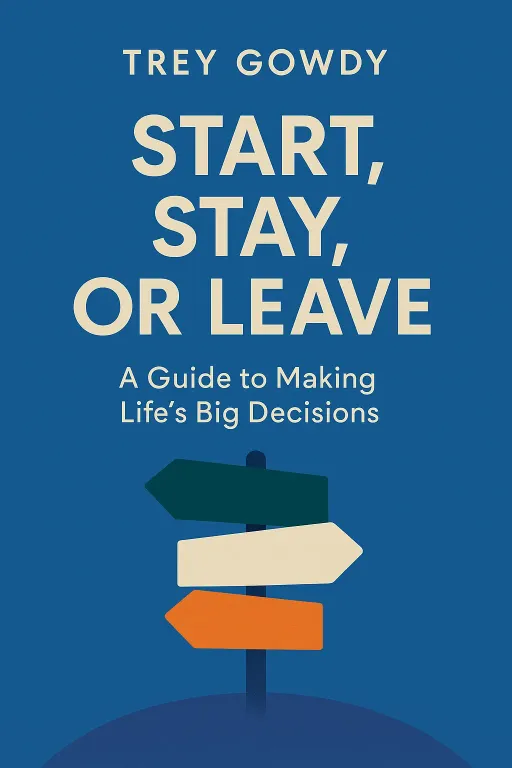
Prof. Eleanor Hart: What if the most important decision you ever make isn't about starting a new job, or leaving a city, or even who you marry? What if it's the decision you make before all of those—the one about how you'll judge your own life? Former prosecutor Trey Gowdy argues that most of us are living our lives trying to meet other people's expectations, and as he puts it, "It is a lifelong sentence they submit themselves to." In his book,, he offers a way out.
Prof. Eleanor Hart: I’m Professor Eleanor Hart, and with me today is Honglei Yang, an analytical thinker who is deeply interested in how we can actively improve our own mindset. Honglei, welcome.
honglei yang: Thanks for having me, Eleanor. It’s a fascinating topic.
Prof. Eleanor Hart: It is. And today we'll dive deep into this book from two powerful perspectives. First, we'll explore why the most important decision is defining your own finish line, before you even start the race. Then, we'll discuss the surprising power of 'staying' put, and how, like Rosa Parks, sometimes the most revolutionary act is to not move at all.
Deep Dive into Core Topic 1: Defining Your Own Finish Line
SECTION
Prof. Eleanor Hart: So, Honglei, let's start with that core idea. Gowdy tells this incredible story from his own wedding day. He's standing at the altar in his hometown church, and the pastor, in front of everyone, makes this grand pronouncement that one day Trey will be governor and his wife, Terri, will be the first lady.
honglei yang: Wow, no pressure there.
Prof. Eleanor Hart: Exactly. And he writes about how that single comment, that external expectation, followed him for years. It became a benchmark for success that he didn't even choose. He spent a huge portion of his life measuring himself against this prediction someone else made for him.
honglei yang: That's such a powerful illustration of an external metric for success. It's something I think a lot of people, especially in their twenties and thirties, grapple with—the pressure from family, from social media, to hit certain milestones by a certain time. You must have this career, this house, this life. It's a recipe for feeling like you're constantly failing.
Prof. Eleanor Hart: It is. And Gowdy's antidote is a concept he borrows from his career as a prosecutor. He says you have to "Start at the End." Before he ever went to trial, he would write his closing argument first. He needed to know the story he was telling, the destination he was driving towards, before he took the first step. For life, he asks: what is the closing argument for life? What will matter on your last day?
honglei yang: I love that. It’s about reverse-engineering your life from your own core values, not from a job title or an award someone else gives you. It’s a fundamental shift in perspective. He also talks about the 'mirror model' of success instead of a ladder or a pyramid, right? I found that really compelling.
Prof. Eleanor Hart: Yes! I was hoping you’d bring that up. Explain that, because I think it's a crucial part of building this mindset.
honglei yang: Well, a ladder or a pyramid, which is our typical model for success, implies you're always climbing, often over others, to get to a single, narrow point at the top. It's inherently competitive and externally focused. You're always looking up at the next rung or at who's ahead of you.
Prof. Eleanor Hart: And your success is defined by your position relative to others.
honglei yang: Precisely. But a mirror… success is just you. The only person you're accountable to is the one in the reflection. It's about what you can actually control: your effort, your words, your integrity, your mindset. The conversation about your worth becomes internal, not external. And for anyone looking to improve their mindset, that's the foundational work. You have to change the forum where your success is debated.
Prof. Eleanor Hart: That's a perfect summary. It's about shifting the scorecard from the world's hands into your own. It’s not about winning the game; it’s about defining what game you’re even playing.
honglei yang: And once you do that, the decisions of 'start, stay, or leave' become so much clearer, because you're measuring them against your own rubric, not someone else's.
Deep Dive into Core Topic 2: The Activist's 'Stay'
SECTION
Prof. Eleanor Hart: And that internal scorecard is what gives you the strength for the next big question: Do I stay? We often think of 'staying' as passive, as a failure to act. But Gowdy argues that 'staying' isn't a consolation prize. It can be an active, powerful choice to build, to improve, to commit.
honglei yang: It’s a choice that requires just as much, if not more, conviction than leaving.
Prof. Eleanor Hart: Absolutely. But to make that choice wisely, he says you need honest counsel. He has a whole chapter called "Find Your Nathan," which I found fascinating. It's a reference to the biblical story of King David, who is confronted by the prophet Nathan over a terrible abuse of power. Nathan is the one person who dares to tell the king the truth. A "Nathan" is that person in your life who will correct you, who has your best interests at heart, and isn't just a cheerleader.
honglei yang: The person who tells you what you need to hear, not what you want to hear.
Prof. Eleanor Hart: Exactly. Gowdy talks about his father being that person for him, guiding him through tough career choices. But this is where the book, for me, really opened up when I thought about your interests, Honglei. We often think of these big, world-changing moments as acts of 'starting' something new or 'leaving' an old system. But your mention of Rosa Parks earlier, Eleanor, is the ultimate example of a powerful 'Stay' decision.
Prof. Eleanor Hart: I'm so glad you're making this connection. Tell me more. How do you see her story through this framework?
honglei yang: Well, on December 1st, 1955, her decision was literally to in her seat on that Montgomery bus. On the surface, it was an act of non-movement. But it wasn't passive at all. It was the most active, courageous, and deliberate choice she could have made in that moment. It was a "Stay" that became the "Start" of a revolution.
Prof. Eleanor Hart: And she had already done the work Gowdy talks about. She had "started at the end."
honglei yang: Absolutely. She was a longtime activist with the NAACP. She knew the world she wanted to live in, a world without segregation. She had a deep sense of purpose that was purely internal—it wasn't for fame or recognition. It was based on her own 'mirror model' of dignity and justice. That internal mindset gave her the strength to make that decision.
Prof. Eleanor Hart: And what about her "Nathans"? She wasn't acting in a vacuum.
honglei yang: No, and that's the critical part. She wasn't alone. She had her 'Nathans'—the NAACP, leaders like E. D. Nixon, her husband Raymond, the whole community that was ready to mobilize around her. They were the trusted counsel and the support system that could turn her individual act of 'staying' into a collective movement. Her 'stay' was the catalyst for the Montgomery Bus Boycott, which was a massive decision to 'leave' the system of segregation.
Prof. Eleanor Hart: That's a brilliant connection. You're reframing 'Stay' from a personal choice about a job to a political act of resistance. Gowdy's framework, which comes from a prosecutor's pragmatic world, suddenly takes on this immense historical weight.
honglei yang: Exactly. It shows that improving your mindset isn't just for personal peace or career advancement. A strong internal compass, a clear sense of your 'closing argument,' is what gives you the courage to make a stand—whether that's in a boardroom, in your family, or on a bus in Montgomery, Alabama. Her decision to 'stay' was a profound decision to 'leave' injustice behind.
Synthesis & Takeaways
SECTION
Prof. Eleanor Hart: So, when we pull these threads together, what we've really uncovered is that whether you Start, Stay, or Leave, the real work happens before the decision. It's in those quiet moments of defining your own success, as you said, Honglei, of building that internal mindset.
honglei yang: Right. It’s about crafting that internal mirror so that your reflection shows someone you respect, based on your own values. And it's about understanding that sometimes the most powerful action is to 'stay' with conviction. It's not about being stuck; it's about being rooted in your purpose.
Prof. Eleanor Hart: A perfect place to leave it. So for our listeners, we'll leave you with this question, inspired by Honglei's incredible insight: What is a 'Stay' decision you could make in your life right now—a commitment to a value, a project, or a principle—that could actually be the 'Start' of your most important work yet?
honglei yang: A powerful question to ponder.
Prof. Eleanor Hart: Honglei Yang, thank you so much for this wonderful conversation.
honglei yang: Thank you, Eleanor. It was a pleasure.









