Building Resilience: How Ancient Wisdom Prepares You for Modern Challenges
9 minGolden Hook & Introduction
SECTION
Nova: Most people believe modern life is uniquely stressful, a constant barrage of unprecedented challenges. What if that very belief is the biggest obstacle to thriving?
Atlas: Huh, that's a bold statement, Nova. I think a lot of our listeners, especially those in high-pressure leadership roles, probably feel exactly that — bombarded. What makes you say that belief is the problem?
Nova: Because it creates a 'blind spot.' We get so focused on controlling the external, the things we control, that we completely overlook our most powerful asset: our response. And today, we're diving into two ancient texts that fundamentally solve this problem: Marcus Aurelius's and Viktor Frankl's.
Atlas: Oh man, two titans. Marcus Aurelius, the Roman Emperor whose personal journal became a cornerstone of Stoicism, writing about self-mastery amidst running an empire. And Frankl, a Holocaust survivor, who theorized about finding meaning in suffering experiencing it. Talk about credibility.
Nova: Absolutely. It's fascinating how Aurelius, in a position of ultimate worldly power, and Frankl, stripped of all power, arrived at similar, profound conclusions about human resilience. They both tapped into this incredible inner resource.
Atlas: So, let's tackle this 'blind spot' first. How does it manifest in our high-stakes modern world, and why is it such an issue for, say, a strategic leader?
The Blind Spot: External Overwhelm vs. Internal Power
SECTION
Nova: Well, think about it. Our culture constantly bombards us with things to worry about: the economy, global events, market fluctuations, what someone said on social media. We're conditioned to believe that our well-being is directly tied to these external factors. When they're chaotic, we feel chaotic.
Atlas: That resonates. It’s like we're constantly scanning the horizon for threats, and our internal state just mirrors the external turmoil. It feels almost impossible to disconnect from that.
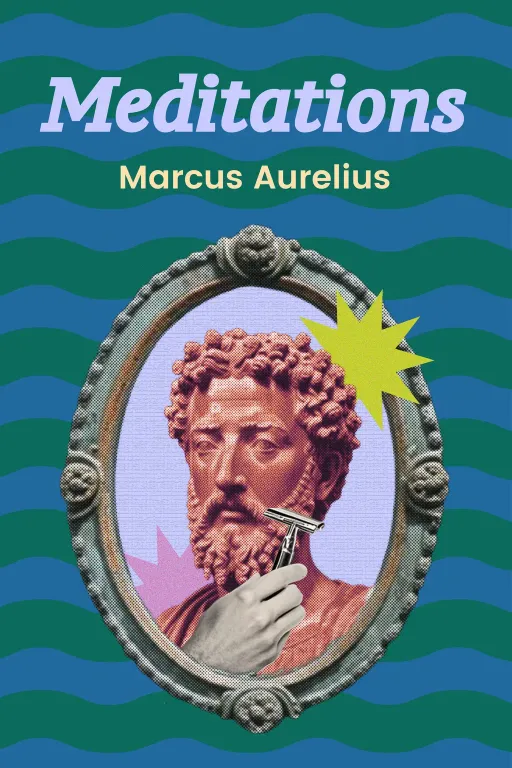
Nova: Exactly! And that's the blind spot. We're trying to control the uncontrollable. Marcus Aurelius, in his, which he wrote purely for himself, not for publication, was essentially practicing this internal separation. Imagine being the most powerful man in the world – a Roman Emperor – constantly dealing with wars on the frontier, plagues decimating your population, political betrayals, personal losses, children dying. His life was a masterclass in external pressure.
Atlas: That's an understatement. He literally had the weight of the world on his shoulders. So, what was his secret? How did he not just crumble under that?
Nova: He learned to focus on what he control. His core Stoic insight was: "You have power over your mind – not outside events. Realize this, and you will find strength." He wasn't saying ignore the wars or the plague. He was saying, "I can't control if a war starts, but I can control how I prepare for it, how I lead my troops, how I respond to setbacks, and crucially, my own judgment and character."
Atlas: That sounds incredibly empowering, but also… incredibly difficult. For someone leading a team or a company, the external like everything. Market shifts, competitor moves, employee morale – it all feels like it demands control. Are you saying we just… ignore those things?
Nova: Not at all! That's the common misconception about Stoicism. It's not about apathy or ignoring reality; it's about control. Aurelius was a brilliant general and administrator. He made strategic decisions, he fought battles. But he understood that the of the battle, the of a subordinate, the of a plague – those were outside his ultimate control. What he control was his discipline, his effort, his virtue, and crucially, his emotional response.
Atlas: So it’s about a strategic allocation of mental energy. Instead of pouring all your energy into trying to manipulate external variables you can't guarantee, you focus it on the variables you absolutely own: your own actions, your own inner state, your own character. That's a powerful reframe for leaders who often feel responsible for.
Nova: Precisely. He was constantly reminding himself, "This is what I can do. The rest is fate." It's a radical act of self-mastery that frees up immense mental bandwidth.
The Shift: Cultivating Inner Strength through Stoicism and Meaning
SECTION
Nova: And that naturally leads us to an even more profound, almost unbelievable example of this principle, pushed to the absolute extreme: Viktor Frankl. If Aurelius showed us how to find strength in a position of immense power, Frankl showed us how to find it in absolute powerlessness.
Atlas: Wow. You're talking about Frankl's experience in the Nazi concentration camps. I mean, there's no greater external suffering or lack of control than that.
Nova: Absolutely. Frankl, a psychiatrist, was stripped of everything: his family, his freedom, his dignity, even his name, reduced to a number. He witnessed horrors unimaginable. Yet, he observed something remarkable among the prisoners. Amidst the same unimaginable suffering, some succumbed, while others, a smaller but significant number, maintained a flicker of hope, a sense of purpose.
Atlas: That's incredible. How? What was the difference?
Nova: Frankl's insight, which became the cornerstone of his logotherapy, was this: "Everything can be taken from a man but one thing: the last of the human freedoms – to choose one's attitude in any given set of circumstances, to choose one's own way." He consciously chose his response. He found meaning in secretly helping other prisoners, in observing human behavior, in clinging to the thought of his wife and his unfinished manuscript. He turned his suffering into a laboratory for understanding the human spirit.
Atlas: That's a gut punch. To think that even in the literal worst-case scenario, the human spirit has that unassailable core of choice. For our strategic seekers, who are constantly striving for impact and results, this is a radical perspective. It means even if a project fails, a market crashes, a strategy goes sideways, the we derive from the effort, the lessons we learn, the character we build – that is still within our control.
Nova: Precisely. It's not about being 'happy' in suffering, but about finding a 'why.' Frankl believed that finding meaning isn't just a psychological trick; it's a fundamental human need. He saw those who had a 'why' – a purpose, a loved one, a task – were more likely to survive. It’s an active, even defiant, act of self-determination. It fundamentally changes the game from 'what is happening to me?' to 'what am I going to do about what is happening to me, and what meaning can I find in it?'
Atlas: So, if Aurelius gave us the framework for controlling our in demanding situations, Frankl showed us how to find and even when everything else is stripped away. It's like a two-pronged attack on helplessness, giving you an internal anchor no matter the storm.
Nova: Exactly! And this isn't just ancient philosophy; it's a practical framework for modern leadership. A leader who understands this won't be derailed by external chaos. They'll focus on their integrity, their decision-making process, and the meaning they and their team derive from their work, regardless of market volatility.
Synthesis & Takeaways
SECTION
Nova: So, these two figures, separated by millennia and vastly different circumstances, converge on the same profound truth: our ultimate freedom lies in our inner response. The blind spot is thinking challenges are purely external; the shift is realizing our greatest power is internal.
Atlas: That's a powerful synthesis. For anyone listening who's navigating complex projects, leading teams, or just trying to stay afloat in a volatile world, the actionable insight is clear: you don't control the waves, but you absolutely control your ship's rudder and where you're ultimately trying to steer it. It's about cultivating that inner resolve and purpose.
Nova: And it's a practice, a daily discipline. Just like Aurelius wrote his to himself every morning, we can consciously choose our attitude, find meaning in our struggles, and focus our energy on what truly matters – our actions and our character. It's the ultimate strategic advantage in any environment.
Atlas: Absolutely. So, the deep question for our listeners this week: when faced with a difficult situation, what is one thing you can control about your reaction, even if you can't control the situation itself? Reflect on that, apply it, and start building that unshakeable inner core.
Nova: A profound challenge for profound growth. This is Aibrary. Congratulations on your growth!