

The Six Pillars of Modernity
6 minIntroduction
Narrator: Imagine standing on the edge of a vast, man-made canyon in the Nevada desert. Below, trucks the size of three-story buildings crawl across the landscape. Suddenly, a countdown echoes, and a section of the mountain disappears in a plume of dust and rock. This isn't a scene from a disaster movie; it's the daily reality of gold mining. To produce a single standard gold bar, workers must blast, crush, and process nearly 5,000 tonnes of earth—the weight of ten fully-loaded jumbo jets. This visceral experience led author and economist Ed Conway to a startling question: if this is what humanity does for a metal we could mostly live without, what does it take to get the materials we truly depend on? And what, exactly, are they?
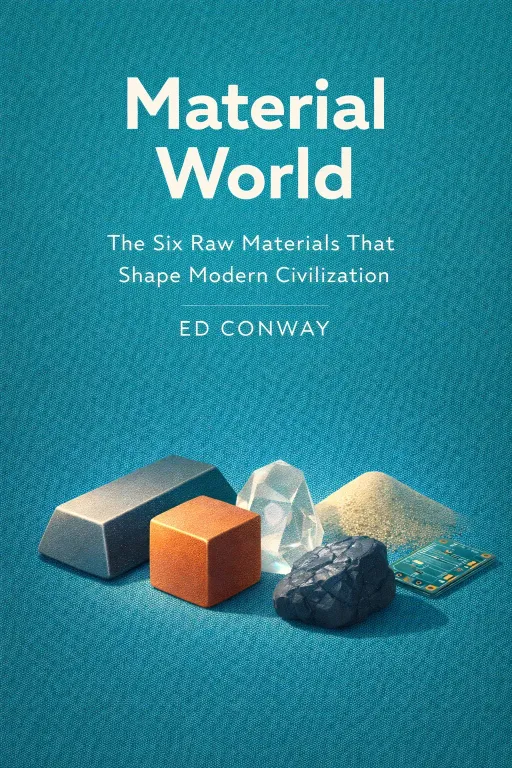
In his book, Material World: A Substantial Story of Our Past and Future, Conway embarks on a global journey to answer that question. He reveals that for all our talk of a "dematerialized" digital economy, our civilization is more dependent than ever on a handful of physical substances. This is the story of the hidden world that underpins our own, a world of sand, salt, iron, copper, oil, and lithium.
The Illusion of a Weightless World
Key Insight 1
Narrator: The book’s central argument is a direct challenge to the modern belief that we live in a weightless, digital world. While value seems to be shifting to intangible assets like software and online services, this digital realm is built upon a massive and growing physical foundation. Conway argues that our dependence on the material world is not shrinking; it's accelerating at an unprecedented rate.
To illustrate this, he points to a staggering statistic: in 2019 alone, humanity extracted more raw materials from the earth than the total amount extracted from the dawn of civilization all the way up to 1950. This trend isn't slowing down. This disconnect between perception and reality is what Conway calls the great illusion of our time. We are blind to the complex, globe-spanning supply chains that deliver our everyday products. He references the famous essay "I, Pencil," which details the thousands of people and myriad resources from across the world required to create a simple pencil. If a pencil is that complex, a smartphone is a miracle of global coordination. Yet, we rarely consider the miners, chemists, engineers, and factory workers who make it possible. This invisibility is dangerous, as recent shortages of everything from carbon dioxide for the food industry to borosilicate glass for vaccine vials have shown. Our world is far more fragile than we think, held together by a web of materials we take for granted.
The Unsung Trinity of Civilization: Sand, Salt, and Iron
Key Insight 2
Narrator: Conway structures his journey around six critical materials, starting with three that have formed the bedrock of civilization for millennia, yet continue to define our modern age in surprising ways.
First is sand. We dismiss it as common, but it is the second-most-used resource on the planet after water. It is the key ingredient in concrete, the substance that builds our cities. But this demand has a dark side, fueling illegal "sand mafias" and causing devastating environmental damage. Yet sand has another, more sophisticated identity. When purified to an almost impossible degree, it becomes silicon—the foundation of every computer chip on Earth. Conway takes us inside the hyper-clean fabs of companies like TSMC, where a single grain of dust can ruin a multi-billion dollar process, revealing how this humble material is the brain of our digital world.
Next is salt. Historically, its ability to preserve food made it a source of immense power, shaping trade routes, financing empires, and even sparking revolutions. Conway recounts how Mahatma Gandhi’s 1930 Salt March, a protest against the British salt tax, became a powerful symbol of resistance that helped cripple colonial rule. Today, salt’s importance is less visible but even more profound. Through an industrial process called chloralkali, it is split into chlorine and caustic soda—chemicals essential for purifying our water, producing medicines, and manufacturing countless other products.
Finally, there is iron. Forged into steel, it is the skeleton of our world. Conway uses the dramatic story of the Azovstal Iron and Steel Works in Mariupol, Ukraine, to make his point. This sprawling complex, a city within a city, became a fortress during the 2022 Russian invasion, a testament to steel's role in both building nations and waging war. As one Ukrainian industrialist states in the book, "You don't have a country without steel."
The Conductors of Modernity: Copper and Oil
Key Insight 3
Narrator: While the first trinity built our world, the next two materials electrified and energized it. Copper is the metal of the electrical age. Its unique properties of conductivity and ductility make it the indispensable medium for transmitting power and information. To illustrate the sheer scale of our demand, Conway takes us to the Chuquicamata mine in Chile, a gargantuan hole in the earth so vast it can be seen from space. For over a century, this single mine has supplied the copper that wires our homes, powers our industries, and connects our world. As we move towards an electric future, our hunger for copper is only set to grow, pushing humanity to consider controversial new frontiers like deep-sea mining.
Then there is oil. We think of it primarily as a fuel, but Conway reveals it as "The Everything Thing." Through the alchemy of refining, crude oil is transformed into a vast array of petrochemicals. These are the building blocks for plastics, fertilizers, pharmaceuticals, textiles, and countless other goods. He uses the example of a modern greenhouse tomato—grown with fossil-fuel-derived fertilizers, protected by plastic sheeting, and transported in a diesel truck—to show how deeply our food system is enmeshed with oil. The plastic that encases our world, from life-saving medical devices to single-use packaging, is a direct product of this material.
The Paradox of a Green Future
Key Insight 4
Narrator: The book's most challenging insight arrives in its final section, which focuses on lithium and the future of energy. Here, Conway presents a crucial paradox: the transition to a green, sustainable economy will require the biggest expansion of mining in human history.
Building a world of electric vehicles, wind turbines, and solar panels is not an act of dematerialization; it is an act of profound rematerialization. A single offshore wind turbine can contain hundreds of tonnes of steel, tonnes of copper, and blades made from fossil-fuel-derived resins. An electric car contains far more copper than a conventional one, and its battery is a dense package of critical minerals.
The story of lithium, or "white gold," exemplifies this challenge. Conway travels to Chile's Atacama Desert, where lithium is extracted by evaporating immense quantities of ancient brine from beneath the salt flats, a process that consumes vast amounts of water in one of the driest places on Earth. This lithium is then shipped to "Gigafactories" to be assembled into the "jelly rolls" that power our EVs. While the cost of this technology is falling thanks to what is known as Wright's Law—the principle that costs decrease as production volume increases—this entire virtuous cycle depends on a secure and ever-growing supply of raw materials. Some estimates suggest we will need to mine more copper in the next 22 years than has been mined in the last 5,000.
Conclusion
Narrator: The single most important takeaway from Material World is that humanity cannot escape its physical reality. Our digital and green ambitions are not separate from the world of mines, refineries, and factories; they are wholly dependent on it. The path to a sustainable future does not involve transcending our need for materials, but rather developing a far deeper and more honest understanding of where they come from and what it costs to get them.
Ed Conway leaves us with a profound and unsettling challenge. To save the planet from the consequences of burning fossil fuels, we must first dig up and process more of the planet than ever before. The critical question for our time is not if we will remain dependent on the Material World, but whether we can become intelligent, innovative, and responsible enough to manage that dependence without destroying our only home.