

The Investor's Mind: How to Learn Like a Pro for Peak Performance
10 minGolden Hook & Introduction
SECTION
Nova: Robin, it's great to have you. I want to start with a question. You're interested in these titans of industry—Warren Buffett, Bill Gates, Jeff Bezos. We talk a lot about their vision, their risk tolerance, their business acumen. But what do you think is the single most underrated skill they all share?
Robin: That's a great question, Nova. My immediate thought goes to something like capital allocation for Buffett, or maybe an obsessive focus on the customer for Bezos. But underrated? Hmm. Maybe it's their ability to filter signal from noise. The sheer volume of information they process is staggering.
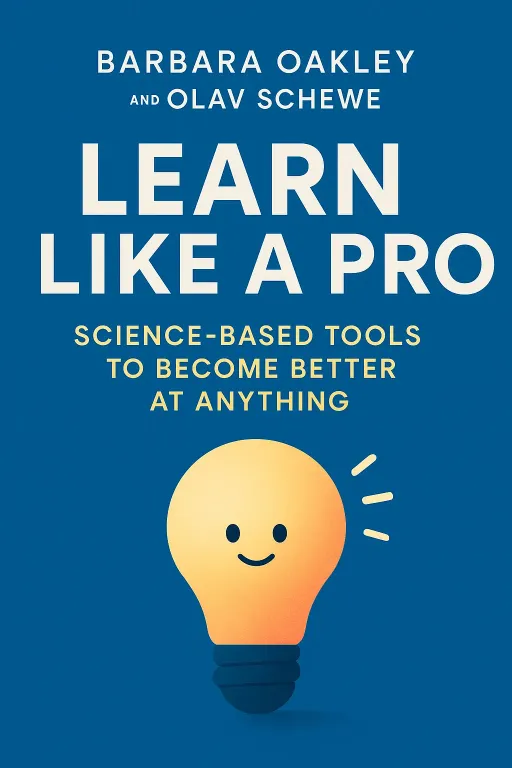
Nova: Exactly! And that's the perfect entry point for our conversation today. I think their true superpower, the engine behind everything else, is their ability to. Buffett famously spends 80% of his day reading. They are professional learning machines. And today, we're diving into the instruction manual: the book "Learn Like a Pro" by Barbara Oakley and Olav Schewe.
Robin: So, not just to learn, but the fundamental mechanics of to learn effectively. I love that. It’s the operating system for the brain.
Nova: Precisely. And we're going to tackle this from two powerful angles. First, we'll explore how to break through those frustrating mental blocks when you're stuck on a complex problem. Then, we'll discuss how to manage your brain's very limited bandwidth to process information more effectively, just like a high-performing leader. Ready to upgrade your mental toolkit?
Robin: Absolutely. Let's get into it.
Deep Dive into Core Topic 1: Mastering the 'Stuck' State
SECTION
Nova: Okay, so let's start with a scenario I think everyone, especially in a high-stakes field, can relate to. You're staring at a spreadsheet, a report, a strategic document... and you're just stuck. The harder you focus, the more the solution seems to slip away. Your brain just hits a wall.
Robin: All the time. It’s that feeling of spinning your wheels. You know the answer is in there somewhere, but you can't access it. You just keep running the same failed logic over and over.
Nova: Well, the book explains this beautifully by introducing two different modes of thinking our brain uses: the Focused mode and the Diffuse mode. The Focused mode is exactly what it sounds like—it's that intense, laser-like concentration you use when you're analyzing details or executing a known procedure. But the problem is, intense focus can also block you from seeing new solutions.
Robin: It creates blind spots. You’re so zoomed in on the trees you can’t see the forest.
Nova: Exactly. And to get to the forest, you need to activate the Diffuse mode. This is a more relaxed, big-picture state of mind. It’s what happens when you go for a walk, take a shower, or just let your mind wander. It’s in this mode that your brain makes surprising connections in the background. The book has a perfect story for this. One of the authors, Olav, was flying his drone.
Robin: Okay, I'm listening.
Nova: He crashes it, and it gets stuck high up in the thin branches of a tall tree. So, he enters focused mode. He throws rocks, he throws sticks, he analyzes the tree trunk to see if he can climb it—all logical, focused efforts. And nothing works. He is completely, utterly stuck.
Robin: I can feel the frustration.
Nova: So what does he do? He gives up. He stops focusing on it. He just walks away and lets it go. Later, as he's doing something completely different, his diffuse mode kicks in and delivers an 'aha!' moment. The idea just pops into his head: attach a fishing line to an arrow, shoot the arrow over the branch, and then use the line to shake the branch until the drone falls. It's a creative, out-of-the-box solution his focused brain could never have come up with.
Robin: That is a brilliant analogy. It's exactly what happens when you're wrestling with a financial model. You can be so focused on a single formula that you miss a fundamental flaw in your assumptions. The best thing you can do is often to close the laptop and go for a run. When you come back, the error is suddenly obvious.
Nova: And you can even weaponize this! The book suggests something called the "Hard Start Technique," especially for tests or reports. You start by tackling the absolute hardest problem first. Spend just a few minutes on it. Even if you don't solve it, you've now loaded it into your brain.
Robin: Ah, so you’re priming the diffuse mode.
Nova: You got it! Then you switch to the easier problems. While your focused mind is racking up points on the easy stuff, your diffuse mode is working on that hard problem in the background. When you come back to it later, you might find you have a fresh insight or a new path forward.
Robin: That's a fantastic productivity hack. It’s like delegating the toughest task to your brain's subconscious background processor. For anyone facing a day of varied tasks, starting with the big strategic challenge for 15 minutes before diving into emails could be a game-changer.
Deep Dive into Core Topic 2: Taming the 'Attentional Octopus'
SECTION
Nova: And speaking of background processors, that brings us to our second big idea: the actual capacity of our brain to handle information at any given moment. It’s way, way smaller than we think. The book uses this incredible metaphor of an "attentional octopus."
Robin: An attentional octopus? I'm intrigued.
Nova: Imagine your conscious mind, your working memory, is an octopus. But it's a bit of a sad octopus, because it only has about four tentacles. Each piece of information you are actively trying to hold and manipulate in your mind takes up one tentacle.
Robin: Only four? That's... terrifyingly low.
Nova: Isn't it? So, if you're trying to understand a new concept from a report, that's one tentacle. You're trying to remember what your boss said about it, that's a second. You're thinking about what to say next, that's a third. And then your phone buzzes with a notification... and that's your fourth tentacle. Your working memory is now completely full. You literally don't have the mental space to think deeply or creatively.
Robin: That is the most accurate description of modern work life I have ever heard. It explains why a single, tiny interruption can completely derail a complex train of thought. You're not just distracted; your cognitive capacity is literally maxed out.
Nova: And the science backs this up. The book cites research showing that when people try to multitask, their cognitive performance plummets by 30 to 40 percent. We feel like we're doing more, but we're actually just switching between tasks very inefficiently and with a much higher error rate.
Robin: So the key isn't to get better at multitasking, it's to get better at multitasking.
Nova: Exactly. It's about fiercely protecting those four tentacles for the one thing that matters most at that moment. And some of the most brilliant minds in history understood this instinctively. The book tells the story of the novelist Victor Hugo when he was facing a deadline for "The Hunchback of Notre-Dame."
Robin: What did he do?
Nova: He was a social butterfly and easily distracted by parties and visitors. So, to force himself to write, he gathered up all of his formal clothes, gave them to his servant, and told him to lock them away and not return them until the book was finished. He was left in his study, naked, with just a pen, paper, and a large shawl.
Robin: No way. That's extreme.
Nova: It's totally extreme! But it's a powerful illustration of the principle. He knew his working memory was vulnerable, so he created an environment where distraction wasn't just difficult, it was impossible. He couldn't go outside. He had nothing else to do. So, he wrote a masterpiece.
Robin: Okay, so I'm not advising my team to lock away their clothes. But the principle is profound. It’s about designing your environment and your schedule for deep work. It’s why leaders block off "thinking time" in their calendars or have "no meeting" days. They are protecting their attentional octopus from the thousand tiny things that want to grab a tentacle.
Nova: It’s a conscious, strategic choice. You have to build a fortress around your focus. Turn off notifications. Close unnecessary tabs. Put your phone in another room. Each one of those actions frees up a tentacle for what truly matters.
Synthesis & Takeaways
SECTION
Nova: So, as we wrap up, we've really landed on two incredibly powerful, science-backed strategies from "Learn Like a Pro." First, understanding and using both the focused and diffuse modes of thinking to solve hard problems and break through mental blocks.
Robin: Right, knowing when to lean in and when to step back and let your mind work its magic in the background.
Nova: And second, recognizing that our working memory is incredibly limited—that four-tentacled octopus—and that our primary job is to protect it from the constant storm of distractions so we can engage in deep, meaningful thought.
Robin: It really reframes the whole idea of productivity. It’s not about hustle or working longer hours. It’s about being strategic with your brain's natural systems. For anyone in leadership or finance, mastering these two concepts isn't just a nice-to-have for personal efficiency; it's a genuine competitive advantage. It’s how you make better decisions, see connections others miss, and ultimately, perform at a higher level.
Nova: Beautifully put. So, for our listeners, here’s a simple call to action. Don't try to change everything at once. Just try one experiment. The next time you face a task you've been procrastinating on, use the Pomodoro Technique mentioned in the book. Set a timer for just 25 minutes, remove all distractions, and give it your full, undivided attention.
Robin: And I'll add one more layer to that. As you do that 25-minute sprint, be a scientist of your own mind. Notice what thoughts try to pull your attention away. Which of your octopus's tentacles are being tugged? Just observing that is an incredibly powerful first step to taking back control.
Nova: I love that. It's not just about learning, it's about metacognition—thinking about how you think. Robin, this has been fantastic. Thank you for bringing such a sharp, analytical perspective to these ideas.
Robin: The pleasure was all mine, Nova. This is the kind of stuff that can genuinely change how you operate every single day.









