Beyond the Hype: The Science of Effective AI Integration in EdTech.
9 minGolden Hook & Introduction
SECTION
Nova: What if I told you the biggest mistake most edtech companies make with AI isn't a lack of data or talent, but something far more fundamental – a simple misunderstanding of what AI actually?
Atlas: Whoa, that's a bold claim right out of the gate, Nova. A simple misunderstanding? I mean, we're bombarded with headlines about AI doing everything from writing novels to passing medical exams. It feels pretty complex, not simple. What this massive blind spot you’re talking about?
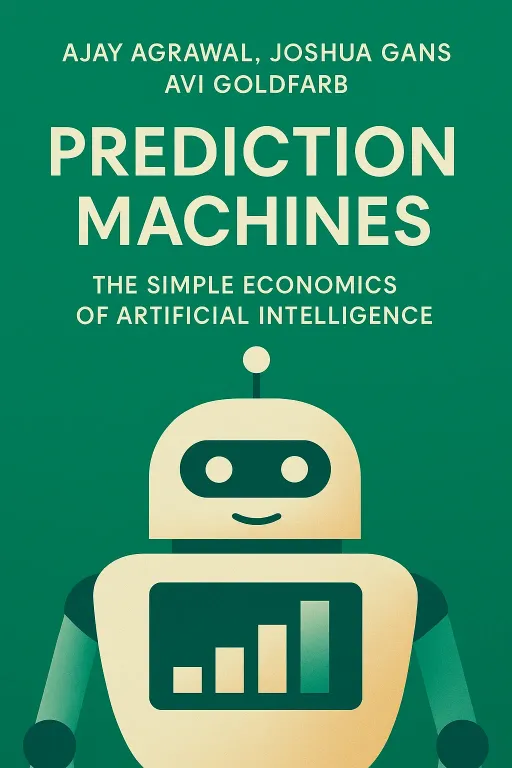
Nova: It's the difference between seeing AI as a magic wand that solves everything, and seeing it as a highly specialized, incredibly powerful screwdriver. And that distinction, that shift in perspective, is what separates the edtech ventures that are thriving with AI from those still just chasing headlines. This insight comes from two phenomenal books we're pulling from today: "Prediction Machines" by Ajay Agrawal, Joshua Gans, and Avi Goldfarb, and "Human + Machine" by Paul R. Daugherty and H. James Wilson.
Atlas: Ah, "Prediction Machines" – I've heard that title thrown around. Aren't Agrawal, Gans, and Goldfarb those economists from the Rotman School?
Nova: Exactly! And their background as economists is crucial because they don't approach AI from a purely technical or futuristic angle. They view it through the lens of fundamental economics, which completely reframes how businesses, and especially edtech, should be thinking about and applying this technology. Their work is both intellectually rigorous and immensely practical, moving us from abstract potential to concrete, strategic application.
Atlas: Okay, so it’s not about the sci-fi dream, but the economic reality. That’s a fascinating angle. So, if we're not just waving a magic wand, what's this "blind spot" you mentioned that's tripping up so many in edtech?
The Blind Spot: AI as Magic vs. Augmented Tool
SECTION
Nova: The blind spot, Atlas, is seeing AI as magic itself, rather than a tool that augments very specific human capabilities. Think of it this way: if you wanted to build a house, you wouldn't just wish for a "magic house builder." You'd hire skilled carpenters, electricians, plumbers, and give them incredibly precise, powerful tools. AI is one of those tools, but we often treat it like the magic house builder.
Atlas: But wait, looking at some of the things AI do, isn't some of it magic? We see these generative AI models creating art, writing code, tutoring students. For someone building a 0-1 growth strategy, the sheer breadth of what's possible can feel overwhelming. It almost like a magic wand.
Nova: And that's precisely the challenge. That perception often leads to trying to automate, or building grand, all-encompassing "AI tutors" that ultimately fall short because they haven't identified the specific, bottlenecked human capability they're meant to augment. "Human + Machine" actually breaks down five distinct approaches to integrating AI effectively. For instance, they talk about "AI as an Advisor" or "AI as an Automator."
Atlas: What's the difference there in an edtech context?
Nova: Take "AI as an Advisor." That could be an AI that monitors a student's progress and a human teacher on which students need extra attention, or which topics are proving most difficult for the class. It augments the teacher's ability to diagnose and personalize. An "AI as an Automator" might be something like automatically grading multiple-choice quizzes or even providing instant, rule-based feedback on grammar in an essay. It takes over a specific, repeatable human task.
Atlas: Okay, so it's about pinpointing a problem or task. But for someone in a high-growth edtech startup, facing a million different challenges, how do you even to identify which 'human capability' to augment? It feels like you could throw AI at anything.
Nova: That's where the magic-wand mindset gets you into trouble. Let's take a hypothetical edtech startup. They see the hype and decide they need an "AI tutor." Their vision is grand: an AI that can teach every subject, answer every question, understand every student's emotional state. They pour resources into building this monolithic system, trying to replace entire human functions.
Atlas: And it sounds like they're trying to build the whole house with one magic button.
Nova: Exactly! The process is often: have a grand, abstract vision, try to build it all at once, and then realize it's an unmanageable beast. They fail because they didn't break down the problem into discrete, augmentable human capabilities. They didn't ask: "What task, currently performed by a human, could be done better, faster, or cheaper with AI?" The outcome is usually wasted resources, a product that doesn't quite deliver, and a lot of frustration. They aimed for magic and missed the mark on tangible value.
AI as a 'Prediction Technology' & Strategic Integration
SECTION
Nova: And that brings us beautifully to the central, game-changing idea from "Prediction Machines" – a concept that completely redefines AI and helps you cut through that "magic" perception.
Atlas: Oh, I'm ready. What's the big reveal?
Nova: AI is fundamentally a 'prediction technology.' It takes information – inputs – and uses it to generate information – predictions. That's it. Its core function is to make predictions cheaper and more accurate. Think about it: predicting student dropout risk, predicting optimal content for engagement, predicting which sales lead is most likely to convert.
Atlas: Prediction technology? That sounds… almost too simple. What's the 'aha!' moment there? And how does that make it different from just, say, a really smart algorithm? I mean, isn't everything an algorithm?
Nova: That's a great question, and it's where the economic lens comes in. The 'aha!' is recognizing that decision we make, in business and in life, involves a prediction. When you decide to show a student a particular lesson, you're predicting it will help them learn. When you decide to hire someone, you're predicting their future performance. If AI makes those predictions cheaper, faster, and more accurate, it fundamentally changes the economics of decision-making. You can make more decisions, better decisions, or entirely new kinds of decisions that weren't feasible before. This also ties into "Human + Machine" and approaches like "AI as a Decision Driver."
Atlas: So basically, AI isn't the decision itself, but it's making the that informs the decision, and that prediction is now incredibly efficient. I like that. So, if I'm a Chief Growth Officer in edtech, where should I be looking for these 'cheaper predictions'? Give me a concrete edtech scenario. Is it about predicting what course a student will buy next, or something much deeper than that?
Nova: It can be both, but often the deeper impact comes from focusing on learning outcomes and operational efficiency. Let's take a contrasting edtech example from our previous one: an online learning platform struggling with student retention, a classic growth challenge. Instead of trying to build an "intelligent assistant" that does everything, they focused on one critical decision point:.
Atlas: That's a huge problem for online platforms.
Nova: Exactly. Traditionally, identifying those students was time-consuming and often reactive. But this company realized that if they could, based on engagement metrics, quiz scores, login frequency, forum participation – all data points they already had – they could then act proactively. They used AI to make this prediction cheaper and more accurate than any human could do manually across thousands of students.
Atlas: So the AI wasn't teaching, it was just flagging.
Nova: Precisely. The process was: identify a critical decision, realize that decision relied on a prediction, and then use AI to make that specific prediction incredibly efficient. Once they had those accurate, cheap predictions, they could then deploy human counselors or targeted, personalized content to those at-risk students. The outcome was a significant improvement in retention rates, a clear, tangible ROI. It's a perfect example of how focusing on a specific, cheaper prediction, rather than a magical AI solution, delivers real value.
Synthesis & Takeaways
SECTION
Nova: So, the profound insight here is this: AI isn't about replacing humans; it's about making specific predictions so cheap and accurate that it fundamentally changes the economics of decision-making. And that's where human ingenuity truly shines – deciding to predict and. It's about designing the system around those newly cheap predictions.
Atlas: That makes so much sense. It really hammers home that deep question from "Prediction Machines": 'Where in your edtech startup could a small improvement in prediction lead to a significant gain in learning outcomes or operational efficiency?' It's about precision, not just raw power. It's about finding those leverage points. So, for our listeners, especially those building 0-1 growth strategies, what's one immediate thing they can do to start thinking like this?
Nova: Start by identifying one key decision in your edtech venture that relies heavily on a prediction – maybe it's student engagement, content efficacy, or even sales conversion. Then, ask yourself: how could a slightly better, cheaper prediction here unlock massive value? Don't look for magic; look for leverage.
Atlas: That's incredibly actionable. We'd love to hear your answers to that deep question. Share your insights and 'prediction machine' ideas with us on social media. Let's keep this conversation going!
Nova: This is Aibrary. Congratulations on your growth!