

Deconstructing the Success Myth: A Young Innovator's Guide to Real Fulfillment
12 minGolden Hook & Introduction
SECTION
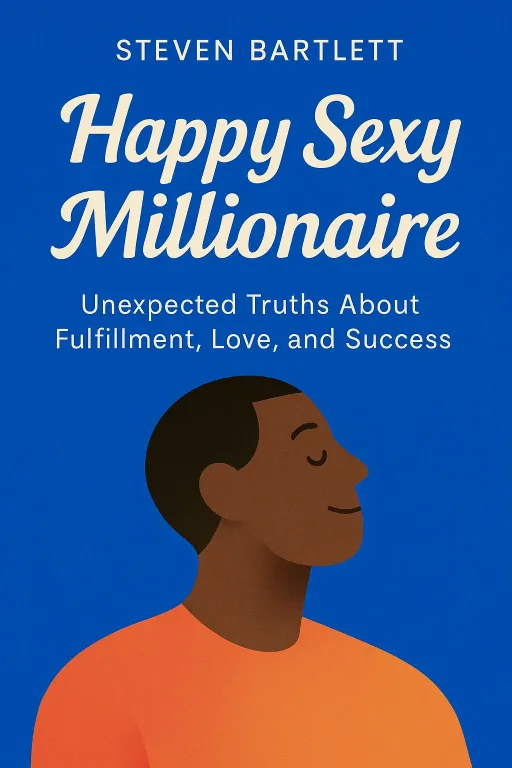
Nova: What if you achieved your biggest dream—becoming a millionaire, building a massive company—and when you finally crossed the finish line, you felt… absolutely nothing? That’s not a hypothetical. That’s the true story of Steven Bartlett, who built a $200 million company by age 27 and realized the rulebook for success he’d been following was a lie. His book,, is a powerful guide for anyone who feels the pressure to succeed but suspects there’s a better way.
Nova: Today, we're lucky to have AMc7, a curious and analytical innovator, to help us deconstruct this. We're going to tackle this from three angles. First, we'll expose the lie behind the traditional 'success' finish line. Then, we'll reveal why you should stop searching for your passion and start building it. And finally, we'll uncover the hidden superpower of knowing when to quit. AMc7, welcome. It's great to have you.
AMc7: Thanks for having me, Nova. This is a topic that feels incredibly relevant. The pressure to follow a certain script is immense, especially in the tech and innovation space. I'm excited to dig in.
Deep Dive into Core Topic 1: The Emptiness of the Finish Line
SECTION
Nova: So let's start there, AMc7. With that feeling of emptiness. Bartlett tells this incredible story in the book. At 18, he's a university dropout, his family's bankrupt, and he's living in a rough part of Manchester, sometimes shoplifting food just to eat. One day, scavenging for loose change in a takeaway shop, he finds £13.40. He says it was one of the happiest, most euphoric moments of his life. It meant he could eat for days.
AMc7: Wow. That's a powerful image. The value of that money was directly tied to his survival.
Nova: Exactly. Now, fast forward a few years. He's 27. He gets the call. The company he built from his bedroom, Social Chain, is going public with a market valuation of almost £200 million. He's achieved the 'millionaire' part of his diary goal from when he was 18. And he says he felt… completely numb. Nothing. How does that paradox strike you?
AMc7: It strikes me as the ultimate dopamine crash. Our modern world, especially through social media, conditions us to chase the 'hit' of external validation—the like, the follower count, the promotion, the funding announcement. Bartlett achieved the ultimate 'hit', the IPO, and discovered it was hollow. It's a profound lesson: fulfillment isn't a notification you receive. It's an operating system that has to be running in the background.
Nova: An operating system! I love that. He talks about how that operating system gets corrupted by what he calls 'contrast.' He says comparison is great for survival, but 'shit for happiness.' He argues that our brains are wired to compare, but in the age of Instagram, we're comparing our real lives to someone else's highlight reel, and it makes our own reality feel broken.
AMc7: It's a design flaw in our social systems. We're running ancient mental software on hyper-modern hardware. The algorithm is designed to show you the most extreme, most successful, most 'perfect' examples, which constantly resets your baseline for what's normal or good. So, as he says in the book, 'perfect' becomes normal, and 'good' becomes disposable. For a young founder or creator, this is incredibly dangerous. You start chasing valuation over value, metrics over mission.
Nova: And you end up like Bartlett, standing on the summit and feeling nothing because you were so focused on the climb that you forgot to ask if you even wanted to be on that particular mountain. He realized his goals—the Range Rover, the millionaire status—were written by an insecure 18-year-old who was just trying to escape the shame he felt growing up poor. They weren't goals.
AMc7: That's the core of it. He was running someone else's script. Society's script. And when the script ended, there was no more dialogue. It's a powerful argument for interrogating your own motivations. do you want that thing? Is it for the internal feeling of mastery and purpose, or for the external signal it sends to others? The book forces you to ask that uncomfortable question.
Nova: And it suggests the answer lies in gratitude. That the only way he could feel anything about his success was to listen to a song that reminded him of his struggle, to force himself to feel grateful for the journey.
AMc7: Right, he had to manually reboot his fulfillment 'operating system.' It wasn't automatic. That's a habit, a practice. It's not a destination. Which I think leads perfectly into his next big idea.
Deep Dive into Core Topic 2: Passion is Built, Not Found
SECTION
Nova: That's a perfect transition, AMc7. From the 'what' of success to the 'how' of fulfillment. Bartlett argues we're asking the wrong question. He says the advice 'follow your passion' is, and I'm quoting, 'anxiety-inducing bullshit.' Instead, he talks about life as an 'infinite game.' What does that mean to you, as someone interested in innovation?
AMc7: It's a game-changing concept, literally. A finite game, like chess, is played to win. There are clear rules, a defined end, and a winner. An infinite game, as author James Carse defined it, is played for the purpose of continuing the play. The goal is not to win, but to keep the game going. Bartlett argues that a career, and life itself, should be an infinite game. When you 'find your passion,' you're treating it like a finite treasure hunt. You find the 'X' on the map, and then... what? The game's over.
Nova: And that's where the anxiety comes from, right? The pressure to find this one perfect thing.
AMc7: Exactly. It's paralyzing. Especially when you have multiple interests. But if you see it as an infinite game, the goal shifts. It's not about finding the perfect thing; it's about building a perfect for growth. This is where his idea of 'skill stacking' comes in, and it's brilliant.
Nova: Explain that for us. He says it's better to be good at many things than the best at one thing.
Nova: He uses the example of Scott Adams, the creator of the Dilbert comics. Adams himself admits he's not the world's best artist. He's not the world's funniest person. He doesn't have the deepest business knowledge. But his unique of skills—being a pretty good artist, having a pretty good sense of humor, and knowing a lot about corporate life—made him the best in the world at what he does. No one else had that specific combination.
AMc7: This is everything. It's the Jeff Bezos playbook. You mentioned my interest in him, and this is why. Bezos wasn't the world's best bookseller. He wasn't a master of logistics from day one. But he stacked skills. He started with e-commerce, then stacked on top of that an obsession with customer data. Then he stacked world-class logistics. Then, realizing he had excess computing power, he stacked cloud services with AWS. Each skill made the others more valuable.
Nova: So 'skill stacking' is like creating an API for your personal career.
AMc7: Precisely! You're not a single, monolithic program. You're a platform of interconnected skills. The question shifts from the passive, 'What is my passion?' to the active, 'What is my unique stack, and what valuable skill can I add to it next?' That's a question you can work on your entire life. That's an infinite game. It's about becoming a category of one.
Nova: I love that. It's so much more empowering. It means you're not waiting for a lightning bolt of inspiration; you're an architect, a designer of your own competence.
AMc7: And passion follows competence. The better you get at something, the more you enjoy it, the more opportunities it creates, which makes you want to get even better. It's a positive feedback loop. You don't find passion; you generate it.
Deep Dive into Core Topic 3: The Art of the Quit
SECTION
Nova: I love that 'life as a platform' idea. But platforms need updates, and sometimes you have to deprecate old features that are no longer serving the system. This brings us to our final, and maybe most controversial, idea from the book: quitting is a skill for winners.
AMc7: This one really challenges a core cultural belief. 'Winners never quit, and quitters never win.' It's drilled into us from childhood.
Nova: Right? But Bartlett flips it completely. He tells this beautiful story from when he was writing the book in a treehouse in Costa Rica. A spider monkey stole his AirPod, and as he watched it swing away through the jungle, he had a revelation. For the monkey to move forward, to get to the next branch, it to let go of the one it's holding. There's a brief, terrifying moment of freefall—of uncertainty—before it grabs the next one. It can't hold onto both.
AMc7: That's a fantastic metaphor. The old branch is the 'safe thing,' the job you hate but know, the relationship that's comfortable but unfulfilling. The fear of that moment in the air, that uncertainty, is what keeps people stuck.
Nova: And Bartlett argues that learning to embrace that uncertainty is a superpower. He even provides a 'Quitting Framework' to make it a logical process, not an emotional one. He asks: Is this thing I'm doing teaching me something? Is it making me happy, more often than not? And is the potential long-term gain worth the definite short-term pain? If the answers are no, you have to consider quitting.
AMc7: It's the 'sunk cost fallacy' applied to life. In the world of technology and startups, you have to be willing to kill a project, even one you've poured millions of dollars and thousands of hours into, if the data shows it's not the future. To the outside world, it looks like failure. To the team, it's a strategic reallocation of resources.
Nova: And that's exactly what he did! He quit his job as CEO of Social Chain, the company that made him a millionaire. People thought he was crazy.
AMc7: But he was just running his own framework. He was reallocating his most valuable and non-renewable resource—his time—to a new project with a higher potential ROI on fulfillment and learning. That's not weakness; that's high-level strategic leadership applied to your own life. It's about having the self-confidence to let go of a past success to make room for a future one.
Synthesis & Takeaways
SECTION
Nova: So, if we bring it all together, it's a pretty radical blueprint for a fulfilling life. We've learned that the finish line society sets for us is a myth, that passion is something we must actively build through skill-stacking, not passively find, and that quitting is a strategic tool for growth, not a sign of failure.
AMc7: It's about a fundamental mindset shift. You have to stop being a player in someone else's finite game and become the architect of your own infinite one. You write the rules, you define the wins, and you decide which game is worth playing.
Nova: That's so well put. So for everyone listening, especially those of you building your own path in life and your career, here's the challenge from the book. A final thought to leave you with.
AMc7: I'm ready.
Nova: Look at your life right now. What's one 'societal script' you're following—a career path, a life goal, a relationship expectation—and ask yourself this one simple question: 'Did I write this script, or did I just accept it?'
AMc7: That's a powerful question.
Nova: It is. And according to Steven Bartlett, answering it honestly could be the start of your own infinite game. AMc7, thank you so much for helping us unpack this. Your insights were fantastic.
AMc7: The pleasure was all mine, Nova. It's given me a lot to think about.









