

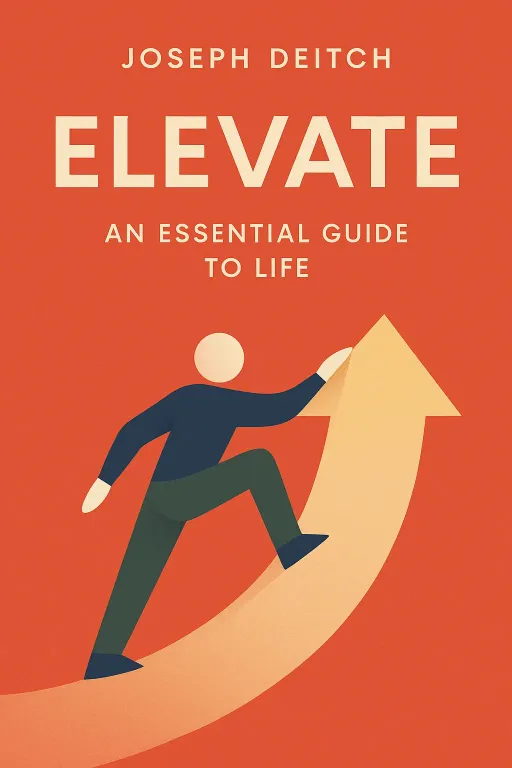
Elevate Your Life: The Dual Power of Awareness and Action
9 minGolden Hook & Introduction
SECTION
Nova: Dav, have you ever had that feeling where you just you're capable of more, but something invisible seems to be holding you back? It's a feeling so many of us share, and it's exactly what author Joseph Deitch tackles in his book, 'Elevate.'
Dav: Absolutely, Nova. It’s that gap between aspiration and your daily reality. You want to improve your mindset, your motivation, your leadership skills, but it's hard to know where to even start. I'm always looking for a clear path, something more like a blueprint than just vague inspiration.
Nova: Well, you've hit on the perfect word. Deitch calls 'Elevate' a rational blueprint for self-discovery. He argues that the key to unlocking that potential lies in mastering two fundamental areas of our lives. So today, we're going to dive deep into this from two powerful perspectives. First, we'll explore the mind-bending idea that 'Our World Is a Mirror of Our Mind.'
Dav: Ooh, I'm intrigued.
Nova: Right? And then, we'll get practical and discuss how 'We Are Biological Supercomputers' that we can learn to program for success and fulfillment. It’s all about bridging that gap between awareness and action.
Dav: I love that. It’s not just about thinking differently, but about differently. Let's get into it.
Deep Dive into Core Topic 1: The World as a Mirror
SECTION
Nova: Okay, so let's start with that first big idea, which is both profound and a little startling: 'Our World Is a Mirror of Our Mind.' What Deitch means is that the world we experience isn't some objective, fixed reality, but a projection of our own internal state—our thoughts, our beliefs, our feelings.
Dav: So, the way I feel on the inside literally changes what I see on the outside?
Nova: That's the core of it. And he tells this fantastic personal story to illustrate it. When he was in his sixties, he was going through some old boxes and found a diary he kept as a teenager. Now, in his memory, his teenage years were just 'fabulous.' He remembered being carefree and happy.
Dav: That sounds like a nice memory to have.
Nova: It does! But then he started reading the diary. And the pages told a completely different story. He wrote about his father's declining health, about feeling lost, about all these struggles he had completely forgotten. His own words revealed a reality that his mind had, over decades, unconsciously edited and rewritten into a more pleasant narrative.
Dav: Wow. That's powerful. It's like our memory isn't a perfect video recording, but a story we're constantly re-editing to fit the narrative we prefer.
Nova: Precisely! And Deitch shares this incredible quote from a spiritual teacher he met, who said, 'It's never too late to have a happy childhood.' The idea is that you can always go back and reframe the past, choosing to focus on the lessons learned or the strength you gained. You can change your past by changing the mirror you're holding up to it.
Dav: That makes so much sense, Nova. It immediately makes me think about my job in customer support. When someone calls in, and they're angry or upset, my initial, unfiltered internal reaction can be defensiveness or frustration. My internal mirror is reflecting a 'difficult person.'
Nova: Of course, that's a very human reaction.
Dav: Right. But I've learned that if I consciously pause and shift my mindset to, 'This person is frustrated and needs help, and I have the tools to provide that,' the entire energy of the call changes. The situation is the same—an upset person on the phone—but because my internal mirror is now reflecting empathy and capability, the interaction itself becomes more positive and productive.
Nova: That is a perfect real-world example, Dav! You're not changing the person on the other end of the line, not initially. You're changing the of that interaction by changing your mind. That's the principle in action. You're choosing what to reflect.
Dav: And it feels more empowering. Instead of being a victim of the situation, you become an active participant in shaping it. It's a huge shift.
Deep Dive into Core Topic 2: The Programmable Supercomputer
SECTION
Nova: And that feeling of empowerment leads us perfectly to the second, more action-oriented idea. If our mind is shaping our reality, the next logical question is, how do we take control of our mind? This is where Deitch introduces the concept that 'We Are Biological Supercomputers, Subject to Programming.'
Dav: I like the sound of that. It feels less mystical and more... technical. More manageable.
Nova: Exactly. It appeals to the analytical side. He says our brains are incredibly powerful machines, but they're running on software—programs—that we've picked up throughout our lives, from parents, teachers, and our own self-talk. And often, that software is outdated or buggy.
Dav: Tell me about it.
Nova: Well, he shares this great story from when he teaches classes. He'll ask the audience, "Who here has a bad memory?" and a ton of hands go up. They're running the 'I have a bad memory' program. So he gives them a list of ten random items to memorize, and most of them do poorly, which just confirms their belief.
Dav: See? The program works!
Nova: It does! But then, he demonstrates how he can easily memorize a list of items. After that, he teaches them a very simple visualization technique. It takes about five minutes. Then he gives them a new list of ten items. And almost every single person in the room gets a perfect score. The room just erupts.
Dav: That's incredible. So what happened?
Nova: Nothing! They didn't get new brains. They just got a software update. They learned a new, more effective program for their existing hardware. And suddenly, they were astounded by their own capabilities.
Dav: I love that analogy. It's not a hardware problem; it's a software issue. It reminds me of another story from the book, where a teacher told the author as a little boy that he had a 'voice like a frog' and should stop singing. And he did! For decades, he ran that 'I can't sing' program that someone else installed.
Nova: Exactly! Deitch says we're all hypnotized to some extent by ideas we've uncritically accepted. The key is to wake up and become the programmer. To take control of the keyboard.
Dav: So, thinking about this practically... if I'm preparing for a presentation or a meeting where I want to step up and show more leadership, I could consciously 'run a program.' Instead of letting that default script play—the one that says, 'I'm just a customer support rep, what do I know?'—I could actively choose a different one.
Nova: What would that new program sound like?
Dav: It would be something like, 'I am a capable and insightful leader. I have valuable experience and a unique perspective.' I could visualize the successful outcome, feel the confidence in my body, and essentially create a 'mental macro' to run right before I walk into the room.
Nova: A mental macro! That's brilliant, Dav. That is the perfect term for it. And that's exactly the kind of practical action the book encourages. It's not just wishing for a different outcome; it's intentional, deliberate programming. You're writing new code for your mind.
Synthesis & Takeaways
SECTION
Nova: So, as we wrap up, it really boils down to these two powerful, interconnected ideas from 'Elevate'. First, that our inner world of thoughts and feelings acts as a mirror, shaping the reality we experience every single day.
Dav: And second, that we're not stuck with our default settings. We are like these incredible supercomputers, and we can absolutely learn to write our own code. We can program ourselves for more confidence, more motivation, and ultimately, more success and happiness.
Nova: Absolutely. And for everyone listening, the beauty of Deitch's approach is that he doesn't suggest you need to overhaul your entire life overnight. In fact, he advises against it. He recommends creating what he calls a 'Stairway of Success' by starting with the low-hanging fruit.
Dav: Which is so much more achievable. So, maybe the challenge for all of us this week is to pick just one thing. Just one small step on that stairway.
Nova: I love that. What would you suggest?
Dav: Well, based on our chat, maybe it's one of two things. You could either focus on the 'mirror'—and try to catch and reframe just one negative thought each day, consciously choosing to see the world through a more positive lens.
Nova: A small but powerful shift.
Dav: Or, you could focus on the 'programming.' Install one small, positive 'mental macro' before a daily task you find challenging. Whether it's making a tough phone call, speaking up in a meeting, or even just getting out of bed with more energy. Just one small, new instruction for your supercomputer.
Nova: That's a perfect, actionable takeaway. Just one small step to start building that stairway. Dav, this has been fantastic. Thank you so much for sharing your insights and connecting these ideas so brilliantly.
Dav: Thank you, Nova. It’s been a pleasure. It really gives you a lot to think about—and a lot to.









