The Innovator's Dilemma: Navigating Disruption and Driving Progress
8 minGolden Hook & Introduction
SECTION
Nova: What if I told you that the very things that make a company wildly successful today are often the seeds of its destruction tomorrow? That your greatest strengths could actually be your biggest blind spot?
Atlas: Oh man, that sounds like a paradox wrapped in an enigma. It feels incredibly counterintuitive to anyone who's trying to build something robust and lasting. We're taught to lean into our strengths, right?
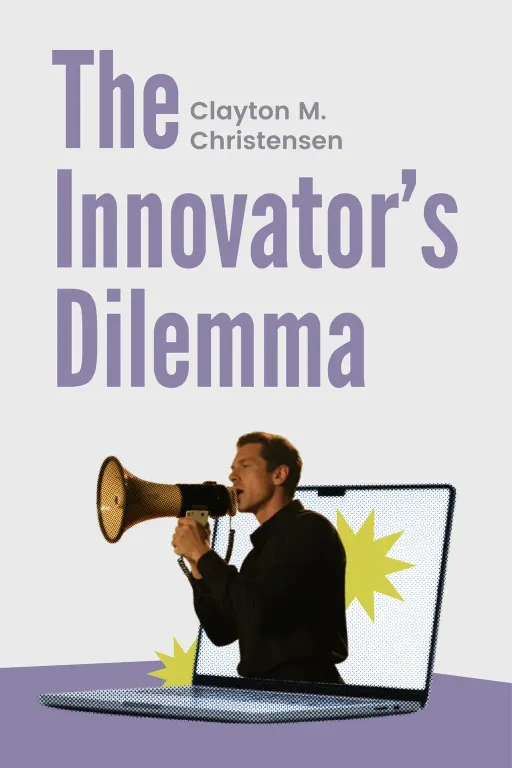
Nova: Absolutely, Atlas! And that's precisely the "dilemma" we're dissecting today, pulled straight from the pages of two seminal works: "The Innovator's Dilemma" by Clayton M. Christensen, and "Crossing the Chasm" by Geoffrey A. Moore. Christensen, a Harvard Business School professor, didn't just theorize this; he spent years trying to understand why even brilliantly managed, seemingly invincible companies—like the old Digital Equipment Corporation—could suddenly collapse, while smaller, seemingly inferior startups rose to dominate. His work was a profound attempt to unravel that corporate mortality.
Atlas: Wow, that's a powerful motivation. So, how can good management lead to failure? For an architect trying to build a resilient system, that sounds like a fundamental flaw in the blueprint.
Nova: It's a fascinating, almost cruel irony of business. And that leads us straight into our first core idea: the innovator's blind spot.
The Innovator's Blind Spot: Why Success Can Be a Trap
SECTION
Nova: Imagine a company, let's call them "BigCo Drives," that makes the best, most reliable hard disk drives in the world. Their customers are huge mainframe computer manufacturers—demanding, high-margin clients who need top-tier performance and capacity. BigCo invests heavily in R&D, constantly improving their drives, making them faster, bigger, and more robust. They listen intently to their best customers, and those customers are thrilled.
Atlas: Sounds like a dream scenario for any 'Cultivator' trying to grow a thriving business. They're optimizing, they're listening to their market, they're innovating. What could possibly go wrong?
Nova: Here's the twist. While BigCo is busy perfecting its high-end drives, a tiny startup emerges. They're making much smaller, slower, less capacious drives—initially only 5.25-inch, then even smaller 3.5-inch drives. These drives are far too underpowered for BigCo's mainframe customers. They're also cheaper, have lower margins, and cater to a completely new, unproven market: personal computers.
Atlas: So, BigCo looks at these tiny drives and thinks, "Not for us. Our customers don't want that. The margins are terrible. It's a toy." Is that the blind spot?
Nova: Precisely. BigCo's management, acting completely rationally, sees these new drives as "inferior" and irrelevant to their core business. Investing in them would mean diverting resources from their high-profit, demanding customers. Their internal processes, their incentive structures, their very culture, are all geared towards serving those existing, profitable clients. It’s not bad management; it’s management applying the wrong criteria. They rationally allocate resources to what's currently most profitable.
Atlas: But wait, how do you even these 'low-end' threats when you're busy cultivating success with your current robust systems? It sounds like you're saying that the very definition of success can make you myopic. For someone trying to build sustainable growth, ignoring what feels like a 'toy' could be catastrophic.
Nova: That's the innovator's dilemma in action. These disruptive innovations often start as "worse" products by traditional metrics. They offer less performance, less capacity, but they bring new value propositions: they're smaller, cheaper, simpler, more convenient, or enable entirely new use cases. Over time, these initially "inferior" products improve rapidly, eventually meeting the performance needs of the mainstream market, but with a different cost structure or form factor. By the time BigCo realizes the threat, it's often too late. The new market, built around the disruptive technology, has already solidified, and the incumbent is too slow and structurally unprepared to compete.
Atlas: That's incredible. It's like you're too busy tending to your prize-winning garden that you don't even notice a new, hardier species of plant taking root just outside your fence, and that plant eventually overtakes everything.
Nova: A perfect analogy, Atlas. And this leads us to the next critical step for those disruptive innovations we just discussed: how they actually manage to take over.
Crossing the Chasm: Bridging the Gap for Disruptive Ideas
SECTION
Nova: This is where Geoffrey Moore's "Crossing the Chasm" comes in. He builds on Christensen's ideas, focusing on the unique challenges disruptive technologies face in moving from early adopters to the mainstream market. Think of it as a huge, terrifying gap.
Atlas: A chasm, indeed. So, you've got this disruptive product, everyone's raving about it in a small niche, but it can't quite break through to a wider audience. I imagine a lot of great ideas die in that gap.
Nova: They absolutely do. Moore identifies distinct customer segments: the "innovators", the "early adopters", the "early majority", the "late majority", and the "laggards." The biggest, most perilous gap—the chasm—is between the early adopters and the early majority. Early adopters are willing to tolerate bugs and pay a premium for new tech; the early majority wants something reliable, complete, and with clear benefits.
Atlas: Okay, but if you're an 'Architect' building a new system, or a 'Cultivator' trying to grow a community with a truly disruptive idea, how do you bridge that chasm? It sounds like you're asking us to predict the future and build for customers who don't even exist yet, while still serving our current, small community of visionaries. That’s a huge risk for sustainable growth.
Nova: It's not about predicting the future for everyone, but about strategic focus. Moore's key strategy is to identify a specific, narrow "beachhead" market within the early majority. You dominate that segment completely, build a complete solution for them, and then use that success as a springboard to adjacent markets.
Atlas: Can you give an example? Because "dominate a narrow segment" sounds a lot easier said than done.
Nova: Think about early electric vehicles. Initially, they appealed to environmentalists and tech enthusiasts—the early adopters. For the early majority, though, there were huge concerns: range anxiety, lack of charging infrastructure, high costs, limited model choices. Most car companies tried to appeal broadly, and largely failed. Then came Tesla. Instead of trying to please everyone, they initially targeted a very specific, high-end luxury market. They made a car that was not just electric, but also high-performance, stylish, and a status symbol. They created a complete ecosystem around it, including their own charging network.
Atlas: Right, like they built a foundation for a very specific type of early majority customer first. They cultivated that niche.
Nova: Exactly. They dominated that luxury EV segment, proving the technology and building brand trust. With that success, they then had the resources, credibility, and operational experience to gradually expand into lower-priced models, broader charging infrastructure, and appeal to a wider audience. They crossed the chasm by focusing intensely on one specific group of pragmatists, demonstrating undeniable value, and then scaling from there. It's about securing that initial foothold before attempting a full-scale assault on the mainstream.
Synthesis & Takeaways
SECTION
Nova: So, bringing these two powerful ideas together: Christensen's "Innovator's Dilemma" helps you the threats and opportunities—the initially inferior innovations that could become tomorrow's giants. Moore's "Crossing the Chasm" gives you the to capitalize on them, to take those disruptive ideas from a niche to the mainstream. It’s about proactive leadership rather than reactive defense.
Atlas: That's a profound synthesis. For our listeners who are building robust systems and vibrant communities, what's the one thing they should 'cultivate' from this discussion? How do they apply this foundational knowledge to ensure lasting value?
Nova: It comes down to cultivating "peripheral vision." Leaders must actively seek out and nurture initially 'inferior' innovations that serve new customer needs, even if it feels like it might cannibalize current business. It means trusting your intuition as much as your data to see beyond the immediate horizon of your current, profitable customers. It's about having the courage to invest in the future, even when it looks messy and unprofitable today, to truly build something resilient and enduring.
Atlas: That's a powerful call to action for anyone driven by lasting value and sustainable growth. It challenges you to look beyond what's comfortable and profitable right now.
Nova: Indeed. So, we leave you with this reflective question: Where might a 'disruptive innovation' be emerging in your industry that your current focus overlooks?
Nova: This is Aibrary. Congratulations on your growth!