The 'Innovation Illusion' is a Trap: Why Slow, Deliberate Progress Outlasts Quick Wins.
9 minGolden Hook & Introduction
SECTION
Nova: Everyone talks about 'disruption' like it's the holy grail, right? It's the buzzword that makes every startup glow and every established company panic. But what if chasing that shiny, new, disruptive thing too hard is actually the fastest way to kill your own project, or even your entire company?
Atlas: Whoa, that's a bold statement, Nova. It feels almost sacrilegious in our tech world, where the mantra is constantly "innovate or die." As engineers and architects, we're always pushing for the next big leap in Agent systems. Are you saying we should… slow down?
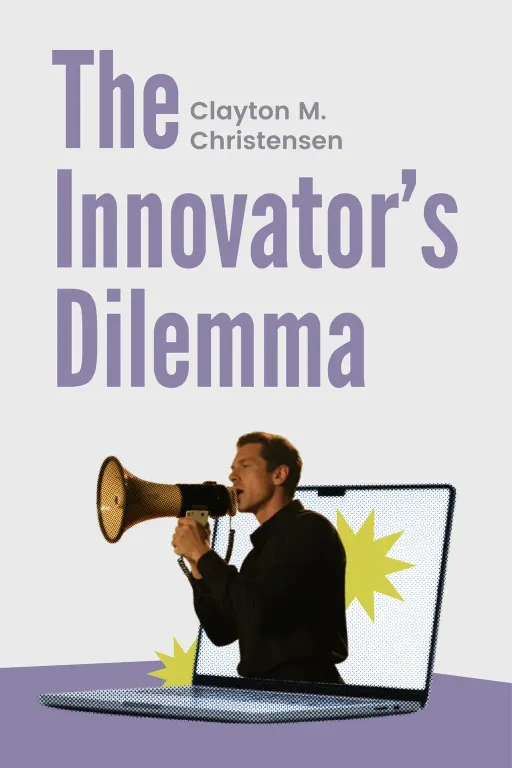
Nova: Not necessarily slow down, Atlas, but be. Today, we're diving into some foundational thinking from two seminal books: "The Innovator's Dilemma" by Clayton M. Christensen and "Crossing the Chasm" by Geoffrey A. Moore. Christensen, a brilliant Harvard Business School professor, published "The Innovator's Dilemma" after grappling with a puzzling question: why do great companies fail? He saw how well-managed companies, doing everything 'right,' still stumbled when faced with disruptive technologies. The book was initially rejected by several publishers, seen as too radical, but it went on to become a cornerstone of modern business strategy, profoundly shaping how Silicon Valley thinks about innovation. And Moore’s "Crossing the Chasm" then gave us the playbook for how to actually those disruptive innovations adopted.
Atlas: That makes me wonder, in the Agent engineering space, we're constantly bombarded with new frameworks, new models, new approaches. Is this relentless pursuit of the next big thing, the 'disruptive' Agent architecture, potentially blinding us to more subtle, yet crucial, improvements in what we already have?
The Innovation Illusion: Why Chasing 'Disruptive' Can Be a Trap
SECTION
Nova: Precisely. That's the core of what we're calling "The Innovation Illusion." Christensen's work highlights how successful companies, ironically, often fail they listen too closely to their most profitable customers and continuously improve their existing products. This is what he calls "sustaining innovation"—making good products better. It's vital, it drives profits, but it can create a blind spot.
Atlas: So, they're focused on making their current Agent model faster, more accurate, more scalable for their existing enterprise clients, right? That sounds like good business sense to me. Where's the trap?
Nova: The trap is that while they're doing that, a smaller, often initially inferior, disruptive technology emerges. It doesn't meet the needs of the incumbent's core customers, so it's dismissed. Think about the hard disk drive industry, a classic example Christensen used. Manufacturers were focused on building larger, higher-capacity drives for mainframe computers, where the profit margins were huge. They poured resources into making those drives better and better.
Atlas: And then?
Nova: And then, smaller upstarts started making tiny, low-capacity drives. These weren't powerful enough for mainframes, but they were perfect for a nascent market: personal computers. The established players looked at these little drives and said, "Our mainframe customers would never buy those. They're too small, too slow, too low-margin." They dismissed them.
Atlas: I see where this is going. Those "inferior" drives became the standard for PCs, and as PC demand exploded, the disruptive technology improved exponentially, eventually surpassing the performance of the traditional drives. The incumbents, who were so good at sustaining innovation, found themselves with a superior product for a shrinking market, while the disruptors owned the future.
Nova: Exactly. So, if you're building an advanced Agent system, focused on refining its current capabilities for enterprise clients, you be creating a vacuum. You're optimizing for today's known problems, which is essential. But you might be overlooking some scrappy, low-cost open-source Agent framework—or a completely different paradigm for Agent interaction—that seems "inferior" today because it doesn't solve your current enterprise client's problems.
Atlas: That's a mind-bender. It's like, by doing my job incredibly well, by being a top-tier architect delivering stable, high-performance Agent solutions, I could inadvertently be setting myself up for obsolescence. But how do you even those nascent, 'inferior' Agent innovations when your whole team is optimized for delivering high-performance, scalable solutions? Our metrics are all about current client satisfaction and immediate ROI.
Balancing the Innovation Equation: From Dilemma to Deliberate Progress
SECTION
Nova: That's precisely where we need to talk about the "balancing act," and that's where Geoffrey Moore's "Crossing the Chasm" becomes indispensable. It's about strategically managing the integration of these different forms of innovation, making sure those disruptive ideas don't just die in the lab. Moore explains that there's a huge "chasm" between early adopters—those visionaries who eagerly embrace new tech for competitive advantage—and the early majority, who are pragmatists and wait for proven, reliable solutions.
Atlas: So, you build this amazing, potentially disruptive Agent. The early adopters, the bleeding-edge researchers, the internal R&D teams, they love it. They play with it, they find ways to optimize it. But then what?
Nova: Then you hit the chasm. Many disruptive innovations, even brilliant ones, die here because companies try to appeal to everyone. They dilute their message, try to be all things to all people, and end up satisfying no one. Moore argues you need a laser-focused strategy: target a specific niche within the early majority, a "bowling alley" strategy, to gain a decisive foothold before expanding.
Atlas: So, for an Agent engineering team, if we've built this groundbreaking new Agent architecture, the challenge isn't just building it, it's getting it adopted. Are you saying we shouldn't try to sell it to every department at once, or aim for a universal rollout, but instead find that one "pragmatist" team that desperately needs it, even if it's not perfect yet, and build a complete solution just for them?
Nova: Exactly. You build a whole product solution for that specific niche, solve their pain points completely, and then use that success as a beachhead to expand to other segments of the early majority. This requires differentiating between sustaining innovation—improving existing Agent features for your core users, ensuring stability and scalability—and disruptive innovation—developing new Agent paradigms for new markets or new types of users. It's a dual strategy.
Atlas: It sounds like a tightrope walk. As an architect trying to create value and ensure long-term success, how do you convince leadership to invest in a "niche" Agent solution that might not have immediate, broad ROI, especially when they're demanding enterprise-wide impact and quick wins? It goes against the very grain of how many large organizations operate.
Synthesis & Takeaways
SECTION
Nova: That's the strategic challenge, Atlas. It's about understanding that sustained growth comes from a of both types of innovation. You need to keep refining your core Agent systems to serve your current users beautifully—that's your sustaining innovation. But you also need to nurture those disruptive Agent ideas, even if they seem small or niche today, giving them the space and resources to develop, perhaps in separate teams or ventures.
Atlas: So, it's not "disrupt or die," but "strategically balance and deliver value," right? It's about knowing when to incrementally improve our current Agent's decision logic and when to incubate that wild, new decentralized Agent network for a completely different problem or user base.
Nova: Precisely. It’s about being a true architect of innovation, not just a reactive engineer. The tiny step for our listeners, especially those deeply involved in Agent engineering, is to look at your current work. Identify one 'sustaining innovation'—an improvement to an existing Agent feature, maybe enhancing its performance or stability for your current users. And then, identify one 'disruptive innovation'—perhaps a new approach to an Agent's reasoning engine for a new use case, or a completely different interaction model that's currently niche. How are you consciously balancing them? Are you giving the disruptive one enough space to breathe, even if it looks 'inferior' today, while still delivering rock-solid improvements for your core users?
Atlas: That's a powerful challenge. It forces us to break boundaries, as our growth advice suggests, and truly integrate technology with business vision. It’s about being a true architect, not just a coder, and understanding the long game of value creation.
Nova: Absolutely. It's about moving from simply reacting to innovation to proactively shaping it, ensuring long-term value and stability. This isn't just about technology; it's about strategic thinking, understanding market dynamics, and having the courage to invest in the unproven while optimizing the proven.
Atlas: Fascinating. This really makes you rethink what 'progress' even means in the fast-paced world of tech.
Nova: It certainly does. And that's all for today's deep dive into the innovation illusion.
Atlas: Thank you for joining us.
Nova: This is Aibrary. Congratulations on your growth!