The Creativity Trap: Why You Need to Embrace the Unknown for True Innovation
7 minGolden Hook & Introduction
SECTION
Nova: You know, Atlas, we’ve all seen those movies—the lone genius, late at night, a single apple on the desk, and then… A lightning bolt of inspiration, a sudden flash of brilliance, and the world is changed.
Atlas: Oh, the classic Hollywood trope. The "eureka!" moment, perfectly packaged and ready for mass consumption. It’s almost romantic, isn't it?
Nova: It absolutely is. And it’s also, for the most part, a myth. A beautiful, inspiring, utterly misleading myth about how real creativity and innovation actually work.
Atlas: Wait, hold on. Are you saying that creativity isn't this sudden, almost divine download from the universe? Because if not that, then what it? Where do these truly groundbreaking ideas even come from then?
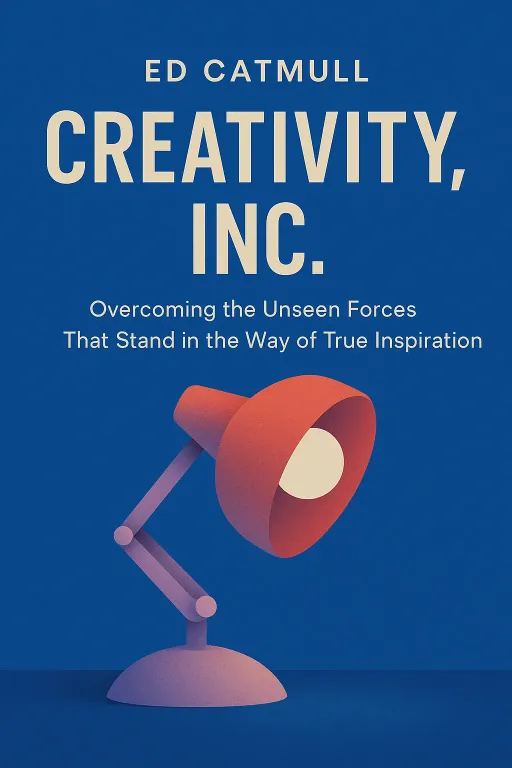
Nova: Well, if you strip away the romanticized notions, what you're left with is often a much messier, more iterative process. It's built less on individual genius and more on something far more fundamental: trust and psychological safety. And some of the best insights into this come from people like Ed Catmull, the legendary co-founder of Pixar. His foundational work at Pixar is practically a masterclass in building truly innovative environments.
The Creativity Trap: Fear of Mistakes & Stifled Innovation
SECTION
Nova: What Ed Catmull highlights so brilliantly in his book,, is this cold, hard fact: many believe creativity is a sudden flash of genius, but it's often a messy, iterative process. And our fear of making mistakes, our pursuit of that perfect initial idea, is exactly what stifles true innovation.
Atlas: That makes me wonder, Nova, in a world that often rewards perfection and punishes failure, how do you genuinely create an environment where everyone feels safe to actually mistakes? Because that sounds like a tightrope walk between vulnerability and, well, outright chaos.
Nova: It’s a fantastic question, and it’s precisely why Catmull emphasizes that it's crucial to create an environment where everyone feels safe to offer ideas and make mistakes. It's not about being reckless; it's about fostering genuine collaborative creativity. Think about it: if every idea has to be fully baked, fully polished, and guaranteed to succeed from minute one, how many truly novel, paradigm-shifting concepts would ever even see the light of day? We'd be stuck in incrementalism.
Atlas: Right, like observing an ecosystem. If every new species had to be perfectly adapted from its first mutation, evolution would grind to a halt. There has to be room for those 'half-baked' experiments. But what about the human element? We’re not just biological systems; we have egos, reputations.
Nova: Exactly. And that's where the psychological safety comes in. It's the belief that you won't be punished or humiliated for speaking up with ideas, questions, concerns, or mistakes. Adam Grant, in his book, illustrates this beautifully. He shows how original thinkers aren't fearless; they're often full of doubts. Their success comes from acting on ideas these doubts, and refining through feedback.
Atlas: So you’re saying it’s not about eliminating doubt, but about creating a system where doubt can be expressed and refined without fear of personal reprisal. But how does that translate into action? Is this a 'top-down' mandate, or can an individual start to cultivate this 'safe space' within their own sphere of influence?
Cultivating Vulnerability & Trust for Unlocked Potential
SECTION
Nova: That’s a really insightful distinction, Atlas. While leadership setting the tone is incredibly powerful, the beauty is that cultivating an environment where vulnerability is accepted, not punished, can begin anywhere. It unlocks a team's deepest creative potential. It’s about building trust, piece by tiny piece.
Atlas: I can see how that would be... almost like a neuroethological principle. If you create the right neural pathways and reward systems in an organism, it learns to explore rather than retreat. Where does fit into that, specifically? What does that look like in practice?
Nova: Trust is the bedrock. It’s the implicit agreement that we are all here to solve problems together, and that means sometimes we'll stumble. It means trusting that your seemingly outlandish idea won't be ridiculed, that your genuine mistake will be seen as a learning opportunity for everyone, not a personal failing. It’s about leaders modeling vulnerability themselves. If a leader can say, "I messed up here, and here's what I learned," it gives everyone else permission to do the same.
Atlas: That's a great way to put it. For someone like me who values deep observation and understanding patterns, that leap into 'vulnerability' can feel counter-intuitive. We're wired to identify risks, predict outcomes. How do you reconcile that scientific rigor with the messiness of vulnerability and unknown outcomes?
Nova: You make an excellent point. It’s not about abandoning rigor; it’s about applying rigor to the of exploration, rather than just the final product. It’s about rigorous experimentation, rigorous feedback loops, and rigorous learning from failures. It acknowledges that the path to true innovation is rarely a straight line. It's more like a complex adaptive system, constantly adjusting, evolving, and sometimes, yes, making what looks like a 'wrong turn' that ultimately leads to a breakthrough. It's about seeing the whole, interconnected picture of creativity, where the 'failures' are just part of the evolutionary process.
Synthesis & Takeaways
SECTION
Nova: So, to synthesize, true creativity isn't about being fearless, or being a genius, or even avoiding mistakes. It’s about building systems and cultures that allow us to navigate doubt and mistakes constructively, leveraging collective intelligence over individual brilliance. It’s about creating fertile ground for ideas to grow, even if they start out as tiny, vulnerable seedlings.
Atlas: That’s actually really inspiring. It redefines creativity not as a rare gift, but as a cultivated environment. It's about resilience in the face of the unknown, trusting the iterative process, much like how species adapt and thrive over time, not through a single perfect leap, but through countless small adjustments and environmental interactions.
Nova: Exactly! And the best part is, you don't need to overhaul your entire organization to start. The tiniest step can make the biggest difference.
Atlas: What's that tiny step, then? For someone who wants to start building that kind of environment, what's one actionable thing they can do tomorrow?
Nova: Tomorrow, ask a team member for their 'half-baked' idea. Without judgment. Just genuine curiosity. That's it. Listen, explore, and understand. That’s how you start building that trust and psychological safety. That’s how you open the door to true innovation.
Atlas: I love that. It's simple, actionable, and starts with observation and connection. A perfect way to begin understanding the 'why' behind people's actions and fostering deeper creative ecosystems.
Nova: This is Aibrary. Congratulations on your growth!