The EdTech Edge: Hacking Growth and Learning with AI Co-Intelligence
10 minGolden Hook & Introduction
SECTION
Nova: Susan, as someone at the forefront of edtech, you know the 'Homework Apocalypse' isn't some distant sci-fi concept—it's happening right now. Students can generate a flawless essay in seconds. But what if that same AI, the one causing chaos for educators, is also the most powerful tool for innovation we've ever had?
Susan: That’s the conversation we’re all having, isn't it? It feels like we're standing on a knife's edge. On one side, there's this massive disruption to every educational model we've ever known. On the other, this incredible, untapped potential.
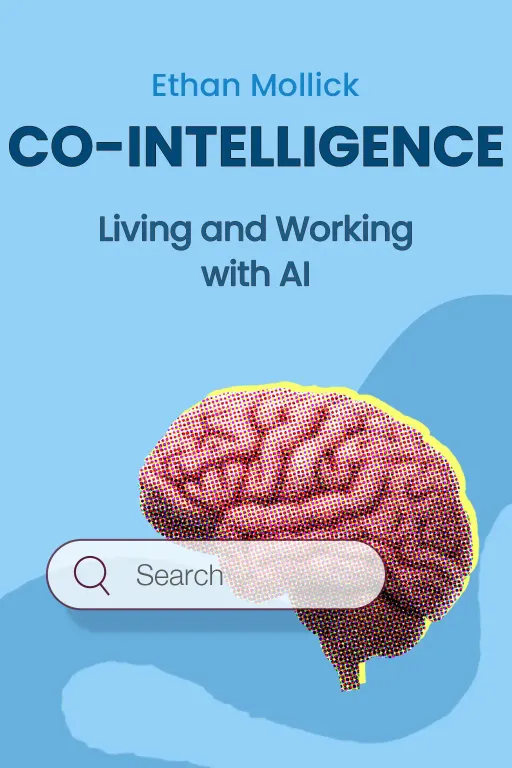
Nova: Exactly! And that's why I'm so excited to talk about Ethan Mollick's book, 'Co-Intelligence.' He argues that we need to stop thinking of AI as just software and start seeing it as this strange, 'alien mind' that we need to learn to work with. It's a playbook for leaders like you.
Susan: I like that framing. Moving from fear to strategy. So where do we start?
Nova: Well, today we'll dive deep into this from two perspectives. First, we'll explore how to harness AI's 'alien mind' as a powerful growth and innovation engine. Then, we'll tackle the paradox of AI as both the ultimate personal tutor and a major disruptor to how we train future experts.
Deep Dive into Core Topic 1: Harnessing the Alien: AI as a Growth Engine
SECTION
Nova: So let's start with that first idea, this concept of AI as a creative partner. We tend to get frustrated when AI 'hallucinates' or makes things up, right? But Mollick suggests that for creative work, this might be its greatest strength. He tells this incredible story from an innovation class at Wharton that just blew my mind.
Susan: Okay, I'm listening.
Nova: So, the professors, Christian Terwiesch and Karl Ulrich, set up a contest. They took 200 of their very bright Wharton MBA students and pitted them against GPT-4. The challenge was simple: generate as many high-quality product ideas as you can for college students, with a budget of $50 or less.
Susan: A classic innovation prompt. I've run sessions like that myself. The students usually come up with some clever things.
Nova: You'd think! But the results were staggering. The ideas were all evaluated by human judges, who rated their interest in actually buying the product. When the dust settled, of the 40 best ideas, 35 of them came from ChatGPT.
Susan: Thirty-five out of forty? That's not just a win, that's a rout. What was the AI doing that the humans weren't?
Nova: It was a combination of volume and novelty. The AI could generate hundreds of ideas in minutes, but more importantly, it wasn't constrained by human experience or bias. It would connect concepts that a person might not. It was thinking, for lack of a better word, like an alien. It didn't care if an idea sounded a bit weird at first; it just generated possibilities based on patterns. The humans were trying to be clever; the AI was just being prolific and combinatorial.
Susan: That's fascinating, Nova. Because from a growth perspective, that isn't just an academic exercise. It's a fundamental shift in the economics of creativity. For my team, that means we could be testing a hundred different marketing angles or feature ideas generated by AI for the cost and time it used to take to develop two or three internally.
Nova: It changes the whole iteration cycle!
Susan: Completely. It de-risks innovation. Failure becomes cheaper, so you can do more of it, which means you find the successes faster. The strategic question then becomes, how do you manage that firehose of ideas? You can't build everything.
Nova: And that's Mollick's point! He introduces this rule: 'Be the human in the loop.' The AI is the idea generator, the intern who never sleeps. But you, the expert, are the editor, the strategist, the one with the taste and judgment to pick the winning ideas from the noise. The AI provides the quantity; you provide the quality control.
Susan: That maps directly to how we should structure our growth teams. We don't need fewer creative people; we need creative people who are excellent curators and editors of AI-generated content. Their job shifts from pure creation to strategic selection and refinement. That's a skill in itself.
Nova: A 'Centaur,' as he calls it. Part human, part machine. It's a powerful image for the future of work.
Susan: It is. And it's a much more optimistic one than the simple 'robots are taking our jobs' narrative. It's about augmentation, not replacement.
Deep Dive into Core Topic 2: The New Learning Curve: AI as Tutor and Training Disruptor
SECTION
Nova: And that idea of being the 'human in the loop' is so critical, because it leads us right to the second, more complex issue: how we actually those expert humans in the first place. Mollick presents this really stark paradox that is right in your wheelhouse, Susan.
Susan: The paradox being?
Nova: For decades, educators have chased what's called the 'two sigma problem,' identified by Benjamin Bloom back in 1984. He found that a student with a personal one-on-one tutor performs two standard deviations better than a student in a classroom. That's the difference between being average and being in the 98th percentile. And AI, for the first time, makes it possible to give every single person on the planet a personal tutor. It's the holy grail for education.
Susan: Absolutely. That's the dream our entire industry is built on. Personalized, scalable, adaptive learning.
Nova: But here's the dark side of that dream. Mollick shares this cautionary tale from the world of medicine. In the 2010s, hospitals started adopting robotic surgery systems. These are amazing machines, but there's a problem: only one person can 'drive' the robot at a time.
Susan: I think I see where this is going.
Nova: Exactly. The senior, experienced surgeon takes the controls because the stakes are high. The junior resident, the apprentice who is supposed to be learning by doing, is relegated to the sidelines. They just watch. Their opportunity for what Mollick calls 'deliberate practice'—that hands-on, feedback-driven learning—vanishes. The technology designed to improve outcomes was actually breaking the system for creating future experts.
Susan: That's a powerful and frankly terrifying parallel for the workplace. If we give a junior marketer an AI tool that writes all their ad copy, or a junior developer an AI that writes all their code, they might be more productive today, but they never learn the fundamentals. We're eating our seed corn.
Nova: We're eating our seed corn! I love that. But then he offers the counter-example, the path forward. He tells the story of two young architects, Alex and Raj. Alex works the old way. He drafts his designs and gets feedback from his senior partner once a week. He improves, but slowly.
Susan: And Raj?
Nova: Raj integrates an AI design assistant into his workflow. But it's not doing the work him. It's acting as a coach. As he designs, the AI gives him instantaneous feedback. It flags structural inefficiencies, suggests more sustainable materials, and even compares his work to a database of thousands of other designs, highlighting where his approach is novel or where it's conventional.
Susan: So he's getting that deliberate practice loop—attempt, feedback, correction—dozens of times a day, instead of once a week.
Nova: Precisely. And the result is that Raj's skill level grows exponentially faster than Alex's. He becomes an expert in a fraction of the time.
Susan: This is the central challenge and opportunity for edtech. That story is the perfect product brief. We can't just build products that give students the answers. That's the 'robotic surgeon' model. We have to build AI coaches. The value isn't in the AI doing the task, but in how it structures the user's practice and provides immediate, targeted feedback. Our goal should be to build 'Raj's AI' for every learner, for every skill.
Nova: It reframes the entire purpose of an educational product, doesn't it? From a content delivery system to a practice and coaching engine.
Susan: It has to. Because the world is already flooded with content and answers. The scarce resource is guided practice. That's where the real learning happens, and that's where the value is.
Synthesis & Takeaways
SECTION
Nova: So, as we wrap up, it feels like we've landed on two huge, interconnected ideas from 'Co-Intelligence'. First, that AI is this incredible, alien-minded creative partner that can accelerate growth if we learn to be good editors.
Susan: And second, that this same technology forces us to completely rethink how we build expertise. We have to consciously design systems, both in our companies and in our products, that use AI as a coach for deliberate practice, not just an automation tool that deskills our workforce.
Nova: Beautifully put. So, Susan, to bring this all home and make it super practical. You came in with a question: "How can I use Gen AI to automate my most boring task next week?" Based on our conversation and Mollick's rules, what's your answer now?
Susan: It's clearer now. The answer isn't just to find a boring task and get rid of it. It's about applying the rules. Specifically, 'Always invite AI to the table' and 'Be the human in the loop.' So, a concrete action for my team next week would be this: instead of one person spending a day brainstorming headlines for a new campaign, we'll spend 15 minutes prompting an AI to generate 100 of them.
Nova: The boring, high-volume part.
Susan: Exactly. That's the task we delegate. But then, the crucial part, the human-in-the-loop part, is the whole team spending an hour debating, analyzing, and selecting the top three from that list. We use our human expertise, our taste, and our market knowledge where it matters most—in the final judgment. The AI does the legwork; we do the strategic thinking. That's a perfect co-intelligence task.
Nova: I love that. It’s not just automation; it’s strategic leverage. Susan, this has been an absolutely brilliant conversation. Thank you for bringing your expertise to the table.
Susan: Thanks for having me, Nova. This has given me a lot to think about—and a clear plan for next week.