The Silicon Architects: From Jobs's Vision to the Global Chip War
10 minGolden Hook & Introduction
SECTION
Orion: When you look at the back of an iPhone, it says 'Designed by Apple in California. Assembled in China.' It tells a simple story of American innovation and Chinese manufacturing. But it’s a lie. Or at least, a massive oversimplification. The most valuable, most complex, and most irreplaceable part of that phone—its brain—is made somewhere else entirely: Taiwan. And the battle for control over that tiny piece of silicon is the most important story in the world right now.
AR: That’s a powerful way to put it. It’s something we never think about. We see the finished product, but the journey it takes is completely invisible.
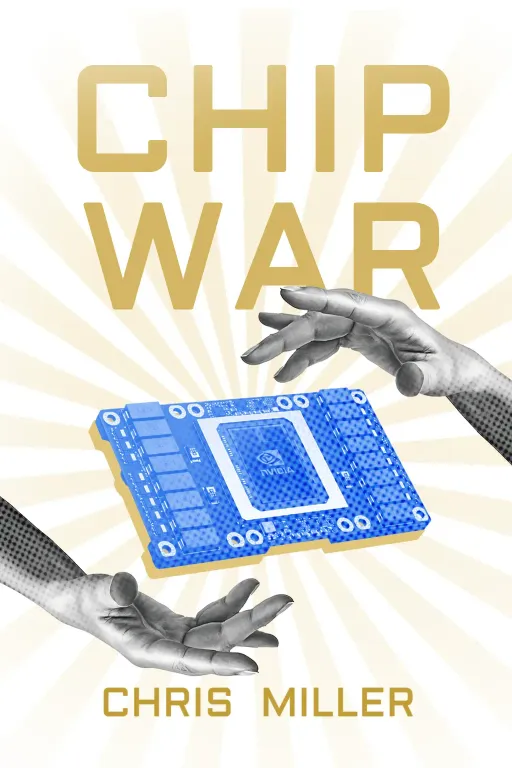
Orion: Exactly. And that's why we're here. Today, we're diving into Chris Miller's incredible book, 'Chip War,' to understand this high-stakes conflict. We'll tackle this from two main angles. First, we'll explore the godfathers of Silicon Valley—the brilliant and paranoid minds who built the world Steve Jobs inherited. Then, we'll pivot to the present day and discuss how their creation, the semiconductor, has become the ultimate weapon in the new cold war between the US and China.
Orion: AR, welcome. You're a huge tech enthusiast and you’re fascinated by Steve Jobs. This book basically unpacks the entire universe that made someone like Jobs possible.
AR: Thanks, Orion. I'm excited. That opening already has me hooked. The idea that Jobs's vision for Apple, which was all about total control of the user experience, was ultimately dependent on this hidden global battle... it's a side of the story I've never considered.
Deep Dive into Core Topic 1: The Architects of the Digital Age
SECTION
Orion: So let's start there. To understand Apple, you have to understand the company that was, in many ways, its spiritual predecessor: Intel. And to understand Intel, you have to know the story of the 'traitorous eight'.
AR: 'Traitorous eight,' I like that. It sounds dramatic.
Orion: It was! In the late 1950s, the man who co-invented the transistor, William Shockley, started his own company, Shockley Semiconductor. He was a genius, but also a notoriously paranoid and abusive manager. He recruited the eight brightest young minds in the country, including a guy named Bob Noyce and another named Gordon Moore. After a year of his tyrannical leadership, they'd had enough. In an act of rebellion that would define Silicon Valley, all eight of them quit at once to start their own company, Fairchild Semiconductor.
AR: That's incredible. It completely reframes the 'garage startup' myth. It wasn't just about a new idea; it was about escaping a toxic environment. You can see the DNA of that in Jobs and Wozniak leaving their own paths to start Apple. It's a culture of rebellion.
Orion: It is the founding myth of the Valley! And that culture was forged in the furnace of intense competition. A decade later, Bob Noyce and Gordon Moore did it again. They left Fairchild to start their own company: Intel. This leads us to Andy Grove, a Hungarian refugee who survived the Nazis and the Soviets, and became Intel's third employee. He took over as CEO and famously lived by the motto, 'Only the Paranoid Survive.'
AR: I've heard that phrase, but I never knew the full context. It sounds like he brought a different level of intensity.
Orion: He did. And he needed it. In the early 1980s, Intel was the king of memory chips, or DRAM. But Japanese companies like Toshiba and NEC were getting incredibly good at making them cheaper and with higher quality. Intel was bleeding money. So Grove made one of the gutsiest calls in business history. He looked at his co-founder, Gordon Moore, and said, 'If we got kicked out and the board brought in a new CEO, what do you think he would do?' Moore replied, 'He would get us out of memories.' Grove’s response was, 'Why shouldn't we walk out the door, come back in, and do it ourselves?'
AR: Wow. So they were facing their own 'Chip War' with Japan back then. And Grove's decision to completely abandon their main product, memory chips, to bet everything on a smaller business line—microprocessors... that's a level of strategic guts that feels very 'Steve Jobs.' It's like when Jobs killed the iPod, Apple's most successful product, to make way for the iPhone.
Orion: It's the exact same playbook. Total conviction, even if it means destroying your own cash cow. And that decision is what put an 'Intel Inside' every PC and made the digital world we know. But it also created a global, interconnected supply chain, with design in one place and manufacturing in another. And that interconnectedness is where our second story begins.
Deep Dive into Core Topic 2: The Weaponization of the Supply Chain
SECTION
Orion: So, for decades, this global supply chain was seen as a triumph of capitalism. American design, Asian manufacturing. It was efficient. But recently, Washington realized this interdependence wasn't just a strength, but a weapon that could be turned against its rivals. The prime target? Huawei.
AR: Right, the Chinese telecom giant. I know them for their phones, which were getting really good, and their 5G equipment.
Orion: Exactly. By the late 2010s, Huawei was a monster. Their R&D budget was on par with Google's. They were poised to dominate the 5G rollout globally. The US government, first under Obama and then aggressively under Trump, saw this as a major national security threat. So, they launched an assault.
AR: This is where they banned them, right? Citing espionage concerns.
Orion: That was step one. They banned Huawei equipment from US networks and pressured allies to do the same. But that was just a flesh wound. The kill shot was far more sophisticated. The US government realized that even though Huawei designed its own advanced chips through its HiSilicon division, it didn't them. They were manufactured by a Taiwanese company called TSMC.
AR: The same company that makes Apple's chips.
Orion: The very same. And here's the choke point: TSMC, to make those cutting-edge chips, relies on hyper-specialized manufacturing equipment and design software that is almost exclusively American. So, in 2020, the US Commerce Department invoked something called the 'Foreign Direct Product Rule.' It essentially said, 'If you are a foreign company, like TSMC, and you use American tools to make a chip for Huawei, that is now illegal.'
AR: Whoa. So it's not about banning a product. It's about cutting the entire technological umbilical cord. The US found the one 'choke point' in the whole global system—the manufacturing tools—and squeezed.
Orion: Precisely. And it was devastating. The book describes how Huawei's multi-billion dollar smartphone business just... evaporated. They couldn't get the advanced chips they needed. Their revenue plummeted. It was a 'Sputnik moment' for China, a shocking realization of just how vulnerable their entire tech ecosystem was to American control.
AR: This connects back to the first topic. The very system of specialization that Noyce and others created—these 'fabless' design companies like Nvidia or Apple, and the pure-play 'foundries' like TSMC—is what created these choke points. The US didn't have to be the best at, it just had to control the most critical, irreplaceable parts of the process.
Orion: You've nailed it. It's the ultimate irony. The globalized system that American innovators pioneered is now the primary weapon in a new kind of economic warfare. And that brings us to the terrifying dilemma at the heart of the book.
Synthesis & Takeaways
SECTION
Orion: So on one hand, we have the story of American innovation, this rebellious, paranoid, brilliant culture that created Silicon Valley. On the other, we see how the global system it built has become a geopolitical weapon, with the US, China, and Taiwan locked in a dangerous triangle.
AR: And at the center of it all is TSMC in Taiwan, a company most people have never heard of, but which the book says produces 37% of the world's new computing power each year. The fact that it's located in what is arguably the most volatile geopolitical hotspot on the planet is... unsettling, to say the least.
Orion: It's the central vulnerability of our entire digital world. The book makes it clear that a Chinese blockade or invasion of Taiwan wouldn't just be a regional conflict; it would trigger a global economic depression on a scale we've never seen. The production of everything from iPhones to cars to medical equipment would grind to a halt.
AR: It changes how you see technology. It’s not just about innovation and cool gadgets anymore. It's about supply chains, geography, and military strategy.
Orion: Exactly. So, for our listeners, and for you AR, the takeaway from 'Chip War' is this: The future of technology isn't just about the next great product. It's about geography. It's about who controls the foundries. So the next time Apple announces their new M4 or M5 chip, the real question isn't just 'How fast is it?' but 'Who can build it, and what would happen if they suddenly couldn't?'
AR: That's a sobering thought, but a necessary one. It adds a whole new dimension to being tech-savvy. Thanks, Orion, this was fascinating.
Orion: My pleasure. It's a story everyone needs to understand.