AI's New World Order: From Superpowers to Super-Tutors
9 minGolden Hook & Introduction
SECTION
Nova: What if the future of AI—the very technology powering personalized learning—isn't being forged in a quiet Silicon Valley lab, but in a brutal, gladiator-style coliseum where thousands of companies fight to the death for a single idea?
Frank Wu: That's a powerful image. It's definitely not the 'two founders in a garage' story we're used to hearing.
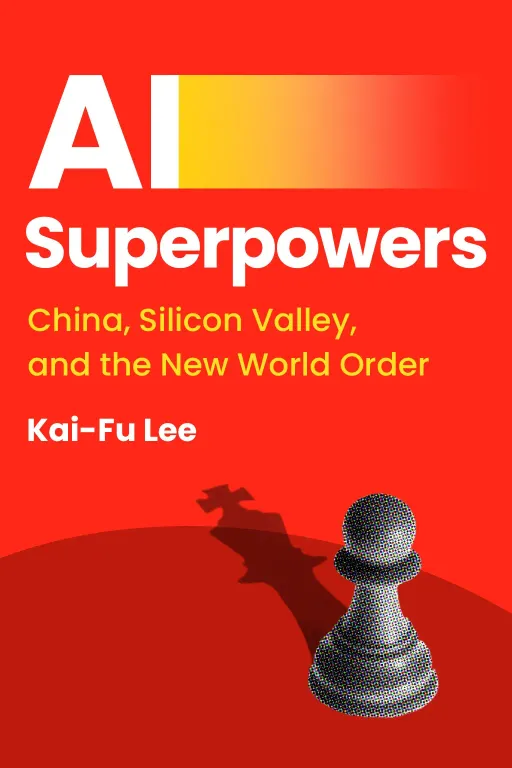
Nova: Exactly. And it’s the central argument in Kai-Fu Lee’s groundbreaking book, "AI Superpowers: China, Silicon Valley, and the New World Order." It suggests a seismic shift in where and how innovation happens. And I couldn't think of a better person to explore this with than you, Frank. As the co-founder of Aibrary, you're literally building an Agentic AI for personal growth, turning books like this into personalized learning. You're on the front lines of this revolution.
Frank Wu: It's a fascinating time to be in this space, that's for sure. The book really resonated because it’s not just theory; it describes the market forces we feel every day.
Nova: I’m so glad you’re here. Today, we're going to dive deep into this from two perspectives. First, we'll step into that brutal, hyper-competitive tech 'coliseum' to see how China's so-called 'copycats' became world-class gladiators. Then, we'll examine the tangible results of this race—the 'four waves' of AI that are already starting to reshape everything from our cities to our classrooms.
Deep Dive into Core Topic 1: Gladiators vs. Missionaries
SECTION
Nova: So Frank, let's start with that 'coliseum'. The book’s big idea is that while the West, particularly the US and Canada, sparked the fire of deep learning, China is poised to benefit most. Not because of more research breakthroughs, but because of its absolutely brutal entrepreneurial environment.
Frank Wu: Right, the "Age of Implementation" as he calls it. The core technology exists, and now it's a race to apply it.
Nova: Precisely. And nothing illustrates this better than the story of Wang Xing. In the West, he was initially dismissed and labeled 'The Cloner.' He built a Chinese version of Facebook called Xiaonei, a version of Twitter called Fanfou, and then, most famously, a version of Groupon called Meituan.
Frank Wu: I know his story. It’s legendary in startup circles. The Groupon-clone market in China was insane.
Nova: Insane is the word. Lee calls it the "War of a Thousand Groupons." Imagine, within months of Groupon's success in the US, over 5,000 nearly identical websites popped up in China. It was a bloodbath. Companies hired thugs to intimidate rivals' employees, they launched smear campaigns, they offered deals so cheap they were losing money on every transaction, just to starve the competition. Groupon itself tried to enter China with a massive war chest and failed spectacularly.
Frank Wu: And Meituan, Wang Xing's company, not only survived but won. How?
Nova: That's the core of the 'gladiator' thesis. Wang Xing didn't win by having a better idea; he won by being a better fighter. While his American counterparts were focused on a clean user interface, Wang's team was in the trenches. They built scrappy but effective back-end tools for merchants, they managed payments meticulously, and they were relentlessly, obsessively focused on operational efficiency. They didn't have a lofty mission statement about 'connecting the world.' Their mission was to survive. As Lee puts it, "Wang Xing didn’t succeed because he’d been a copycat. He triumphed because he’d become a gladiator."
Frank Wu: You know, it's fascinating that the book calls it 'copycat,' because from a product and marketing perspective, what I hear is rapid, market-driven iteration on an unprecedented scale. It's less about 'stealing' an idea and more about a ruthless focus on what users and merchants actually need to make a two-sided marketplace work.
Nova: That's a great reframe. Tell me more about that.
Frank Wu: In Silicon Valley, we often fall in love with a mission or a technology. We can become a bit insulated. What this 'gladiator' environment forces is an extreme form of product-market fit. There's no room for ego or a 'vision' that the market doesn't want. Your product has to deliver tangible value, immediately, or you're dead. As a founder, that's both terrifying and incredibly clarifying. It strips everything away except for execution.
Nova: So the 'shame' of copying is replaced by the 'pride' of winning.
Frank Wu: Exactly. And that winning formula—light on ideology, heavy on execution and data—is perfectly suited for the age of AI implementation. You have the data, you have the engineers, and you have a culture that rewards applying it faster and more effectively than anyone else.
Deep Dive into Core Topic 2: Riding the Four Waves
SECTION
Nova: And it's that ruthless focus on delivery that's accelerating what Lee calls the 'four waves of AI.' He breaks it down into Internet AI, Business AI, Perception AI, and Autonomous AI. The first two are about the digital world—recommendation engines, fraud detection. But the third wave, 'Perception AI', is where things get really interesting for your world, Frank. This is where AI gets eyes and ears.
Frank Wu: This is the online-merge-offline, or OMO, concept. It’s about digitizing the physical world.
Nova: You got it. It's about blurring the lines. And the book gives a startling example of this in action: AI-powered education in China. It describes classrooms where cameras are installed to monitor students. They use facial recognition to track attendance, but also to analyze expressions to gauge if a student is engaged or confused.
Frank Wu: Wow. Okay.
Nova: It goes further. This data, combined with answers from in-class clickers, feeds into an AI profile for each student. That profile then generates personalized homework. If you're struggling, you get more foundational problems. If you're excelling, you get advanced challenges. Grading is automated. AI even assesses English pronunciation. It's a complete, data-driven feedback loop.
Frank Wu: On one hand, that's the dream of personalized learning. That's the promise we're all chasing. At Aibrary, we're trying to achieve something similar by understanding a user's learning style through their interactions with content—what ideas they connect with, what formats they prefer. The goal is a truly individual learning path.
Nova: But the 'how' here is very different.
Frank Wu: Very different. On the other hand, the surveillance aspect is... a lot. It raises a huge, fundamental question that we have to grapple with as we build these technologies: how do we create 'Agentic AI' that empowers the user, rather than just optimizing them for a system? The goal should be to foster curiosity and growth, not just compliance and higher test scores.
Nova: The human versus the machine.
Frank Wu: Yes. And as a dad of a three-year-old, I think about this constantly. Would I want her in a classroom where an algorithm is judging her attentiveness? I'm not so sure. There's a fine line between a helpful 'super-tutor' and a 'super-proctor.' The risk is that we optimize for the things that are easy for a machine to measure—like time-on-task or correct answers—and in doing so, we squeeze out the things that are immeasurable but vital, like creativity, daydreaming, and collaborative problem-solving.
Nova: So the 'gladiator' environment that is so good at implementation might not pause to ask those ethical questions. It just builds what's possible, as fast as possible.
Frank Wu: It's a double-edged sword. The speed is incredible, and it can lead to amazing tools that help people. But without a strong ethical framework, a human-centric design philosophy, you could easily build a system that, while 'efficient,' is ultimately dehumanizing.
Synthesis & Takeaways
SECTION
Nova: So it seems like these two ideas are deeply connected. The 'gladiator' culture from Topic 1 is what's making the rapid, and sometimes controversial, implementation of Perception AI in classrooms from Topic 2 a reality so much faster than we might expect.
Frank Wu: Absolutely. The competitive pressure forces companies to use every advantage, and in China, that includes a different cultural approach to data and privacy. It creates this perfect storm for rapid deployment of OMO and Perception AI.
Nova: Which leaves us with a critical choice to make. So, Frank, as someone building this future, what's the one thing we need to hold onto to ensure AI leads to human flourishing, not just cold, hard efficiency?
Frank Wu: I think it comes back to the most powerful part of the book for me, which was Kai-Fu Lee's personal story. He talks about his whole life being an optimization algorithm—maximizing his impact, his success. Then he gets a stage IV cancer diagnosis. And in that moment, he realizes that his life's value wasn't in his output. It was in the love he shared with his family.
Nova: It's a beautiful and humbling conclusion.
Frank Wu: It is. And it's the perfect metaphor for our relationship with AI. AI is the ultimate tool for optimization. It will always be better at that than we are. But we humans are not optimization algorithms. Our purpose is found in connection, empathy, creativity, and love. So for me, the best AI for personal growth won't just make us smarter or more productive. It will be the one that frees up our time and cognitive load so we can be more human. That has to be the North Star. Let machines be machines, and let's focus on helping humans be better humans.
Nova: A powerful and hopeful note to end on. Frank Wu, thank you so much for sharing your insights today.
Frank Wu: It was my pleasure. A fantastic conversation.